


Trust is the currency of healthcare. Before a patient schedules an appointment, they have already made a judgment about your practice. That judgment is increasingly shaped by what they find online. A well-designed website, consistent reviews, and helpful content can make the difference between a prospective patient choosing your clinic or scrolling past it.
In healthcare marketing, this is both a challenge and an opportunity. Digital marketing is not just about driving traffic or generating leads. Done well, it builds the kind of credibility that earns patients before they ever come to your office. Here is how to approach it strategically.
Why Patient Trust Starts Online
Patients today research their healthcare options the same way they research anything else. They read reviews, compare providers, scan websites for tone and professionalism, and look for signals that a practice understands their needs. Studies consistently show that a significant share of patients check online reviews before selecting a provider, and many treat those reviews with the same weight as a personal recommendation.
This matters across every type of practice, from a single-provider family clinic to a multi-location hospital network. The digital experience you create is often a patient’s first impression of your care. And in healthcare, first impressions carry outsized weight.
Lead with Transparency and Expertise
One of the most effective ways to build trust digitally is to consistently demonstrate expertise without being clinical or inaccessible. Your blog and content strategy are central to this. When your website publishes articles that answer the questions real patients are asking — whether that is what to expect from a procedure, how to manage a chronic condition, or when a symptom warrants a visit — you position your practice as a reliable resource, not just a service provider.
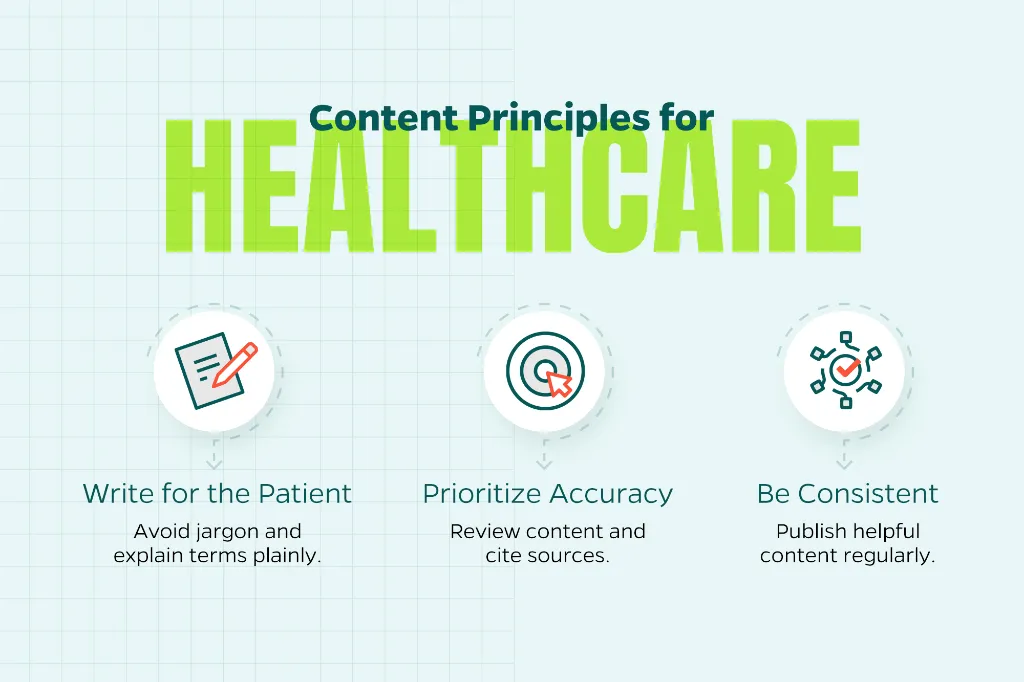
Here are a few principles that guide this kind of content:
- Write for the patient, not the provider. Avoid heavy jargon. If a term needs to be included, explain it plainly.
- Prioritize accuracy. Outdated or incorrect health information erodes trust immediately. Review content regularly and cite reputable sources where appropriate.
- Be consistent. Publishing one or two articles a year signals disengagement. A steady cadence of helpful content signals that your practice is active and invested in patient education.
Your Website is a Trust Signal
A slow, cluttered, or outdated website sends a message you probably do not intend. Patients associate the quality of your digital presence with the quality of your care. That may not be entirely fair, but it reflects how people make decisions under uncertainty.
Your website should load quickly on mobile devices, present clear information about your providers and services, and make it easy to act. Navigation should be intuitive, and the overall design should feel professional and welcoming. Patients want to feel that your practice is organized and approachable before they arrive.
Provider bios deserve particular attention. A brief, well-written biography that highlights credentials, areas of focus, and even a personal detail or two can go a long way in humanizing your team. Patients ultimately are choosing someone they will trust with their health.
Reviews and Reputation Management
Online reviews are one of the highest-leverage trust tools available to healthcare marketers, and they are often underutilized. A practice with dozens of recent, positive reviews on Google will consistently outperform a competitor with a handful of older ones — even if the clinical quality is comparable.
Encourage satisfied patients to share their experience through a simple, low-friction process. A follow-up email or text with a direct link to your review profile removes the guesswork and significantly increases the likelihood of a response. Make the ask genuine and timely. It should ideally be shortly after a positive interaction, not weeks later.
Negative reviews also require attention. Ignoring them is not an option. A thoughtful, professional response that acknowledges the concern, shows prospective patients that your practice takes feedback seriously and handles it with maturity. That kind of response can strengthen trust, even when the underlying review is critical.
Local SEO Builds Credibility at the Community Level
For most healthcare practices, the patient base is geographically concentrated. Local search optimization ensures that when someone nearby searches for a provider in your specialty, your practice appears prominently and accurately.
Start with your Google Business Profile. Keep it fully populated and up to date. Make sure you have accurate hours, current contact information, photos, and responses to reviews. An incomplete or inaccurate profile creates friction and doubt. The same goes for inconsistency in how you appear across directories. When your name, address, and phone number appear identically across platforms, search engines and patients alike gain confidence in your listing.
Paid Advertising Can Amplify Trust
Paid search and social advertising can extend your reach, but the messaging matters. Ads that lead with patient outcomes, community involvement, or the expertise of your providers tend to resonate more than purely transactional messaging. Healthcare decisions are personal, and your advertising should reflect that.
Landing pages tied to your ads need to align with the promise made in the ad itself. If someone clicks on an ad for a specific service, they should land on a page tailored to that service instead of a generic homepage. This continuity builds confidence and reduces the chance a prospective patient abandons the experience before converting.
Trust is Built Over Time, Not in a Single Campaign
Perhaps the most important thing to understand about digital trust-building in healthcare is that it is cumulative. Every piece of content published, every review responded to, every accurate directory listing compounds over time. Practices that commit to a consistent digital presence do not just attract more patients; they attract patients who already feel a degree of confidence before the first contact.
Need Help?
Straight North helps healthcare organizations build trust online through content strategy, SEO, and digital advertising. Contact us to learn how we can support your marketing goals.