


When someone in your city searches “primary care doctor near me” or “dental office in [your town],” or “chiropractic clinic in my area,” you want your practice to show up. That’s the core promise of local SEO. You want to make sure your medical office appears in front of the right patients at the right moment. For most practices, local search is the single most important digital marketing channel, yet it’s often one of the most overlooked.
Unlike broad SEO strategies that chase national rankings, local SEO focuses on geographic relevance. Patients need an appointment, they have a specific symptom, or they’re looking for a specialist close to home. By getting your practice at the top of those searches you will receive more calls, achieve more booked appointments, and generate a steadier patient pipeline.
In this blog we will show you how to optimize local SEO for your office and where to focus your efforts.
Start with Your Google Business Profile
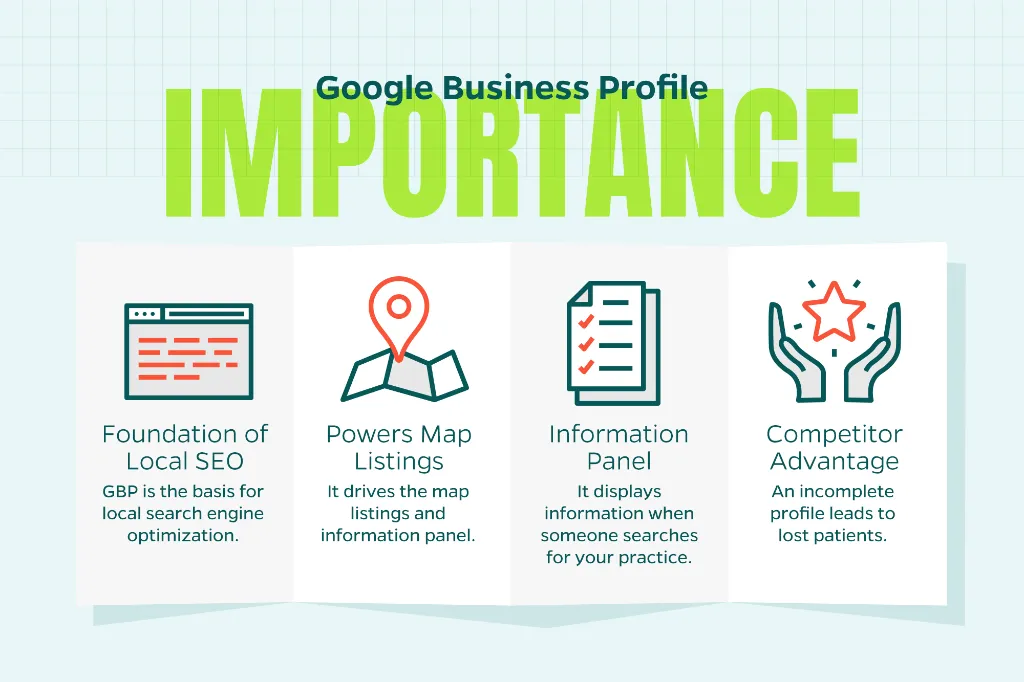
Your Google Business Profile (GBP) is the foundation of local SEO. It’s what powers the map listings and the information panel that appears when someone searches for your practice by name or by specialty in your area. If your profile is incomplete, outdated, or unclaimed, you’re handing potential patients to your competitors.
Claiming and verifying your profile is the first step. From there, fill out every section thoroughly. That includes your practice name, address, phone number, website, hours of operation, accepted insurance (where applicable), and a description that accurately reflects your services. Upload photos of your office and staff — these humanize your practice and give patients a sense of what to expect before they walk through the door.
Keeping this information current matters more than most practices realize. A phone number that’s been disconnected, holiday hours that never got updated, or an old address following a relocation can frustrate patients and damage your local ranking. Google rewards profiles that are active, accurate, and regularly maintained.
NAP Consistency Across the Web
NAP stands for name, address, and phone number. These three pieces of information need to match exactly wherever your practice is listed online. That means your website, your Google Business Profile, Healthgrades, Zocdoc, Yelp, your hospital’s directory, and any other platform where your practice appears.
Inconsistencies confuse search engines and erode trust. If Google sees your practice listed as “Sunrise Family Medicine” in one place and “Sunrise Family Medicine & Urgent Care” in another — or if your suite number appears in some listings but not others — it creates ambiguity that can suppress your rankings. A citation audit, where you systematically review and correct your listings across the web, is often one of the highest-ROI tasks in a local SEO effort for medical practices.
Optimize Your Website for Local Searches
Your website plays a supporting role in local SEO, reinforcing the signals your GBP and citations are sending. A few key areas deserve attention.
Location-specific pages are important if you operate multiple offices. Each location should have its own dedicated page with a unique address, phone number, and content — not a duplicate of the other locations with only the city name swapped out. If you’re a single-location practice, make sure your city and region are woven naturally into your homepage, service pages, and meta descriptions.
Schema markup is another tool worth using. It’s a type of structured data you add to your website’s code that helps search engines understand what kind of business you are, where you’re located, and what you do. LocalBusiness and MedicalOrganization schema can give your site a modest but meaningful edge in local search results.
Mobile performance matters enormously here as well. Most local searches happen on mobile devices, often by people who need information quickly. A slow-loading or hard-to-navigate site on a phone is a ranking liability.
Patient Reviews: Earn Them and Respond to Them
Online reviews are one of the most influential ranking factors in local SEO. They are also one of the most influential factors in a patient’s decision to choose your practice. The quantity of your reviews, their overall rating, and how recently they were posted all feed into how Google evaluates your local presence.
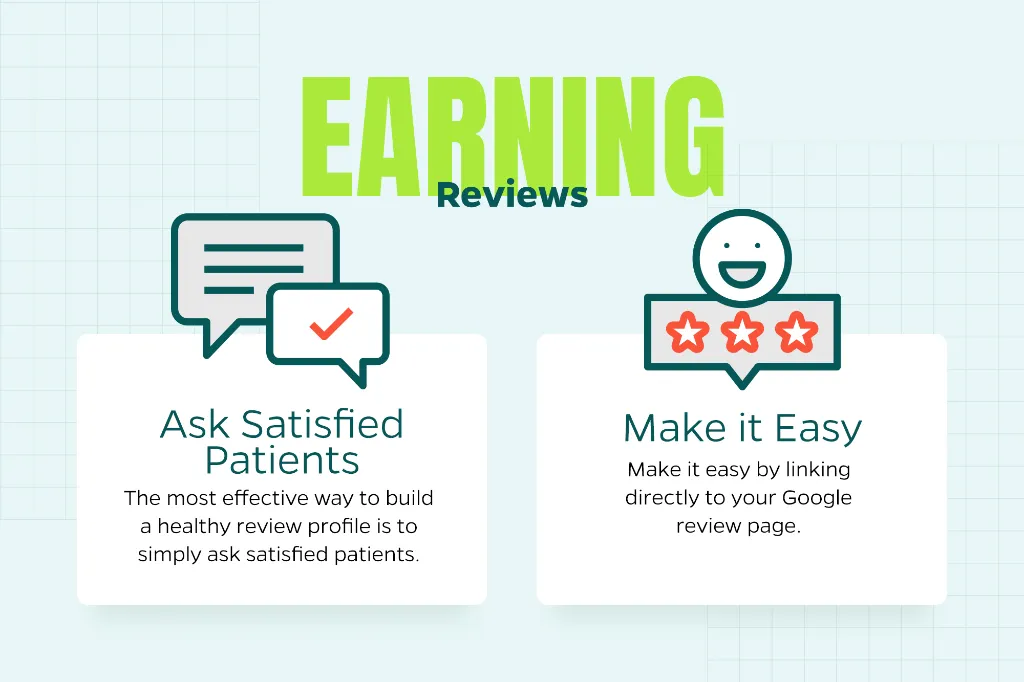
Earning reviews requires a process. Patients who have a good experience rarely leave reviews on their own; those with a bad experience often do. The most effective way to build a healthy review profile is to simply ask satisfied patients — at checkout, via a follow-up email, or through a patient portal message. Make it easy by linking directly to your Google review page.
Responding to reviews matters too, both positive and negative ones. A thoughtful, professional response to a critical review demonstrates that your practice takes patient feedback seriously. Just be mindful of HIPAA when responding online. Never confirm that someone is a patient or reference any details about their visit.
Create Content That Speaks to Your Community
Content marketing and local SEO overlap more than many practices expect. Blog posts and service pages that address the health concerns of people in your specific community can draw in qualified local traffic over time.
Think about what your patients ask you. Are allergies particularly bad in your region during certain seasons? Is there a population in your area that has specific health concerns your practice addresses? Content that connects your expertise to the lived experience of people in your community tends to rank well locally and builds the kind of authority that search engines reward.
Even something as straightforward as a page titled “When to Visit Urgent Care vs. the ER in [Your City]” can drive meaningful local traffic and give prospective patients a reason to trust your practice before they’ve ever set foot inside.
Measure What’s Working
Local SEO is an ongoing effort. Tracking your results helps you understand where to invest more time and where something needs attention. Google Business Profile Insights shows you how patients are finding your listing, what actions they take, and how often your profile appears in searches. Google Search Console surfaces the specific queries driving traffic to your website.
Pay attention to trends over time rather than fixating on week-to-week fluctuations. Consistent upward movement in local rankings, a growing volume of calls from your GBP, and more appointment requests from organic search are all signs your strategy is working.
Local SEO is Competitive But Winnable
Most medical offices are not doing local SEO well. They have unclaimed or neglected GBP listings, inconsistent citations scattered across dozens of directories, and websites that haven’t been touched in years. That’s good news for practices willing to invest in doing things right. The bar for standing out in local search is often lower than it seems.
A focused, well-executed local SEO strategy — built on an accurate GBP, consistent citations, a mobile-friendly website, a steady stream of patient reviews, and locally relevant content — can move your practice from invisible to prominent in your market.
The patients you want to reach are already searching. The question is whether they’re finding you.
Ready to Improve Your Practice’s Local Visibility?
Straight North helps medical offices build and execute local SEO strategies that drive real patient inquiries. If you’re ready to get found by more patients in your area, contact us today to start the conversation.