



No business escapes negative reviews. You may get a one-star critique about a long wait time or a detailed grievance about a service gone wrong. Unfortunately, they all show up on Google, Yelp, Facebook, and industry-specific directories. Yet, if you are a small and mid-sized businesses with a local presence, how you respond to those customer reviews matters as much as the reviews themselves.
A professional response can turn a frustrated customer into a loyal one. It also signals to prospective customers reading your reviews that you take their feedback seriously. And from a local SEO standpoint, regular, relevant activity on your Google Business Profile is a positive signal to search engines.
Here is how to handle negative reviews in a way that protects your reputation and builds trust.
Respond Promptly, But Not Impulsively
Timing matters. Ideally, you should aim to respond within 24 to 48 hours. A quick response shows that you are attentive and that customer concerns do not fall through the cracks. Waiting too long can make it look like you either do not care or did not notice.
That said, do not fire off a reply in the heat of the moment. If a review feels unfair or inaccurate, take a few minutes to cool down before writing your response. Once your reply is public, it reflects your brand. A defensive or argumentative tone will do far more damage than the original review.
Start With Acknowledgment, Not Defensiveness
The opening lines of your response set the tone for everything that follows. Lead with empathy and acknowledgment; avoid excuses. Even if you believe the reviewer is being unreasonable, their experience felt real to them. Consequently, other people who read the response will pick up on whether you seem dismissive.
A strong opening does a few things including:
- Addresses the reviewer by name when possible
- Thanks the reviewer for sharing feedback (even if it stings)
- Acknowledges the reviewer’s frustration without immediately going into defense mode
For example, say something like “Thank you for taking the time to share your experience, John. We are sorry to hear your visit did not go as expected.” It is simple, human, and sets a constructive tone.
Take Responsibility Where It’s Due
If your business made a mistake, you should own it. Give your customer a straightforward apology, offer a clear explanation of what went wrong, and present how you plan to address the issue. Prospective customers are not necessarily looking for perfection. They want to see that your business handles problems with integrity.
Avoid the trap of qualifying your apology to the point where it becomes meaningless. Phrases like “We’re sorry you feel that way” or “We’re sorry if there was a misunderstanding” often read as non-apologies. If something was your fault, say so directly. Then move on to expressing what you are doing to resolve it.
Keep It Concise and Move the Conversation Offline
Your public response should be brief. Acknowledge the issue, express concern, and invite the customer to continue the conversation through a private channel. Long back-and-forth exchanges in the comments do not look good to anyone browsing your reviews, and they rarely resolve the underlying issue.
Close your response by providing a direct point of contact — a phone number, email address, or the name of a specific person they can reach out to. This shows you are willing to make things right and gives the customer a clear next step. It also demonstrates to future readers that you do not leave problems unresolved.
Address Inaccurate or Unfair Reviews Calmly
Sometimes a review is factually wrong, or it is clear the reviewer may have confused your business with another. In these cases, it is still important to stay measured. Responding with frustration or sarcasm reflects poorly on your business, regardless of how justified you feel.
Politely correct the record if needed, but keep the focus on your commitment to customer service rather than on being right. Say something like “We want to make sure we understand your experience, but we don’t have a record matching this visit, and we’d love to connect directly to sort things out.”
If a review violates the platform’s policies — such as spam, fake reviews, profanity, or personal attacks — flag it for removal. Most platforms, including Google, have a process for this. That said, it can take time and is not always successful. In the meantime, a calm and professional response still shows potential customers that you are a caring and professional business.
Why This Matters for Local SEO
From a search engine optimization perspective, review responses contribute to your local search visibility. Google’s algorithm for local rankings considers the quantity and quality of your reviews, as well as how actively you engage with them.
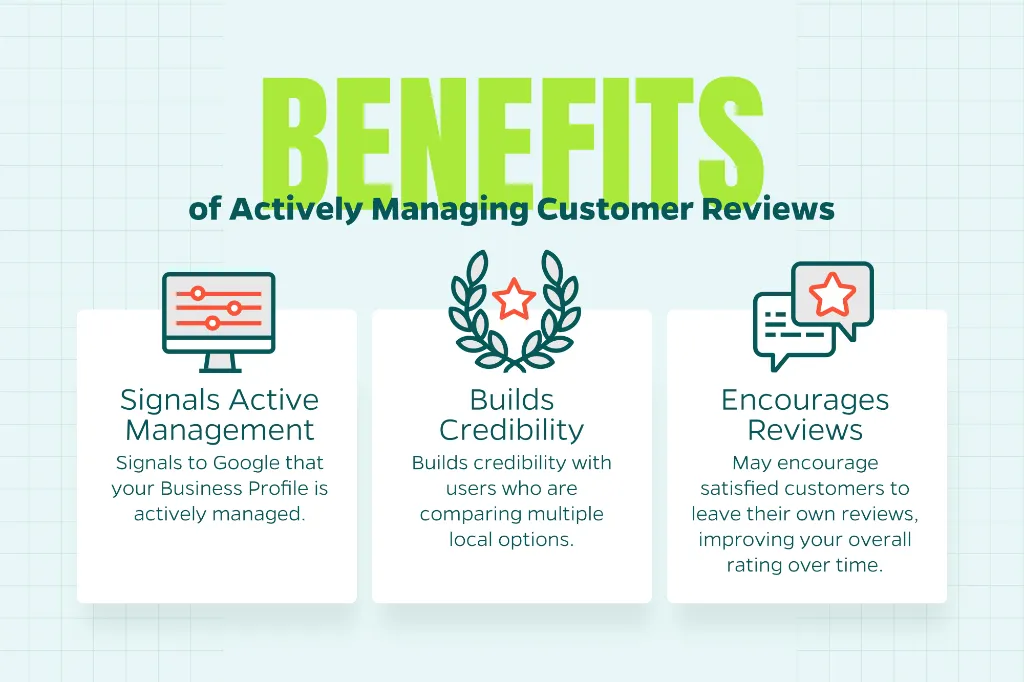
Consistent review engagement can help your business in a few meaningful ways:
- It signals to Google that your Business Profile is actively managed
- It builds credibility with users who are comparing multiple local options
- It may encourage satisfied customers to leave their own reviews, improving your overall rating over time
Businesses that respond to all reviews tend to build stronger local authority than those that ignore feedback entirely. Think of it as an ongoing conversation with your community, not a task to check off when problems arise.
Build a Process, Not Just a Policy
Ad hoc review management leads to inconsistency. Some reviews get answered thoughtfully, others get ignored, and tone varies based on whoever happens to check the account that day. For small businesses especially, it is worth building a simple, repeatable process.
That process might look like this:
- Set up notifications so you are alerted when a new review comes in
- Designate one or two people responsible for drafting responses
- Create a set of approved response templates that can be customized for most situations
- Review and refine responses before posting, especially for anything sensitive
Templates save time and help maintain a consistent brand voice, but every response should be personalized enough to show customers they were heard. A response that reads like a copy-paste form letter can do more harm than good.
Managing your online reputation is a long game. A steady, professional approach to negative reviews builds the kind of trust that drives both repeat business and new customer conversions. The businesses that get this right are rarely the ones that never receive a bad review. They are the ones that respond to every review as if someone important is watching.
Need Help?
Want to strengthen your local SEO and online reputation strategy? Contact Straight North to learn how we can help.