




Key Takeaways
- E-E-A-T now shapes trust before the click — not just after the visit.
- AI favors content that’s clear, evidence-backed, and difficult to replicate.
- Your reputation across the web matters as much as the content on your website.
- Measure SEO by visibility, influence, and trust rather than traffic alone.
- The brands that win in AI search become the easiest to trust and the hardest to replace.
For years, Google’s E-E-A-T framework (Experience, Expertise, Authoritativeness, and Trustworthiness) has been treated as an on-page SEO principle. Brands demonstrated credibility through expert-written content, trustworthy information, and helpful experiences designed to earn rankings and convince visitors after they arrived on a website.
Today’s search experience changes that equation.
AI Overviews, featured snippets, knowledge panels, review platforms, comparison pages, and other search results increasingly shape a user’s opinion before they ever click. Instead of evaluating a brand solely through its website, both users and AI systems build trust by looking across the broader web.
In talking with Straight North Senior SEO & GEO Strategist Bob Hand, one theme emerged repeatedly: zero-click search isn’t making E-E-A-T less important. It’s making it much bigger. Credibility is no longer confined to your website. It influences whether your brand appears in AI-generated answers, how it’s represented in search results, and whether it’s considered a trustworthy source before a visitor ever reaches your homepage.
AI overviews, featured snippets, local packs, review snippets, comparison results, and knowledge panels can all influence whether someone sees a brand as credible in the SERPs. That means SEO is becoming about both the traffic, and as a trust-building channel. The goal is to still earn qualified traffic, but marketers also need to think about whether the brand is visible in places where users are forming opinions. A brand can lose or win trust directly in the search results, even when the user does not immediately visit the site.
That changes the role of E-E-A-T. What was once a framework for strengthening trust on your website now extends across the entire search experience, influencing how both users and AI systems evaluate your brand before a visit ever occurs.
Search Used to Earn the Click. Now It Builds Trust.
Zero-click search hasn’t reduced the value of SEO. It has expanded it. Search is no longer just a channel that drives visitors to your website. It’s where buyers begin evaluating brands, comparing options, and deciding who they trust.
That changes how SEO creates value. Success is no longer measured only by rankings and website traffic. Search results including AI Overviews, featured snippets, reviews, comparison pages, and local listings help shape purchasing decisions long before a visitor reaches your site.
“That means SEO is becoming both about the traffic and as a trust-building channel.”
Senior SEO & GEO Strategist | SEO & GEO Authorship Expert
Because of that, success can no longer be measured only by the traffic your website receives. SERPs influence buying decisions by introducing brands, reinforcing expertise, and helping users decide who they trust before they ever visit a page.
As Hand explains, the question is no longer simply, “Did we earn the click?” It’s “Did we build confidence before the click?”
The Search Results Have Become Your First Impression
With the internet at everyone’s fingertips, people are more able now than ever to find solutions to their problems. The journey to get to the final product often takes a bit longer. Before they ever click, they may encounter AI Overviews, featured snippets, online reviews, Reddit discussions, comparison sites, knowledge panels, and other search features that collectively shape their perception.
Rather than trusting a company’s marketing claims, users increasingly trust the broader ecosystem surrounding a brand. They look for consistent signals of expertise and credibility across multiple sources, and AI-powered search does the same when deciding which information to surface.
For marketers, that makes attribution more challenging. They may not be able to identify exactly what influenced a prospect to reach out.
Not every valuable search interaction shows up as an organic session in analytics. This is similar to brand marketing, in that visibility can influence awareness and demand, even when attribution is imperfect or impossible to really track 100%. I’d connect SEO to branded search growth, direct traffic, assisted conversions, lead quality, and sales feedback. The business question is really beyond did this page get a visit? It’s also, did search help create trust, recognition, or demand that contributed to a later action? Which you can ascertain that through surveys, however you onboard your clients, but it’s really about understanding that journey.
As a result, the search results page has become far more than a gateway to your website. The brands that stand out aren’t simply the ones with the best websites; they’re the ones whose expertise is consistently recognized across the web.
E-E-A-T Has Expanded Beyond Your Website
There was a time when demonstrating E-E-A-T was largely an on-site exercise. Brands focused on publishing helpful content, highlighting expert authors, earning backlinks, and creating a trustworthy website experience. Those elements still matter, but they’re no longer enough on their own.
Today, both search engines and AI systems look beyond your website to determine whether your expertise is genuine. Instead of relying solely on what your company says about itself, they evaluate whether other parts of the web tell the same story.
That’s because trust is no longer built through marketing claims. It’s built through corroboration.
When someone searches for your company, your products, or the problems you solve, they’re not just evaluating your homepage. They are evaluating an entire network of signals. AI systems do much the same, looking for consistent evidence that reinforces your expertise before deciding whether your content deserves to be surfaced or cited.
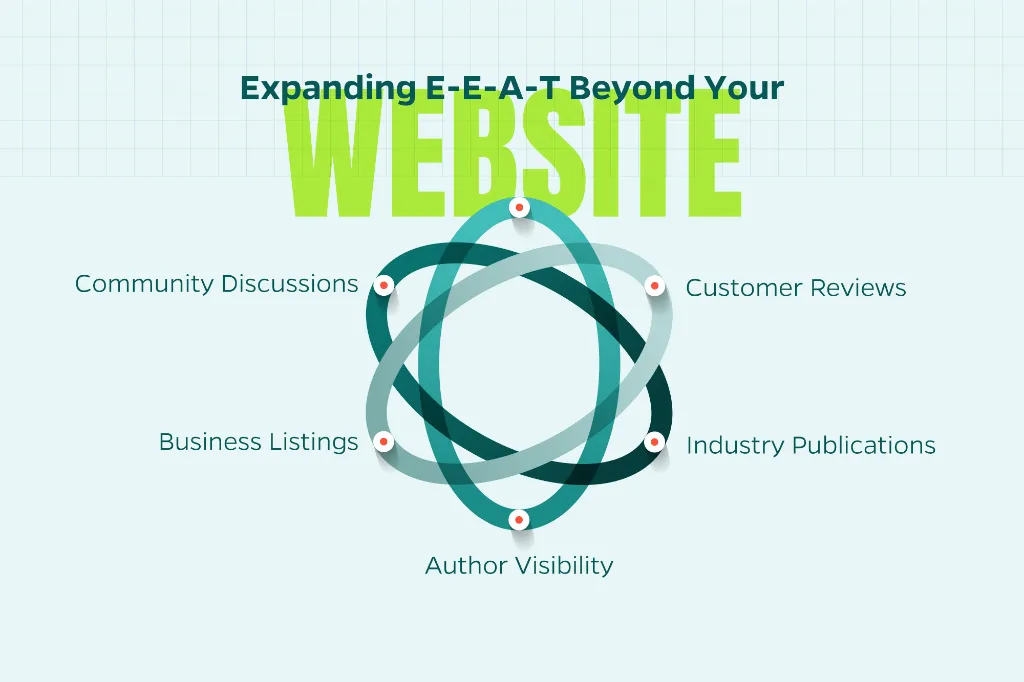
That trust ecosystem can include:
- Customer reviews and ratings that validate real experiences.
- Industry publications, media mentions, and third-party coverage that reinforce credibility.
- Author visibility that demonstrates real expertise behind your content.
- Business listings and directories with accurate, consistent information.
- Comparison sites, forums, and community discussions that shape public perception.
“In a zero-click environment, your reputation has to travel beyond your own domain. That’s what we mean when we say ecosystem. It’s not just living purely on your domain.”
Senior SEO & GEO Strategist | SEO & GEO Authorship Expert
The important shift is that E-E-A-T is no longer something you publish. It’s something the rest of the web confirms. Every review, citation, expert mention, directory profile, and third-party reference either strengthens or weakens the confidence people and AI systems have in your brand.
That’s why brands should periodically search for themselves the way a prospective customer would. Look at your branded search results, your primary services, and your key industry topics:
- Do the search results reinforce your expertise?
- Are reviews current?
- Is your business information consistent?
- Are reputable third parties validating your claims?
- Or are outdated listings, weak reviews, and irrelevant pages creating gaps in your credibility?
The answers reveal something more valuable than rankings alone. They reveal whether your digital presence tells a consistent, trustworthy story that gives both people and AI a reason to choose your brand prior to reaching your website.
AI Is Compressing the Buyer’s Research Process
When Google first came out, users endlessly searched through pages of information to get to the result they wanted. Google knew it needed to solve that issue by getting people the answer faster. AI-synthesized answers have made it a lot easier, as it does the search for people and gives them a summarized response quicker.
What it could mean is that potential buyers may narrow it down to a few companies faster, and your company may not be a part of that decision.
If your brand is missing in those searches, you may be excluded before the user ever researches you directly. If your brand is included but described poorly or incompletely, that can shape how perception is shaped before you can explain yourself. AI summaries can also influence what users think before buying decisions. That makes source inclusion, accurate representation, and strong supporting content more important to actually show up in those searches at points where users are actually forming those early opinions that ultimately determine what their buying decision is going to be.
It’s time to make your company part of the conversation.
Give AI a Reason to Choose Your Content
AI chooses content that provides the clearest, most credible answer. If your page says the same thing as everyone else’s, AI has little reason to reference it.
The strongest content follows a simple formula:
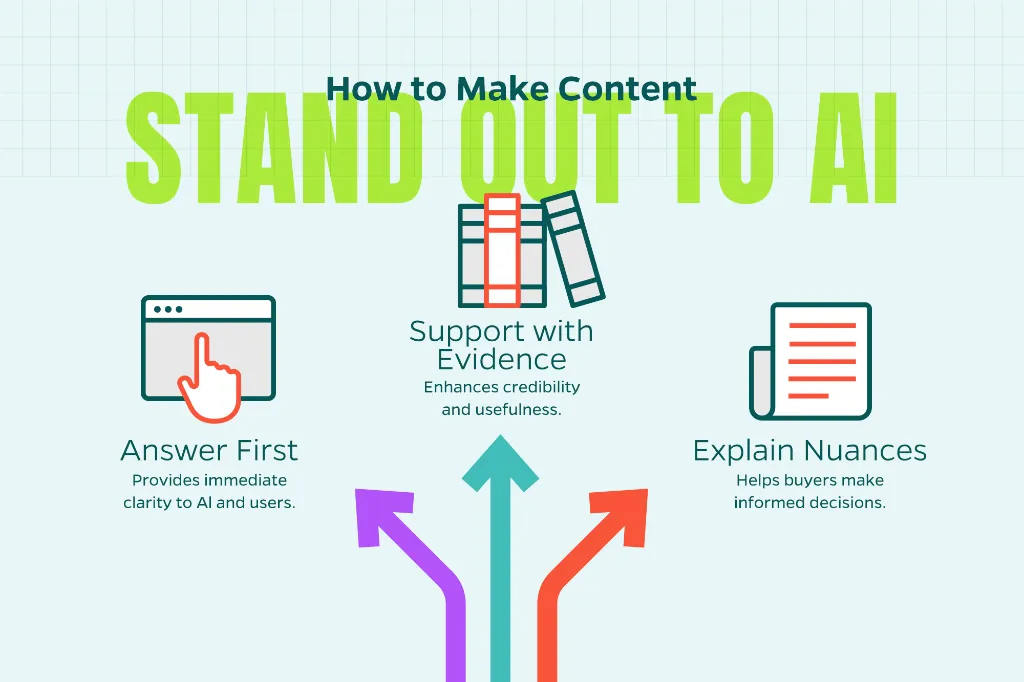
- Answer the question first.
- Support the answer with evidence.
- Explain the nuances that help buyers make a decision.
That evidence might include:
- Original research or proprietary data
- Expert commentary
- Real-world examples and case studies
- Practical experience
- Buyer guides, comparisons, pricing, tradeoffs, and FAQs
The goal is to create content that’s more useful than what’s already available. The pages most likely to be cited help users understand not just what the answer is, but why it matters.
Don’t just answer the question. Answer the decision behind the question.
Build Content That’s Easy to Extract but Impossible to Replace
Don’t bury the lede when writing. Start with a direct answer and then reinforce it with proof, examples, and context. Clear headings and straightforward explanations make your content easier to retrieve without sacrificing depth. If a question can be answered concisely — even in a meta description — there’s no reason to hold it back. Remember that concise doesn’t mean shallow.
The real differentiator comes after the answer. Original research, proprietary data, firsthand experience, expert perspectives, customer examples, and unique insights give AI a compelling reason to cite your content instead of someone else’s. If your page simply repeats what every other page says, good structure alone won’t make it stand out.
“A good model is answer first, prove it second, explain the nuance third. The content should be easy to summarize, but not easy to replace.”
Senior SEO & GEO Strategist | SEO & GEO Authorship Expert
Here is a simple framework:
- Answer first.
- Prove it with evidence, examples, and supporting data.
- Explain the nuance with context and expert insight.
- Differentiate with original research, proprietary data, and firsthand experience.
The goal is simple: make your content easy to summarize, but not easy to replace.
Measuring SEO When Traffic Tells Only Part of the Story
AI-powered search doesn’t make traditional SEO metrics obsolete; rather, it makes them incomplete on their own. Rankings, clicks, impressions, and organic conversions still provide valuable insight, but they no longer tell the whole story. As AI Overviews and other answer engines reshape search results, fluctuations in traffic may reflect changes in the search experience rather than changes in content performance.
To understand your true visibility, broaden your measurement framework beyond traffic alone.
AI citations can show whether the brand is being used as a source. Brand dimensions can show whether the brand is being named even without a link. Direct traffic and assisted conversions can help capture delayed or indirect impact, and referral traffic from AI tools should be tracked wherever available. It still won’t capture everything, but if you have access to that information, include that as piece of the puzzle to get a fuller picture. The right measurement model blends search performance, brand demand, and visibility and AI answers to your business outcomes.
Expand SEO Reporting with AI Visibility Signals
Traditional SEO KPIs should remain the foundation of reporting, but they need additional context. Round out metrics with signals that capture broader business influence, including:
- Direct traffic
- Assisted conversions
- Referral traffic from AI platforms (where available)
- Brand sentiment
- Third-party reputation
- Customer service and sales feedback
- Competitor visibility
Together, these metrics paint a more complete picture of how search contributes to awareness, consideration, and demand. The goal isn’t to replace traditional SEO reporting; it’s to expand it.
Help Leadership See the Bigger Picture
One of the biggest challenges with AI-powered search is that not every interaction results in a measurable click. Those touchpoints still influence purchasing decisions, even if they aren’t captured through traditional attribution.
“Zero-click influence is not a perfect measurement model. You’ll want to present it as a realistic review of how buyers research today.”
Senior SEO & GEO Strategist | SEO & GEO Authorship Expert
When reporting to leadership, focus less on proving every interaction and more on demonstrating overall search influence. Pair performance data with real examples of where your brand appears in AI-generated results, compare your visibility with competitors, and explain how those signals contribute to awareness, trust, consideration, and ultimately pipeline. The objective isn’t to create a perfect attribution model. You want to avoid underestimating the role search plays throughout today’s buying journey.
SEO Is Becoming a Cross-Functional Trust Strategy
AI-powered search is changing what SEO teams are responsible for and what success looks like. Rankings, clicks, and traffic remain important, but they’re no longer the only indicators of performance. As buyers increasingly research through AI-generated answers, reviews, comparison pages, and other search experiences, success also depends on whether your brand is visible, trusted, and accurately represented wherever those decisions are being made.
Trust Is Built Across the Organization
The website no longer owns trust. The company does.
I’d say that SEO cannot own every trust signal alone. Content teams shape the information users and search systems rely on. PR helps third-party validation and media visibility. Brand teams, marketing teams can help keep messaging and positioning consistent. Product marketing can help users identify use cases, differentiation, buyer concerns. Sales teams can share what prospects are asking and where they’re getting confused. Customer service and reputation management teams can influence reviews and public feedback. Legal or compliance teams are important, where content involves regulated or high-risk claims in YMYL topics. Subject matter experts provide the credibility and real experience behind the content. It’s really a team game as far as managing a strong trust ecosystem. In this environment, SEO becomes more cross-functional because search visibility depends on the full reputation of the business, not just the website.
As search becomes more answer-driven, SEO evolves into the team that connects these signals. Search visibility increasingly reflects the overall reputation of the business and not just the quality of a single webpage.
Build for Today’s Demand While Strengthening Tomorrow’s Authority
The strongest SEO programs balance immediate performance with long-term trust.
Some content exists to capture existing demand through high-intent searches and conversion-focused pages. Other assets like original research, expert commentary, customer stories, reviews, and digital PR build the authority that strengthens rankings, increases AI visibility, and improves buyer confidence over time.
The brands that create lasting search advantage don’t treat traffic and trust as competing priorities. They build both simultaneously.
“Strong brands tend to use short-term performance content to capture demand, and long-term authority content to create and defend demand.”
Senior SEO & GEO Strategist | SEO & GEO Authorship Expert
When buyers consistently encounter accurate information, credible expertise, and trusted third-party validation across search results, AI answers, reviews, and industry publications, the brand becomes familiar before the website visit ever occurs. That’s what durable SEO looks like in an answer-driven search environment: being visible, believable, and part of the buyer’s consideration set long before the first click.
The Brands That Win Will Earn Trust Before They Earn Traffic
Traditional SEO focused on optimizing pages to earn rankings and clicks. Modern SEO is about shaping how buyers perceive your brand throughout their search journey.
That means SEO is no longer just about publishing content that ranks. Brands also need credible authors, original research, accurate business information, strong reviews, third-party validation, and consistent messaging across the web. They must understand how they’re represented in AI-generated answers, comparison pages, review platforms, and other sources that influence buying decisions. The goal is to build trust wherever customers encounter your brand and not just after they arrive on your website.
I think it’s easy to get stuck in the trap of assuming that, no-click means no value, or that, zero-click search represents lost traffic. I think it’s easy to underestimate how much users can learn, compare, and form opinions directly in the search result. Focusing on traffic loss, ignoring brand visibility, trust, and later demand, I think not monitoring how the brand is represented in AI answers, review snippets, comparison results, and third-party services. If you assume that SEO is only working when it produces an immediate organic session, you’re not really looking at the full picture. The better view is that zero search changes where value is created. Some value happens before the click, some happens after a later branded search, and some shows up through direct or assisted conversions, PPC, what have you. The challenge is not to pretend that attribution is perfect, it’s to understand that search influence is broader than organic traffic.
One of the biggest misconceptions about zero-click search is that fewer clicks automatically mean less value. In reality, buyers can research, compare options, build confidence, and narrow their choices long before a website visit occurs. Search still influences those decisions, even when attribution is delayed, shared across channels, or impossible to measure perfectly. The challenge isn’t proving every interaction. It’s recognizing that search creates value well beyond the last click.
The brands that succeed will move beyond treating SEO as a traffic channel and embrace it as a trust strategy. They’ll combine expert-driven content with original insights, real-world experience, strong governance, and external credibility to become the sources AI systems and buyers rely on.
In AI-powered search, the brands that stand out won’t simply publish more content. They’ll become the brands that are easiest to trust and hardest to replace.