

You woke up this morning and decided it’s time to start a new exercise routine. You open ChatGPT and type, “What’s a good workout plan for someone in their {enter age here}?” In seconds, you have a detailed day-by-day plan. AI interacts with you to point you in the right direction. But that’s just the start. Next, you jump over to Google to find training videos, nearby gyms, equipment, and maybe even new workout clothes.
What this simple example shows is how people now use AI tools and search engines together to get the answers, products, and services unique to their circumstance. For SEO experts, that means understanding not just what people search for, but how and where they’re searching.
As AI continues to reshape search behavior, SEO is evolving from keywords and backlinks to providing trusted, useful experiences. In a July blog post, AI and Search SEO Expert Tom Lustina explored this shift, and recently, I spoke with him about how Google’s AI Overviews are influencing that evolution. Tom shared insights on how Google’s move toward a more interactive AI experience could signal the beginnings of a paid advertising model, and what that means for understanding future AI search behavior.
So, what fuels a brand’s growth in AI Overview impressions?
3 Main Factors Driving AI Overview Growth
First, it starts with growth in traditional search impressions, in general. Google continues to gain traction here, as increasing search impressions remains core to its business model. They still dominate in that area, and they are continuing to grow. In fact, Q3 was Google’s first $100 billion dollar quarter, and Q4 will be even bigger.
Second, a brand’s commitment to increased production of informational content further drives their AI Overview growth. More informational content means more opportunities to rank.
Third is Google’s own expansion of AI Overviews. We’ve reached an important turning point here though. Google has shifted its focus from expansion of AI Overviews to inclusion of links within AI Overviews. Tom shares more on what this means for search.
So, instead of focusing on adding more AI Overviews at this point, they’re focusing on making them more interactive. So, that means adding more links to them so that users can start to click within them more, because that is also a huge part of Google’s model. They want as much search impressions as they can possibly get, and then they want as many clicks as they can possibly get. Once they have more clicks, once they can prove out that people will click within AI Overviews and AI Mode, that’s when they will introduce a paid model, paid advertising with it, because you need clicks for paid advertising. So, we see this, as the next step right now. Google is now focusing on making AI Overviews and AI Mode more interactive. And then, once they perfect that step, or once they feel comfortable with that step, then they will introduce a paid model, and you will see paid advertising within AI Mode and AI Overview.
Why Is This Shift From AI Overview Expansion to Link Inclusion So Important?
While Google initially focused on introducing more AI Overviews to traditional search results, they are shifting their attention toward enhancing interactivity and integrating links more seamlessly. Google appears to be refining the experience and setting the stage for the introduction of paid advertising within this space.
“We won’t fully understand how people are searching until ChatGPT and other AI platforms release that data. Once they release that data, then we can really focus in on exact prompts and how we should optimize for those.”
For SEOs, this shift will mark a significant turning point. Once Google launches a paid model within AI Overviews and AI Mode, access to more detailed search behavior data will likely follow. It’s similar to what happens in traditional search, where SEOs benefit from search data that is shared with their paid advertising counterparts. Until then, understanding how users search in AI-driven environments such as Google’s AI Mode or ChatGPT remains largely speculative, inferred from patterns in conventional search behavior rather than direct data.
Does ChatGPT Have an Effect on Google Usage?
You might be surprised to know that Google’s user base actually increased with the advent of ChatGPT. According to an August 2025 Semrush study, “ChatGPT Is Not Replacing Google — It’s Expanding Search,” the introduction of ChatGPT has fundamentally changed how people search rather than replacing traditional search engines. Instead of choosing one or the other, users are now turning to both tools, often more frequently than before.
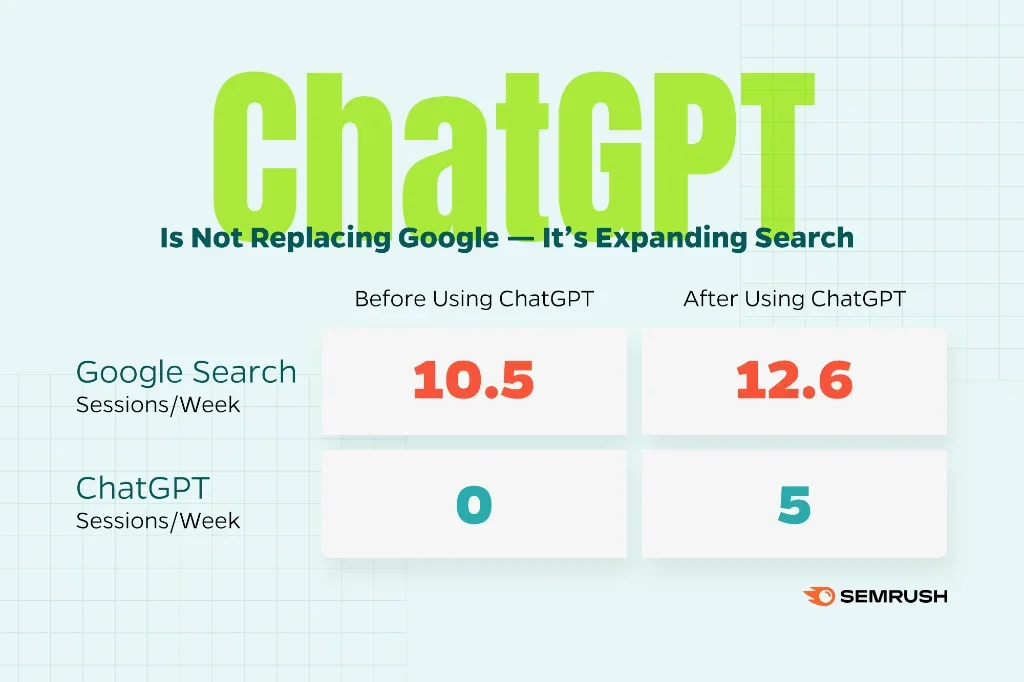
To put this into perspective, Tom breaks down the study and why its findings matter:
Semrush conducted a study based on usage of Google and usage of ChatGPT. More specifically, how people used Google before and after they started using ChatGPT. And what they discovered is people actually use Google more once they start using ChatGPT. And that is incredibly important to us, because we’ve had this fear over the last year or two that ChatGPT was coming on, and AI platforms were coming on so strong that traditional search would just go away. Once you start using ChatGPT, there’s really not an interest in using anything else, but that is exactly the opposite of what we’re seeing. In fact, when people start using ChatGPT, they use Google more, so it’s not one or the other. You actually use both, and you use both more as a result.
AI-information sources are still working on being as accurate as possible. They are aggregating information from Google and other search engines to produce their answers. In some cases, with statistics or even dates, hallucinations still occur. As such, users often turn to Google to validate what AI tools provide. Likewise, the more people use AI platforms, they will continue to figure out what makes more sense for a traditional search versus the AI answer.
This interdependence between platforms raises another question:
What Does the Future Hold for Google and ChatGPT?
Coexistence. When you do a search in an AI platform, it will indicate that it’s performing simultaneous searches. It’s most likely searching within a traditional search engine, which in many cases will be Google as it’s the largest. It relies on these search engines for full consideration within topic in order to synthesize a deep answer.
Ultimately to appear in AI responses, brands must still rank well in Google search results, because traditional search remains foundational to AI visibility. But while Google adapts technologically, it’s also facing changes on the legal front.
How Google Dodged a Breakup and What It Means for AI
A year ago, regulators officially declared that Google was a monopoly. At first, nothing really happened, as regulators were still figuring out what to do next. Then, this past September, the remedies finally came out, and to everyone’s surprise, Google stayed intact.
If this ruling had come down earlier, things might have gone very differently. But the rise of ChatGPT and other AI platforms changed the game. With so many new players entering the search and information space, Google doesn’t have the same iron grip it once did. That shift helped convince regulators that breaking up the company wasn’t necessary.
Instead, Google was ordered to share its search index with others including companies like OpenAI. That’s a big deal. It means AI platforms will have access to cleaner, more reliable search data, helping them give sharper, more accurate answers to prompts. In the long run, the move could level the playing field and be mutually beneficial, making AI tools stronger yet reliant on the Google index.
“And as long as ChatGPT is relying on Google, it’s very clear that both will be around, and it makes sense to continue optimizing within traditional search in order to do better in AI platforms and ChatGPT.”
What’s the Behavioral Landscape in the AI Search Era?
With all the different ways that users can find information online, what we are finding is that they continue to choose platforms based on intent. If looking for quick facts or perhaps validation of data, they may jump on Google for a quoted answer that is retrieved from the web. Perhaps they need synthesis and more interaction, in which case AI tools will come in handy.
For SEO marketers, your role expands to maintaining visibility across AI platforms, and monitoring brand mentions and sentiment across the web.
Any of the platforms, any of the AI agents or platforms that are released that are relevant to your audience, a brand needs to live and breathe there as well. You need to interact with them there as well. One, just to be there because they’re there, but also, one of the things that we’re seeing moving forward is ChatGPT and AI Mode will have access to those other platforms, and they’ll use them as well. So it’s becoming more common for you to be within ChatGPT and ask ChatGPT to add to a Spotify list or help you make reservations; you know, all of those types of things. Those are the, like, the simplest ones, but that’s really going to spread, so as a brand, you need to think about everywhere your audience is going to go, because they’re going to go to more places, rather than just always start their session at Google. So you have to think about those other places, and there’s going to be kind of a double benefit there. There’s the benefit of being where your audience is, but you’re also going to do better at AI platforms, because those AI platforms will be going to those other places on your behalf. Acting, you know, on your behalf to interact with your audience.
With this new behavioral reality in mind, how can marketers adapt?
Optimization Strategies for the AI Era
As mentioned previously, you and your company can get in front of what’s being said about your brand by doing an AI search. If people are asking ChatGPT and others whether they should trust your brand, you should do the same to see what answers come back. That way you can see if you need to proactively reach out to some of the sites that may be providing negative feedback, find out why, and see how to improve your brand’s impression there.
So, if you ask ChatGPT a question, it’s going to consider the brand, but it’s more likely to consider the rest of the web. So, a major consideration there, for your brand, for your brand queries, for brand marketing moving forward is you have to consider every location where people are talking about your brand, or where they should be talking about your brand. You have to consider how accurate the information there is, as simple as, is the address correct on this website? Because that might be pulled in by ChatGPT to share with your audience. But you also have to consider brand sentiment as well. So people are asking ChatGPT and others questions about whether they should trust a brand, you know, things like that. So you have to conduct those searches within ChatGPT, see if you like the answer that’s coming up, but then also look at the sources there, and if you don’t like what’s coming up, consider a strategy to work with those other sites that are giving that information back to ChatGPT, that is negative sentiment, if that’s the case. So, the traditional searches always help there. But then you also have to consider, more than ever, third-party validation, how accurate your brand information is across the web, but also how people are talking about your brand across the web.
It’s incredibly important to do searches about your brand and products in AI platforms. AI platforms like ChatGPT might perform 50 unique searches in order to synthesize a singular answer from that information. But that information and its sources are regularly updating and changing, which means that you’ll see a different answer each time you query for the same thing. It’s always worth it to go back and ask the same questions, so you can see the directional changes and find opportunities to optimize for your brand. Treat optimization for AI platforms as an ongoing campaign, not one-time SEO work.
Ultimately, keeping up with these shifts comes down to adaptability and remembering a few key truths.
Key Takeaways
- AI and traditional search coexist and reinforce each other. Users now rely on both ChatGPT and Google for complementary purposes: exploration and validation.
- Google’s focus has shifted from expansion to engagement. AI Overviews are becoming more interactive, paving the way for a future paid advertising model in AI Mode.
- SEO remains foundational. Ranking well in traditional search remains essential, as AI platforms most likely will synthesize their answers from Google’s index.
- Brands must manage presence and sentiment across the web. AI relies heavily on third-party validation, not just owned content, to form brand narratives.