


This article is part of CFO Turned CMO, a series on what I’ve learned from leading both finance and marketing. It explores how my finance background has shaped the way I approach marketing, and how that perspective can help other business leaders make better decisions about growth.
Every business has more marketing ideas than it has resources.
That’s certainly been true for us.
We couldn’t pursue every initiative at once, so we had to decide where our efforts would have the greatest impact. As I thought through that challenge, I found myself approaching it the same way I approached many decisions in finance, not by asking which opportunity was good, but by asking which one could influence the greatest portion of the buyer journey.
That question has become one of the primary frameworks I use to prioritize marketing investments. When resources are limited, and they almost always are, I look for the investments that create the broadest influence across the marketing and sales process, not just the biggest improvement in a single marketing channel.
That framework led us to one of the most important decisions we’ve made in our own marketing.
Looking for Leverage
Several years ago, we wanted to accelerate lead flow, but like every growing business, we had limited resources. We had to decide where our efforts would have the greatest impact.
As I evaluated our options, one thing became clear.
Nearly every prospective customer eventually visited our website.
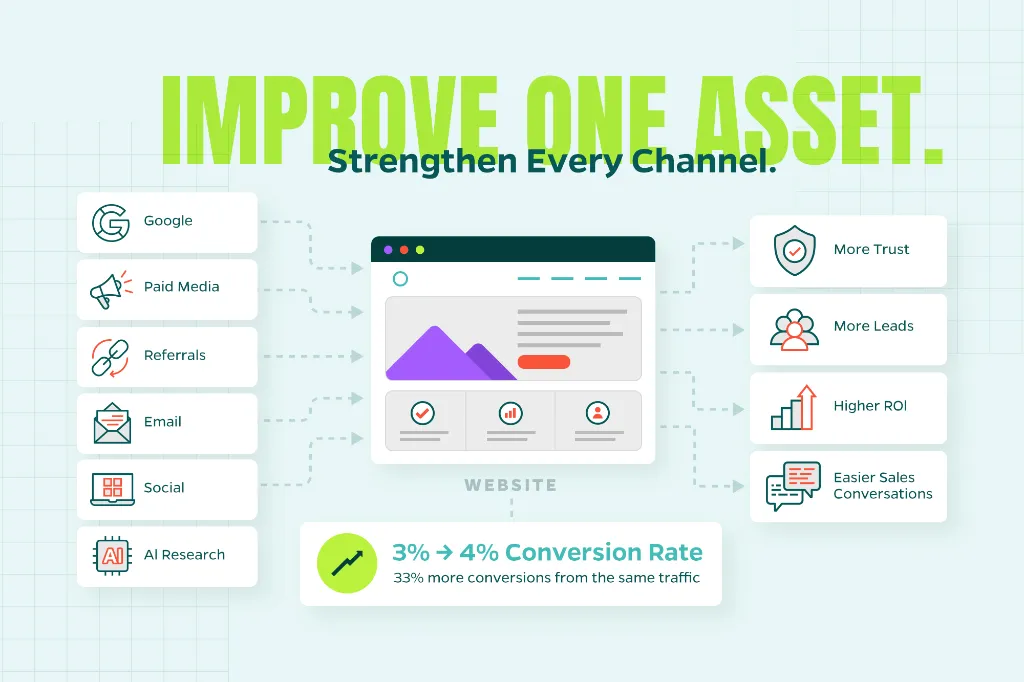
Some discovered us through Google. Others came through referrals, partner relationships, paid advertising, email, social media, or industry connections. Today, many buyers also use AI as part of their research before ever speaking with a company.
The journey is different for every buyer.
The destination usually isn’t.
Our website consistently became part of the buying process.
That realization shifted my thinking. Instead of asking which channel could generate more traffic, I started asking how we could improve the one asset almost every channel already depended on.
If we made our website more effective, we wouldn’t simply improve one source of leads. We could improve nearly every source feeding into it.
That’s the kind of leverage I was looking for.
Every Investment Has a Sphere of Influence
One idea has become a useful framework for me.
Every investment has a different sphere of influence.
Some investments improve one campaign.
Others improve one channel.
The highest-leverage investments improve the entire system.
Imagine your website converts 3% of qualified visitors into leads. If you improve that conversion rate to 4%, you’ve increased conversions by 33%.
The math is interesting, but what matters more is what it represents.
You didn’t have to increase your advertising budget.
You didn’t need another thousand visitors.
You didn’t have to launch another campaign.
Every visitor you were already earning simply became more valuable.
Every marketing investment driving people to your website immediately produced a better return because the destination became more effective.
That’s why I believe some investments deserve greater priority. They don’t simply generate additional demand. They improve the return on demand you’re already creating.
Looking Back, We Didn’t Improve the Website. We Improved Trust.
Looking back, I don’t think our lead flow increased simply because we improved our website.
I think it increased because we improved trust.
The website simply became the vehicle for delivering it.
Every decision we made had the same objective: reduce uncertainty.
Prospective customers visit your website with questions, even if they never consciously ask them.
- Do these people understand my business?
- Can they solve my problem?
- Have they done this before?
- Can I trust them?
The faster we could answer those questions, the easier it became for someone to move forward.
That mindset shaped every improvement we made.
We clarified our messaging so visitors could quickly understand who we help and the outcomes we deliver. We added more customer success stories and testimonials because marketing can make claims, but customers provide proof. We strengthened our messaging around results instead of simply listing services.
Perhaps most importantly, we showcased our people.
Many companies say they have experts.
We wanted to show ours.
We highlighted our strategists, their backgrounds, and their experience. We put faces to names because expertise feels different when buyers can actually see the people behind it.
It humanized our brand.
More importantly, it made our expertise tangible.
Anyone can claim to have experts.
Showing them builds trust.
Turn Expertise Into a Marketing Asset
That decision led to another realization.
Every business already has subject matter experts.
Whether you’re a manufacturer, financial advisor, software company, roofing contractor, law firm, healthcare provider, or marketing agency, you have people solving customer problems every day. They’ve developed judgment that only comes from experience.
Unfortunately, much of that expertise never reaches prospective customers.
We wanted to change that.
One of our goals was to capture more of our team’s knowledge and make it available to buyers, not because we wanted to publish more content, but because we wanted to better communicate our expertise.
The goal wasn’t content.
The goal was trust.
Rather than simply researching topics and summarizing information already available online, we wanted our subject matter experts to drive the ideas. Experienced marketers and writers still played an important role, but the insights came from the people closest to the work.
Experts don’t simply explain what something is.
They explain why one approach is better than another. They discuss tradeoffs, provide context, and share first-hand experiences that can’t be replicated through research alone.
That’s what buyers are looking for.
They’re not hiring a company because it has information.
They’re hiring a company because it demonstrates judgment.
That same investment also creates benefits beyond the website.
We didn’t create expertise-driven content simply because we wanted better SEO. We created it because we wanted to better communicate our expertise and build trust. We also knew that same investment would strengthen SEO by giving search engines a deeper understanding of our expertise and the topics we wanted to be known for. As AI becomes a larger part of the buying journey, that same content also supports GEO by helping AI better understand our brand, our expertise, and the problems we’re qualified to solve.
One investment created multiple returns.
It built trust with buyers.
It strengthened our website.
It supported our SEO and GEO.
And because prospects often consumed that content throughout their evaluation process, it also made sales conversations easier.
We found ourselves providing fewer customer references because buyers had already seen enough proof to believe we could deliver. They asked for fewer examples because they’d already read success stories and testimonials. Many simply told us, “Your clients are clearly happy,” or “You guys are the experts.”
The website didn’t replace the sales process.
It made it easier.
The Bigger Lesson
Over several months, our lead flow increased by roughly 70%.
We didn’t accomplish that by dramatically increasing our marketing budget.
We accomplished it by improving an asset that almost every prospective customer touched.
The biggest lesson wasn’t that websites matter. Most business owners already know that.
The bigger lesson was about how to prioritize investments.
When resources are limited, don’t just ask which investment will generate the next lead.
Ask which investment improves the greatest number of buyer touchpoints.
For us, that meant strengthening our website, better communicating our expertise, showcasing our people, sharing customer success stories, and creating educational content that built trust throughout the buyer journey.
Those tactics will look different for every business.
- A manufacturer may highlight its engineers.
- A financial advisor may showcase the expertise of its advisors.
- A roofing company may educate homeowners through practical guidance and project examples.
The tactics aren’t the point.
The principle is.
Every investment has a sphere of influence.
Some improve one campaign.
Others improve one channel.
The best investments improve the entire growth system.
When resources are limited, those are the investments I prioritize because they make every future marketing investment more effective.