


For HVAC, plumbing, pest control, and other home services companies, marketing budgets are often spread thin. You are often allocating money across paid search, local SEO, social media, direct mail, and more. Without a clear way to track which of those channels are driving calls and booked jobs, it is nearly impossible to know where to invest next. This article breaks down what marketing attribution means for home services businesses, the common models companies use, and practical steps to start measuring ROI with more confidence.
Why Attribution is Challenging for Home Services
Home services companies face a few challenges that make attribution harder than it is for a typical e-commerce business. First, the buying journey often includes a phone call, not just a form fill or online purchase. Second, many jobs come from repeat customers or referrals that are hard to tie back to a specific campaign. Third, some services, such as emergency plumbing or pest infestations, are triggered by urgent need. This means the customer may interact with several channels in a very short window before calling.
Because of these factors, a simple last-click view of marketing performance can be misleading. A customer might see a Google Business Profile listing, then a retargeting ad, then finally search your business name directly before calling. If you only credit that final branded search, you might undervalue the earlier touchpoints that built awareness and trust in the first place.
There is also an offline factor to consider. A neighbor’s recommendation, a yard sign from a past job, or a truck spotted on the way to work can all plant the seed for a future call, before that customer ever visits your website. None of that shows up neatly in a dashboard, which is part of why attribution for home services businesses works best as a blend of digital tracking and old-fashioned customer conversation.
Common Attribution Models to Know
There is no single correct attribution model, but understanding the main options helps you choose one that fits how your customers shop for home services. Here are a few to note:
- Last-click attribution: Gives full credit to the final channel before a call or booking. Simple to set up, but it ignores earlier touchpoints.
- First-click attribution: Credits whichever channel introduced the customer to your business first. Useful for understanding what drives initial awareness.
- Linear attribution: Splits credit evenly across every touchpoint in the customer’s journey. It is balanced. However, it treats every interaction as equally important, which is not always true.
- Time-decay attribution: Gives more credit to touchpoints closer to the conversion. This tends to fit urgent-need services well, since the last few interactions before a call often matter most.
- Position-based attribution: Assigns more weight to the first and last touchpoints, with the middle interactions sharing a smaller amount of credit.
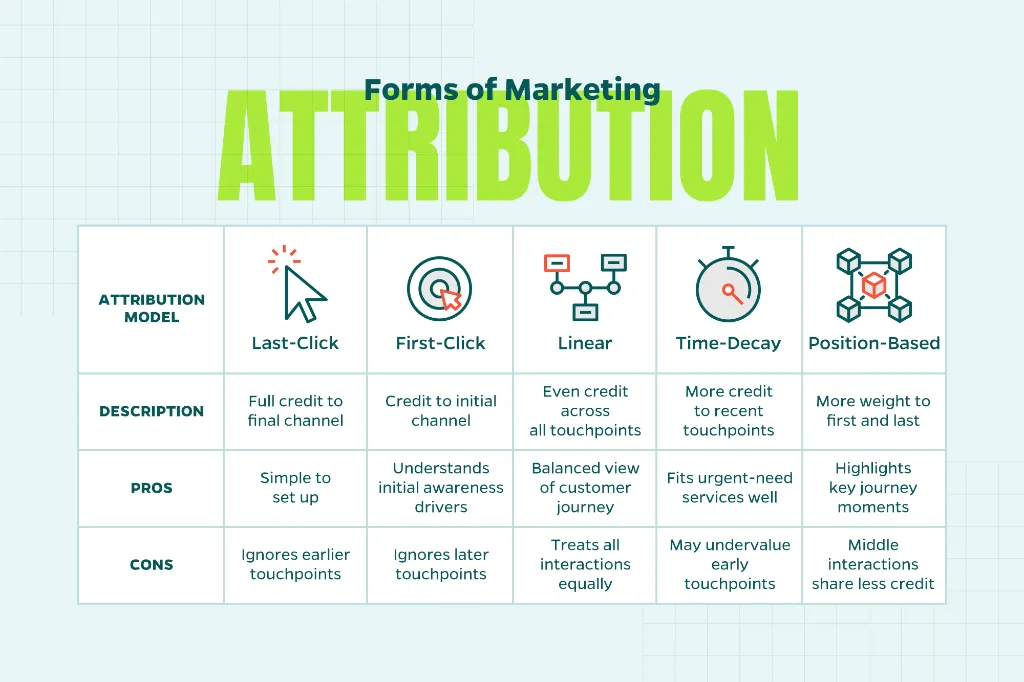
For most home services companies, a time-decay or position-based model offers a more realistic picture than last-click alone, since it recognizes that marketing works together over time rather than in isolation.
Tools That Make Attribution Possible
You do not need an enterprise-level analytics team to start tracking ROI with more accuracy. Here are a few tools tend to make the biggest difference for home services companies:
- Call tracking software: Assigns unique phone numbers to different marketing channels so you can see which ads, pages, or campaigns generate calls.
- Google Analytics and Google Ads: Track website behavior and paid campaign performance, including which keywords and ads lead to form submissions or calls.
- CRM integration: Connects marketing data to actual job bookings and revenue, so you can see which leads turned into paying customers.
- UTM parameters: Tagged links that identify the source of website traffic, helping you separate results from email, social, and paid campaigns.
When these tools work together, you get a much clearer view of the customer journey, instead of guessing based on gut feel. Many home services companies start with just one or two of these tools rather than trying to implement all four at once, and that is a reasonable way to begin. Call tracking paired with basic UTM tagging, for example, can already reveal which channels drive the phone to ring, and that alone is often enough to reshape a budget conversation.
Practical Steps to Improve Your Attribution
Improving attribution does not require an overnight overhaul. Below are a few practical steps can move the needle quickly.
- Set up call tracking for every major channel, including your website, Google Business Profile, and any print or vehicle advertising.
- Train your team to ask new customers how they heard about your business. Log that information consistently.
- Review attribution data monthly rather than annually, so you can adjust budgets before a low-performing channel drains too much spend.
- Look beyond lead volume to job value and close rate, since some channels may generate more leads but fewer high-value jobs.
Over time, these habits build a data set that shows not just how many leads each channel produces, but how much revenue it drives. That is the difference between marketing that feels productive and marketing that is proven to pay off.
Turning Data into Better Decisions
The point of attribution is not to obsess over perfect numbers, since no model will ever capture every step of the customer journey. You should simply aim to make smarter, more confident decisions about where to spend your marketing budget. If time-decay data shows local SEO consistently plays a role in the weeks leading up to a booked job, that is a strong argument for continued investment.
Need Help?
Want help building an attribution strategy that fits your home services business? Contact Straight North today to learn how our team can help you track marketing ROI and make smarter budget decisions.