




Running a home services business means managing a lot at once: schedules, technicians, customers, inventory, and revenue goals. Marketing adds another layer, and it can be difficult to know which numbers truly matter.
The right key performance indicators (KPIs) show whether your marketing is driving business results, not just activity. For HVAC, plumbing, pest control, and other home service companies, a click only matters if it helps produce a qualified lead, a booked job, and revenue.
This article will offer 10 KPIs worth watching.
1. Qualified Leads
Lead volume is a useful starting point, but raw lead counts can be misleading. Tracking qualified leads gives you a more accurate view of performance.
A qualified lead is an inquiry from a prospective customer who needs a service you offer, lives in your service area, and has a reasonable chance of becoming a customer. This KPI answers a simple question: Is your marketing attracting the right people?
2. Cost Per Lead
After tracking qualified leads, measure what each one costs to acquire.
Cost per lead (CPL) is calculated by dividing marketing spend by leads generated. You can track it overall or by channel, campaign, or service line. For example, $3,000 in Google Ads spend that produces 60 qualified leads equals a $50 CPL. Comparing CPL across channels helps show where your investment is most efficient.
Still, the lowest CPL is not always the best result. A higher-cost lead may be more valuable if it is more likely to become a profitable customer.
3. Lead-to-Customer Conversion Rate
Tracking this KPI can reveal whether your marketing is attracting quality prospects and whether your follow-up process is converting them effectively.
Consider two marketing channels:
- Channel A generates 100 leads and 10 customers.
- Channel B generates 50 leads and 15 customers.
Channel A produces twice as many leads, but Channel B produces more customers. If you judged performance only by lead volume, you might put more money into the wrong channel.
For home services businesses, connecting marketing, CRM, and sales data is especially valuable. It lets you evaluate marketing based on what happens after the form is submitted or the phone rings.
4. Cost Per Acquisition
Instead of measuring the cost to generate a lead, cost per acquisition (CPA) measures the cost to gain a customer.
The calculation is straightforward:
Marketing spend ÷ number of new customers = customer acquisition cost
CPA is useful for evaluating paid advertising, SEO, and other lead generation programs. It helps determine whether your marketing investment makes financial sense.
If it costs $100 to acquire a customer who generates $1,000 over time, that is very different from spending $100 to win a single $125 job.
5. Marketing-Attributed Revenue
Marketing-attributed revenue measures the revenue tied to customers generated or influenced by your marketing. Attribution is rarely perfect, especially when customers interact with several channels before contacting you. Yet, a consistent approach can still provide useful direction.
For example, a homeowner might:
- Find your company through an organic Google search.
- Visit your website several times.
- Click a paid ad a week later.
- Call your business and book a service.
Which channel gets credit? There may not be one perfect answer. The key is to use a consistent attribution method and understand its limits.
When you view revenue alongside lead volume and acquisition costs, you get a stronger basis for marketing decisions.
6. Phone Call Leads
For many home services businesses, the phone remains one of the most important conversion channels. Someone with a broken furnace, backed-up drain, or pest problem often wants to talk to a person right away.
That makes phone call leads an important KPI to track.
Call tracking can show which channels, campaigns, and landing pages generate calls. It can also help separate real sales opportunities from existing customer questions, spam, or job inquiries.
7. Conversion Rate
Website conversion rate measures the percentage of visitors who take a desired action, such as submitting a form, calling your business, or requesting an estimate.
This KPI helps evaluate your website and landing pages. If the site attracts relevant traffic but few visitors contact you, the issue may be a weak value proposition, unclear calls to action, long forms, or missing proof points.
For home services companies, conversion actions should be easy to find and complete. Customers often arrive with an urgent need, so reducing friction can make a real difference.
8. Average Job Value
Average job value shows how much revenue you generate per completed job. A pest control company may find that recurring service customers produce far more revenue over time than one-time treatments. An HVAC company may see that replacement projects are more valuable than routine maintenance calls.
Those insights can shape marketing priorities, messaging, and budget allocation.
9. Customer Lifetime Value
Some home services customers book once. Others stay with a company for years.
Customer lifetime value (CLV) estimates the revenue a customer generates over the full relationship. You multiply the average value of a customer’s purchase by how often they buy, and then multiply that by how long they stay with your company
A customer who books annual HVAC maintenance for five years is worth more than a single service call. Likewise, a pest control customer on an ongoing treatment plan may have a much higher lifetime value than a one-time customer.
CLV helps you decide how much you can reasonably spend to acquire a customer.
10. Return on Marketing Investment
Return on marketing investment (ROMI) helps you evaluate whether marketing is creating enough financial value to justify the cost. Depending on your reporting model, you may calculate it using revenue or profit generated by marketing compared with marketing spend.
The exact formula matters less than using a consistent method your team understands.
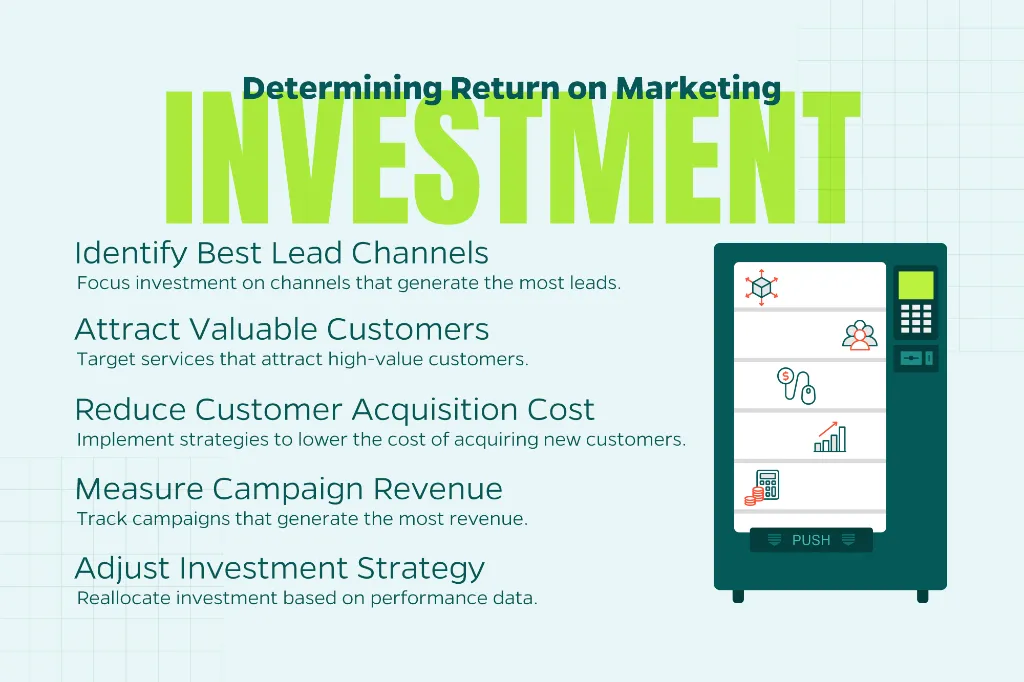
The goal is not to build the biggest dashboard. It is to create reporting that helps answer practical questions:
- Which channels generate the best leads?
- Which services attract the most valuable customers?
- How much does it cost to acquire a customer?
- Which campaigns generate revenue?
- Where should we increase or decrease investment?
Focus on KPIs That Help You Make Decisions
There is no universal KPI list for every home services business. Start with a manageable group of KPIs, make sure your tracking is accurate, and review the numbers consistently. As reporting improves, you will see what is working, where opportunities exist, and how marketing contributes to growth.
Need Help?
If you would like help choosing and tracking the right KPIs for your home services business, contact Straight North to discuss your digital marketing goals.