


Home services businesses live and die by trust. Before a homeowner allows a plumber to tear into their walls, an HVAC technician to access their attic, or a pest control specialist to treat their property, they want confidence that the company knows what it’s doing. That’s where before/after content becomes one of the most powerful tools in the home services marketing arsenal.
Unlike a generic list of services or a page of customer testimonials, before/after content puts proof front and center. It shows potential customers exactly what you can do. When that proof is baked into a thoughtful content marketing strategy, it builds credibility that drives inquiries and converts leads into loyal customers.
Why Before/After Content Works in Home Services
The nature of home services work is inherently visual. A clogged drain becomes a clear one. A pest-ridden attic becomes a clean, sealed space. An aging HVAC system gets replaced with modern, efficient equipment. These are transformations people can see and feel. That’s exactly what makes before/after content so effective.
There’s also a psychological dimension at play. Homeowners shopping for services are often anxious. They’re dealing with something broken, damaged, or troubling. Before/after content speaks directly to that anxiety. It says: “Here’s the problem. Here’s what we did. Here’s the result.” That narrative arc is reassuring, and it mirrors the exact journey your prospective customer is hoping to take.
Beyond emotion, before/after content supports search engine visibility. When written with the right keywords and structured properly, this type of content helps your website appear in searches from homeowners actively looking for the kind of work you do.
Content Formats That Bring Transformations to Life
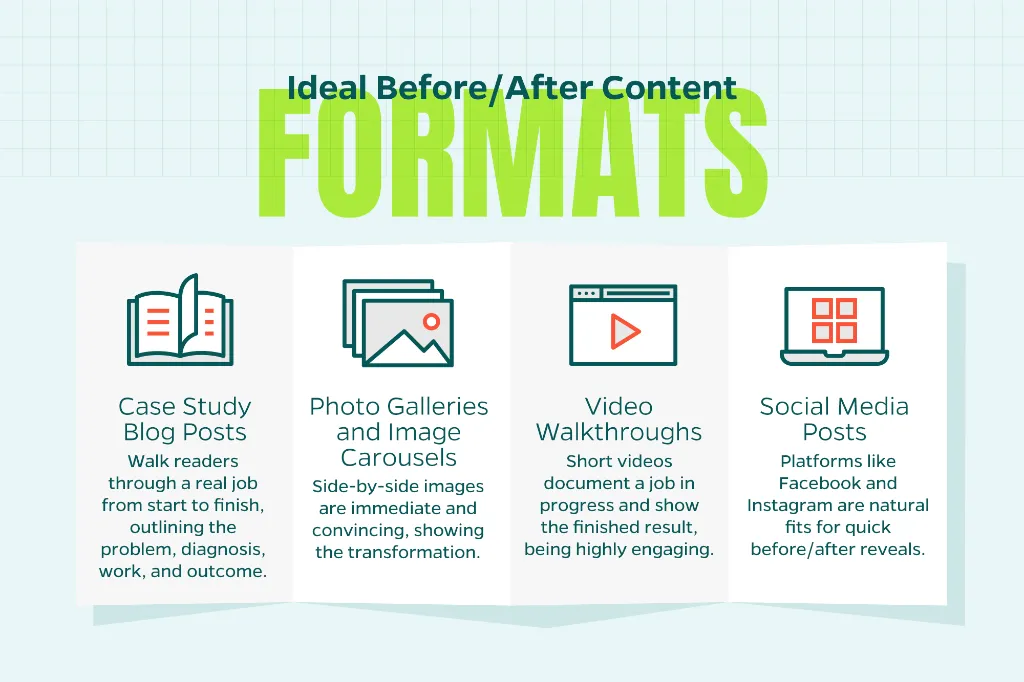
The content format you choose should match both your audience and the platform where you’re sharing the story. Here are the most effective formats for home services companies:
- Case study blog posts. A well-written case study walks readers through a real job from start to finish. It should outline the initial problem, the diagnosis, the work performed, and the outcome. These posts perform well in organic search because they often address specific, high-intent queries like “water heater replacement cost” or “how to get rid of carpenter ants.”
- Photo galleries and image carousels. Side-by-side images are immediate and convincing. Whether it’s a corroded pipe versus a new copper installation or a termite-damaged beam versus a repaired one, photos do the heavy lifting that words can’t always accomplish on their own.
- Video walkthroughs. Short videos that document a job in progress and show the finished result are among the most engaging content for a home services company. A two-minute video of an HVAC technician explaining what was wrong and what was fixed can be more persuasive than a paragraph of text.
- Social media posts. Platforms like Facebook and Instagram are natural fits for quick before/after reveals. A strong image paired with a brief caption can generate meaningful engagement, particularly among local homeowners who are future customers.
Building the Story Around the Transformation
The most effective before/after content goes beyond a photo or a job summary. It tells a story that the reader can connect with. That means giving context to the “before” situation while being specific about the new status quo “after.”
Consider a pest control company that documents a rodent infestation in a garage. The before: droppings along the baseboards, chewed insulation, a family afraid to use the space. The after: a sanitized, sealed, and treated garage with exclusion work done on three entry points. That level of detail makes the transformation feel real and relevant, not like a stock-photo campaign.
When writing this content, be specific without being technical to the point of confusion. Your audience is a homeowner, not a contractor. Explain what was wrong in plain language, describe what your team did, and quantify the outcome wherever possible. Did the customer’s energy bill drop after the HVAC upgrade? Is the new plumbing expected to last 20-plus years? Numbers and measurable outcomes make the transformation feel concrete.
Getting Team Buy-In for Content Collection
One of the biggest challenges home services companies face with this type of content is simply capturing the material in the field. Technicians and crew members are focused on the work, not on pulling out a phone for photos. Building a habit around content collection requires a clear process and team buy-in.
Here are a few practical steps that make this easier:
- Make photo documentation part of the job checklist.
- Use a shared folder or app where field staff can upload images immediately after a job.
- Identify a few team members who are comfortable on camera and invite them to contribute short video clips explaining their work.
- Ask satisfied customers for permission to feature their job in a case study. Most are happy to say yes, especially when the result is something they’re proud of.
The content doesn’t need to be perfect to be effective. Authentic, real-world photos and straightforward writing often resonate more with homeowners than polished, studio-quality production.
Matching Content to the Customer’s Decision Timeline
Before/after content serves different functions depending on where a potential customer is in their decision-making process. Understanding that dynamic helps you publish the right content in the right place.
Someone who has just noticed signs of a pest problem might land on a blog post about what rodent activity looks like and how it gets addressed. That’s a top-of-funnel entry point. A detailed case study documenting a full attic remediation, on the other hand, is built for someone already comparing companies and looking for proof of competence. Both are valuable, and both can be powered by before/after storytelling.
Social media before/after posts tend to work well for awareness and staying top of mind with your existing audience. Blog-based case studies and service pages with project galleries are more effective for capturing search traffic and supporting conversion. A well-rounded content marketing strategy uses both in concert.
Turning Transformations into Long-Term Marketing Assets
One of the underappreciated advantages of before/after content is its longevity. A case study published today can drive search traffic for years. A well-documented project gallery adds credibility to every visitor who lands on your website, regardless of when they arrive.
This is why it pays to think of each completed job not just as a service rendered, but as a potential content asset. Over time, a library of before/after content becomes a compelling body of evidence. It demonstrates your range, your consistency, and your results in a way that no ad campaign can replicate.
Home services companies that commit to this approach find that their content starts doing work for them: generating leads, answering objections before prospects can ask, and differentiating the business from competitors who are still relying on generic “we’ve been in business for 20 years” messaging.
Need Help?
Ready to turn before/after projects into leads? Straight North can help you capture stronger stories and get them in front of the right homeowners. Contact us to learn more.