



This article is part of CFO Turned CMO, a series on what I’ve learned from leading both finance and marketing. It explores how my finance background has shaped the way I approach marketing, and how that perspective can help business leaders make better decisions about growth.
One thing finance teaches you quickly is that not every investment is supposed to pay back on the same timeline.
Some investments are meant to create a return quickly. Others are meant to build efficiency, reduce risk, improve the customer experience, or create value over a longer period.
That concept is obvious in many areas of the business.
If you hire a salesperson, buy equipment, open a new location, or invest in software, you naturally think about the time horizon. You ask: How soon should this pay back? What does success look like in the short term? What value should this create over time?
Marketing should be evaluated the same way. The problem is that marketing often gets forced into one timeline.
We ask every dollar to prove itself quickly. We look for immediate leads, immediate pipeline, immediate revenue, or immediate ROI. And when an investment does not show a clear short-term return, it becomes easy to question whether it is working.
Sometimes that skepticism is warranted. But sometimes we are judging a longer-term investment with a short-term scorecard.
That is one of the biggest mistakes I see in marketing decision-making.
The better question is not simply, “Did this work?” The better question is:
What is the time horizon of this investment, and are we evaluating it accordingly?
That question changes the conversation. It helps separate dollars meant to create demand now from dollars meant to build future efficiency. It makes it easier to compare investments that behave very differently. And it creates a more practical way to build a marketing strategy that supports both short-term performance and long-term value.
Same Dollar, Different Payback Timeline
Not all marketing dollars behave the same after they are spent.
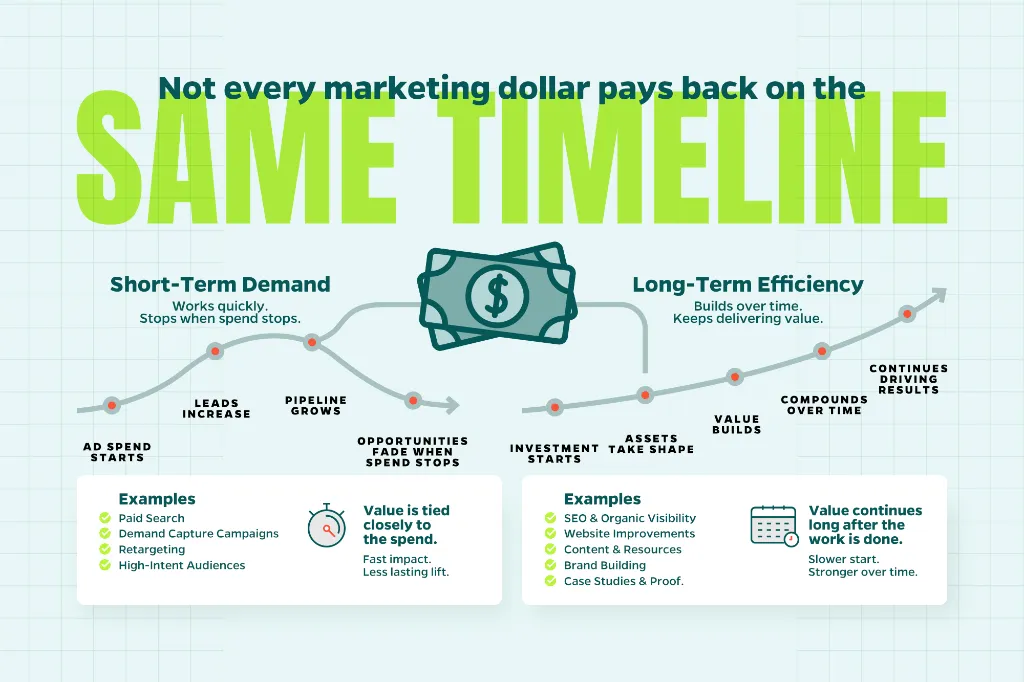
Some dollars are meant to create opportunities quickly. A paid search click is a simple example. Someone is already looking for a solution, you pay to appear, and that person may become a lead quickly. That can be incredibly valuable.
If the business needs demand now and the economics support the cost, that may be exactly the right place to spend.
But the value is usually tied closely to the spend. When the spend slows, the opportunities often slow with it. That does not make it bad. It just means the payback timeline is different.
Other investments work differently.
A strong service page may take time to create and even longer to gain traction. But if it ranks, converts, supports sales conversations, and helps buyers understand why you are different, it can create value for a long time.
A useful article may not produce a lead the day it goes live. But it can answer a buyer’s question, build trust, support organic search, help a salesperson follow up, and continue working long after it was written.
A case study may not create demand on its own. But it can help a prospect feel safer choosing you.
Those are different types of value.
The mistake is evaluating all of them with the same timeline.
The Tradeoff with Short-Term Investments
In my experience, the marketing investments that produce the quickest, cleanest return often create the least value after the spend stops.
That does not mean they are bad investments. In many cases, they are necessary.
Paid search is a simple example. If someone is already looking for a solution, you can pay to show up in that moment. If the economics work, that can be a very good decision. You may generate opportunities quickly, learn which messages convert, and create near-term pipeline.
But the return is usually tied closely to the spend. When the spend slows, the opportunities often slow with it.
That is the tradeoff.
Short-term investments can be easier to measure, easier to justify, and faster to impact the business. But they often do not build as much durable value over time.
Longer-term investments are usually harder to defend early. A better website, stronger content, clearer positioning, improved proof, and brand-building may not create a lead tomorrow. But if they work, they can keep improving performance long after the initial investment.
That does not make one better than the other. It just means they are different types of investments.
Sometimes you need the faster return. You may need pipeline. You may need feedback from the market. You may need to support a near-term growth goal. You may need to create enough momentum to keep investing in the longer-term work.
Sometimes you need to win now so you have the ability to win later. The mistake is not making short-term investments. The mistake is building a marketing strategy where every dollar has to create an immediate return and nothing is building future efficiency.
If every dollar only works while you are actively spending it, the business can end up on a treadmill. Spend creates opportunities. Opportunities slow when spend slows. Then you have to spend again just to get back to the same place.
That may be acceptable for a period of time, especially if the economics are strong and the goal is speed. But it should be a conscious decision, not the default.
Some dollars are buying near-term demand. Some dollars are building future efficiency.
You need both — but you should know which one you are buying.
The Investments That Compound
The marketing investments I tend to like most are the ones that have a chance to compound.
By compounding, I do not mean the return is guaranteed. Marketing is never that clean.
I mean the investment can keep helping after the original work is done.
A better website can improve conversion from paid search, organic search, referral traffic, direct traffic, and sales follow-up.
SEO is a good example. It usually requires patience. It may not create a lead tomorrow, and early progress can be hard to connect directly to revenue. But when it works, the value can build over time. A strong organic presence can continue bringing buyers to the site, support credibility, and reduce how dependent the business is on constantly paying for every visit.
Higher-funnel paid media can also fit into this category. It may not produce the same immediate return as demand-capture channels like paid search, but it can create familiarity before buyers are ready to act. Someone may see your brand, ignore it in the moment, and then be more likely to recognize you later when the need becomes more urgent. That impact can be hard to measure, but it can still matter.
Clearer positioning can make ads perform better, sales conversations easier, and content more useful.
A stronger brand can make buyers more likely to recognize you, trust you, and choose you when the need becomes urgent.
Better content can support SEO, paid social, email, sales enablement, and customer education.
Better proof — reviews, case studies, testimonials, examples, results — can reduce perceived risk throughout the buying process.
These investments may not always produce an obvious immediate return. They may also be harder to attribute. A buyer might click a paid ad, read a blog post, visit the website three times, check reviews, see something on social, talk to sales, and then convert weeks later.
Which investment gets the credit? That is hard to answer perfectly. But imperfect attribution does not mean the value is not there.
This is where finance and marketing can talk past each other. Finance wants to know which dollar created the return. Marketing often knows the return came from a system of things working together.
Both sides have a point.
The answer is not to abandon measurement. The answer is to understand that some marketing investments are not designed to win alone. They are designed to make the entire system stronger.
The Hard Part is Blending Now and Later
The strongest marketing strategies are rarely all short-term or all long-term.
Long-term investments do not automatically produce a better return. But they often create a different kind of value. A stronger website, better content, clearer positioning, stronger brand, better proof, and organic visibility can keep helping the business long after the original work is done.
But there is a catch.
A long-term investment may be the right decision over three years. But if it creates no short-term demand and the business needs pipeline now, it may not be enough by itself.
That is why I think about both short-term and long-term marketing at the same time. The mistake is not choosing one over the other. It is building a plan that depends too heavily on only one.
If you only invest in short-term demand, growth can become dependent on constant spend. The business may keep generating leads, but it may not build much durable value.
If you only invest in long-term assets, you may eventually build something valuable, but you may not create enough near-term opportunity to support the business while those investments mature.
The appropriate mix depends on the business goal, cash position, and timeline.
If the business needs growth in the next six months, the mix should probably lean more toward investments that create faster feedback and demand. If the business has a longer time horizon and can afford patience, the mix can lean more toward compounding investments.
If the sales team has leads but conversion is weak, the best investment may not be more traffic. It may be better messaging, stronger proof, clearer positioning, website improvements, or better sales support.
That is where marketing becomes less about picking channels in isolation and more about understanding how short-term and long-term investments work together.
Some dollars need to work now. Some dollars need to build for later.
And the best dollars, when you can find them, do both.
Final Thoughts
The easiest marketing investments to defend are often the ones with the clearest short-term measurement.
But the easiest thing to measure is not always the most important thing to build.
That is why I try to define the time horizon before judging the investment.
Not every marketing dollar should be expected to pay back on the same timeline.
Some dollars need to create demand now. Some need to build future efficiency. Some need to make buyers more confident. Some need to make every other dollar work better.
The mistake is not choosing short-term or long-term. The mistake is failing to know which one you are buying.
The strongest marketing strategies usually do both. They create enough demand now to support the business today, while also building the assets, trust, and credibility that make growth easier tomorrow.