


A healthcare website can draw plenty of traffic and still fall short if visitors do not take action. What matters is whether they book appointments, request consultations, or call the office. To improve conversions, healthcare organizations need a site that builds trust, communicates clearly, and makes the next step easy.
Here’s what tends to separate high-converting healthcare websites from those that leave opportunities on the table.
Start with Building Credibility
Healthcare decisions are deeply personal. Before a prospective patient fills out a contact form or books an appointment, they need to feel confident they’re in capable hands. If you are in healthcare marketing, trust is the foundation of any conversion strategy, and something you should work on from the beginning.
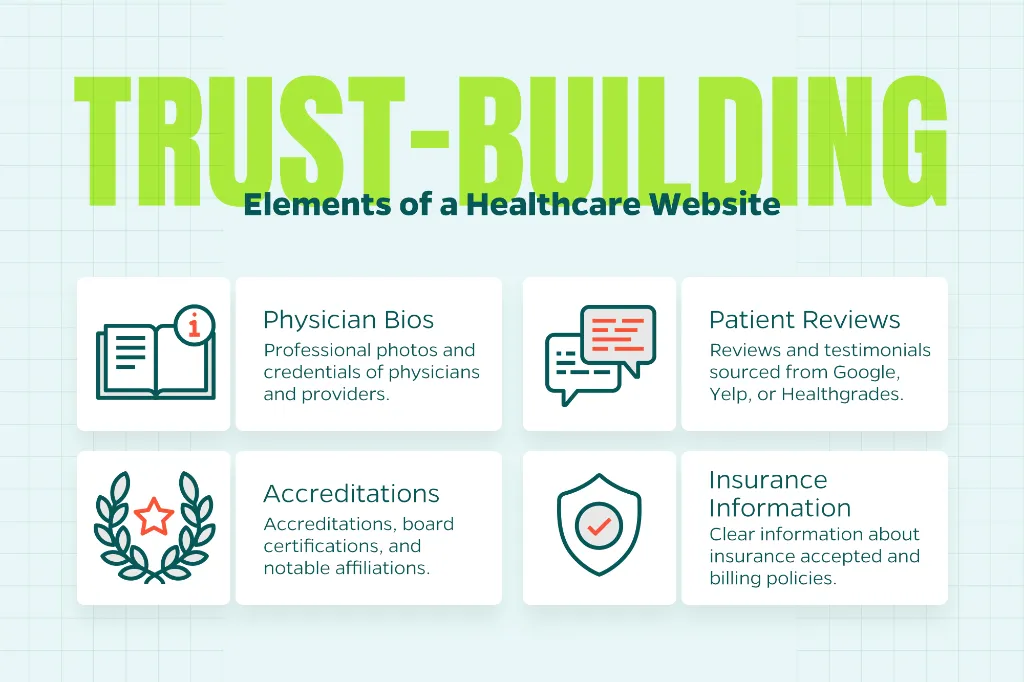
Here are a few elements that consistently build credibility:
- Physician and provider bios with professional photos and credentials
- Patient reviews and testimonials that are ideally sourced from Google, Yelp, or Healthgrades
- Accreditations, board certifications, and any notable affiliations
- Clear information about insurance accepted and billing policies
Patients do their homework. If your website doesn’t reflect the quality of care your team delivers, it’s working against you before anyone walks through the door.
Make Your Calls to Action Impossible to Overlook
One of the most common conversion problems on healthcare websites is buried or vague calls to action. A patient who wants to schedule an appointment shouldn’t have to scroll through three pages of content to find a phone number or booking link.
Effective calls to action in healthcare are specific, visible, and frictionless. Instead of a generic “Contact Us,” try “Request an Appointment” or “Schedule a Consultation Today.” These phrases reflect what the patient wants to do, which reduces hesitation and increases the likelihood they’ll follow through.
Place CTAs in logical spots such as near the top of key service pages, within provider bios, and at natural stopping points throughout longer content. If a visitor needs to hunt for a way to reach you, many of them simply won’t do the work.
Optimize for Mobile
Most healthcare-related searches today happen on mobile devices. They often occur when someone is in the middle of a health concern and needs information quickly. A website that looks polished on a desktop but frustrates mobile users is a significant liability.
Mobile optimization for healthcare goes beyond responsive design. Consider the full user experience:
- Can patients tap your phone number to call directly?
- Is your appointment request form easy to complete on a small screen?
- Do your pages load quickly? Even a two-second delay can meaningfully increase bounce rates.
- Are buttons and navigation elements large enough to tap without frustration?
Google’s mobile-first indexing also means that your mobile experience influences your search rankings. Consequently, a poor mobile experience is a problem on two fronts: the user has a negative experience, and search engines don’t rank your content.
Reduce Friction in the Appointment Process
The moment a patient decides to reach out is a fragile one. Any unnecessary friction at that point — a long form, a slow-loading page, or ambiguity about what happens next — can cost you the conversion.
Online scheduling tools have become a standard expectation in healthcare, particularly among younger patients. If your practice doesn’t offer an online booking option, that absence is likely costing you appointments. Even a simple appointment request form is better than requiring patients to call during office hours.
When you do use forms, keep them short. Ask for what you need to get the conversation started, not every detail upfront. Name, contact information, and a preferred appointment time is often enough to begin. You can gather clinical history after the relationship is established.
Use Clear, Patient-Centered Language
Healthcare websites often err too far in one direction. For example, they may use overly clinical jargon that confuses patients, or vague reassurances that don’t truly communicate anything. Neither converts well.
The goal is to write for the person sitting at home trying to figure out whether your practice is right for them. That means explaining conditions and services in plain language, being direct about what patients can expect from their first visit and acknowledging the concerns or hesitations they may have.
Strong healthcare content answers the questions patients are already asking, like “Do you accept my insurance?” or “How quickly can I get an appointment?” If your website addresses these proactively, patients arrive with less uncertainty — and uncertainty is one of the biggest barriers to conversion.
Track the Right Metrics
Improving conversion rates is an iterative process, and you can’t improve what you aren’t measuring. For healthcare websites, the key performance indicators to monitor include:
- Form submission rates on appointment request and contact pages
- Phone call volume from the website (call tracking tools can attribute calls to specific pages)
- Bounce rates on high-intent pages like service pages and provider bios
- Goal completions in Google Analytics 4, configured to reflect your actual conversion actions
A sudden dip in form submissions, for example, might indicate a technical issue, a form that’s become too long, or a page that’s no longer ranking for the right terms. Regular review of these metrics keeps you ahead of problems before they compound.
Build an Experience That Reflects Your Care
Ultimately, your website is a patient’s first introduction to your practice. The experience it delivers, such as how easy it is to navigate, how clearly it communicates, how much confidence it inspires, shapes whether a visitor becomes a patient.
Healthcare organizations that invest in the full conversion experience consistently see stronger results than those that treat their website as a static brochure. The good news is that meaningful improvements don’t always require a full redesign. Often, targeted changes to calls to action, form design, or page messaging can move the needle significantly.
If you’d like help evaluating your healthcare website’s conversion performance, Straight North is ready to assist. Contact us today to start the conversation.