



A recent college graduate, overwhelmed by credit card debt, searches: “should I take out a personal loan to pay off credit cards?”
They land on a lifestyle blog where a freelance writer frames debt consolidation as “a smart and easy fix,” glossing over interest rates, fees, and long-term risks. Trusting the advice, the graduate takes out a high-interest loan with poor terms only to end up deeper in debt and in a worse financial position than before.
Scenarios like this highlight a critical reality: not all content is held to the same standard in search. In high-stakes “Your Money or Your Life” (YMYL) categories, such as finance, healthcare, legal, cybersecurity, and insurance, Google applies significantly stricter credibility expectations due to the potential for real world harm. As a result, SEO teams must adopt more rigorous approaches to expertise, trust, and content validation than in lower-risk verticals.
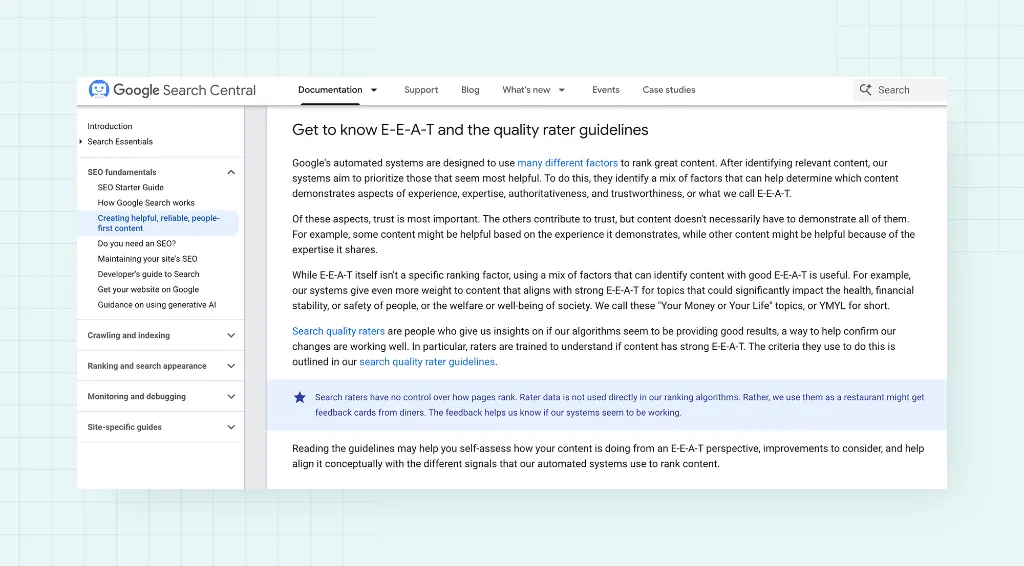
As Straight North Senior SEO Strategist Bob Hand explains, succeeding in these environments means operationalizing E-E-A-T as a core discipline. Prioritizing demonstrable expertise, verified authorship, rigorous review processes, and strong off-site credibility signals help meet elevated trust thresholds and increased scrutiny from search engines and AI systems.
So what exactly qualifies as YMYL content, and why does it carry such heightened standards?
What Qualifies as YMYL and Why Does It Matter?
YMYL content includes any topic that can directly impact a person’s finances, health, safety, or legal standing. Because the stakes are higher, search engines like Google don’t evaluate this content the same way they would a general blog post. They prioritize accuracy and proven expertise over surface-level helpfulness.
At the core of this distinction is the concept of real-world harm. If inaccurate or misleading information could cause someone to lose money, damage their health, or make a poor legal decision, it falls into YMYL territory. That’s why content tied to regulated industries like finance, healthcare, and legal services or content that offers advice, guidance, or decision-making support is evaluated more rigorously. In these cases, it’s not just about whether the content is useful, it’s about whether it’s trustworthy enough to rely on when the consequences actually matter.
“If the content involves advice, guidance, or decision-making support within those YMYL fields, or if it falls into regulated or sensitive industries like finance, healthcare, legal, those can all trigger those flags.”
Signals of Heightened Google Scrutiny
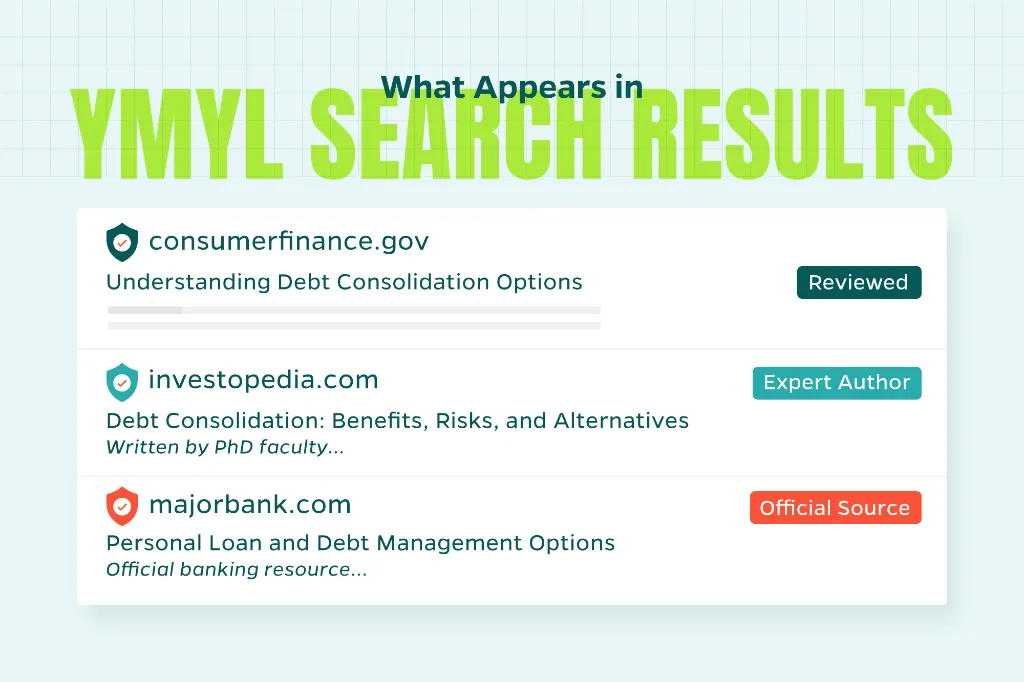
In YMYL spaces, SERPs are typically dominated by highly authoritative domains like .gov sites, educational institutions, and major brands, with increased volatility during core updates. Search engines show a clear preference for credentialed authors and professionally reviewed content, while newer or more generic sites face a much lower tolerance for ranking visibility.
A big part of broad core updates is how credibility is assessed, so you might see a little more shaky SERPs there. If you see preference for credentialed authors, so It’s very rare that you’ll see a piece of content in a highly sensitive subject rank well and not have a byline, or a “reviewed by.” You also see lowered ranking tolerance for smaller or generic sites, so you’re not going to see as many of those instances where some up-and-comer publishes a blog and lands on page one within a week. That’s not going to happen as frequently with YMYL.
These patterns make it clear that success in YMYL search results isn’t just about producing quality content. It also requires a deliberate, structured approach to building and demonstrating credibility.
Building Credibility in High-Stakes Content
To meet these expectations, content must clearly demonstrate expertise and accountability. In YMYL contexts, generic marketing copy isn’t enough. Credibility must be clearly demonstrated. Search engines look for verifiable qualifications such as professional licenses, certifications, advanced degrees, and direct industry experience, along with recognized subject matter expertise.
This is why strong author transparency plays a critical role. About pages and author bios should highlight relevant credentials, hands-on experience, and any public recognition such as speaking engagements or industry panels that reinforce expertise. Aligning contributors with topic-specific expertise helps establish trust with both users and search engines.
When Expert Review Is Necessary
When content moves beyond general information into advice or interpretations, the margin of error narrows significantly. This is especially true for legal, medical, and financial topics where inaccuracies can directly impact outcomes.
In these cases, a useful benchmark is the “liability test”: could incorrect or misleading information cause real harm?
If you’re interpreting laws, medical information, financial guidance, if you’re covering high-risk or regulated topics, or any content where the accuracy materially impacts outcome, again, putting on your legal hat, is this going to cause liability if I am giving bad info? That’s a good barometer.
With that level of responsibility in mind, these expectations must extend beyond authorship into how content is reviewed, validated, and approved before it reaches users.
Legal and Compliance in Content Workflows
In practice, this means embedding compliance and oversight directly into your content workflows.
When creating YMYL content, it’s often necessary to incorporate clear disclaimers and establish regular review cycles to ensure information stays accurate and aligned with current laws and regulations.
For example, a fintech company producing retirement planning content might implement structured processes to maintain compliance without slowing production, including:
- Pre-approved language frameworks: Writers use vetted phrasing (e.g., avoiding definitive advice and instead suggesting consultation with a licensed advisor)
- Defined review thresholds: Content involving investments, taxes, or financial decisions requires review by a certified expert before publishing
- Standardized disclaimers: Every article includes consistent legal language clarifying the content is informational, not financial advice
- Balancing compliance with speed: Teams use templates, clear review rules, and writer training to streamline production while maintaining accuracy and accountability
“Exaggerated or unverifiable claims, financial projections without disclaimers, medical or legal advice, presented as definitive or as causal … can create unnecessary risk and make your content seem less authoritative.”
Visible update timestamps and clearly defined revision practices these areas typically reflects ongoing stewardship, with regular updates that maintain accuracy and relevance over time.
Risky Content Practices to Avoid
Content should avoid guaranteed outcomes or promises, exaggerated or unverifiable claims, and unsupported financial projections that can mislead users. Additionally, advice should not be framed as definitive or causal, but rather presented with appropriate context and nuance to reflect potential variability in outcomes.
Content Freshness & Review Cadence
Determining the right review cadence for YMYL content depends on industry standards, regulatory volatility, and the importance of the page. Benchmarking against competitors and broader industry practices ensure resources are used effectively.
In more heavily regulated or high-impact areas, quarterly or semi-annual updates may be necessary especially for pages tied closely to business outcomes. Whereas, lower-risk content may only require annual reviews. Regardless of cadence, teams should remain flexible and trigger updates whenever major industry changes, regulatory shifts, or significant site updates occur.
To maintain accuracy at scale, forming editorial workflows can help mitigate bandwidth challenges and ensure consistency across teams.
I think “processifying” the editorial process can really do a lot to mitigating bandwidth issues down the line. So, scheduling content audits, having subject matter expert review workflows, assigning content ownership appropriately, having experts in specific niches within the verticals of your industry … just having people to delegate to, and then, updating, tracking, and version control for templates for however you approach your content. You want to make sure that you’re taking a look at not only the content that’s being made, but how that content is being made, and assessing appropriately.
Off-Site Reputation & Authority
But maintaining trust isn’t just about internal processes. It also depends on how your brand is validated and recognized externally.
Once you’ve established a strong content foundation and a process that supports consistent publishing, the next step is expanding its reach. Ongoing PR efforts help amplify your thought leadership, highlighting original perspectives and differentiating your brand from competitors. Building industry partnerships, securing media placements, and earning mentions all contribute to stronger authority signals. Whether managed in-house or through a dedicated PR team, it’s also important to monitor your reputation over time, staying aware of both positive and negative coverage and being prepared to respond when necessary.
Role of Reviews & External Validation
These external validation signals are becoming even more critical as AI systems determine which sources are trustworthy enough to surface in high-stakes search results.
Independent reviews, third-party mentions, and expert validation reinforce credibility beyond brand claims. Negative signals can disproportionately impact trust.
It provides independent credibility beyond brand claims. It can also influence both rankings and user trust. It’s important to have more eyes on your content to show that this is vetted. Google notices when that happens, and they’re more likely to reward content that has a review process. It also reinforces authority in sensitive industries. You know, we’re talking about YMYL, so of course finance, health, legal. It’s not an exclusive list, but definitely those. Negative signals can disproportionately harm trust, so it’s just something to keep an eye on.
AI in YMYL Content
In YMYL contexts, AI-generated results are subject to stricter safety gating, often resulting in fewer AI overviews for sensitive queries altogether. When they do appear, there is a clear preference for authoritative, verifiable sources typically from established brands with strong credibility signals. Anonymous or weakly attributed content is far less likely to surface in these environments.
To align with these expectations, AI-assisted workflows should incorporate mandatory subject matter expert (SME) review, rigorous fact-checking processes, and clear authorship to ensure accountability and trustworthiness.
“Strict fact-checking and citation standards are critical. A few factual errors can quickly erode both user trust and Google’s confidence in your content.”
As Bob Hand notes, clear authorship, accountability, and avoiding overgeneralized or unsupported claims are essential to maintaining a high standard. Though many sites fall short in these areas.
Common Trust Gaps in YMYL Content
With so much content saturating the internet, it’s hard to know what content to trust. Take note of important attributes of the articles that take away from their credibility including;
- Missing or weak authorship signals
- Generic, non-expert content
- Lack of external validation
- Over-reliance on AI-generated content
Really, it’s just a lack of clear authorship. It’s generic content without demonstrable expertise. It’s missing or has weak authorship signals, so maybe there’s even an author name, but there’s no clickable author link that connects that author to any greater expertise. A lack of external validation … again, talking about off-site signals, can also be an issue. And then maybe an over-reliance on, summarized or AI-generated content. You know, I’ve spoken about this a little bit before, but when you generate synthetic data or synthetic content based on synthetic data, you’re really not contributing meaningfully to the conversation, and Google really doesn’t have a reason to reward that.
When transitioning to a high-risk vertical SEO, remember to highlight the expert authorship. These efforts should be supported by ongoing off-site credibility building to reinforce trust and authority.
Building Trust in YMYL SEO: Key Takeaways
Success in YMYL SEO requires helpful content and systems that consistently prove credibility. High-performing strategies align expertise, authorship, review processes, and reputation signals to meet the higher burden of proof required in sensitive verticals.
As scrutiny from search engines and AI systems continues to increase, investing in E-E-A-T as an operational discipline is essential to building trust and maintaining visibility in high-stakes search environments.
In high stakes environments, SEO performance increasingly depends on treating E-E-A-T as a structured operational discipline. That means prioritizing real expertise, verifiable authorship, having a rigorous review process, and strong off-site credibility signals to meet heightened trust thresholds. You want to get on those pages; you have to meet (that) increased burden of proof when it comes to expertise. Especially as AI systems and search engines apply stricter scrutiny to ensure only reliable or accountable content is surfaced. So really, it’s about understanding why that there’s an increased burden of credibility, and overcoming it by investing in authorship, in E-E-A-T as one of those pieces of your SEO game plan.