


Growing your business is exciting. Yet, when you expand a home services business into new neighborhoods or service areas it comes with a unique marketing challenge: you have no reputation there yet. The reviews, referrals, and brand recognition that bring in calls in your established territory don’t automatically translate across town or into the next zip code. For HVAC contractors, plumbers, pest control companies, and other home service providers, breaking into a new service area requires a deliberate strategy. This article will offer tips to help you build a presence that local prospective customers notice and trust. Every tactic is designed to close that trust gap as quickly and credibly as possible.
Start with Local SEO Fundamentals
Before you start spending on advertising, your digital footprint needs to reflect the new area you’re serving. Search engines rely heavily on location signals to decide which businesses show up for “plumber near me” or “HVAC repair in [neighborhood].” If your website and listings don’t mention the new service area, you’re likely not going to be seen by customers searching for you there.
Here are a few foundational steps that go a long way:
- Update your Google Business Profile service areas, or create a new listing if you’re opening a physical location
- Build dedicated location pages on your website for each new neighborhood or city you serve
- Ensure your business name, address, and phone number are consistent across directories
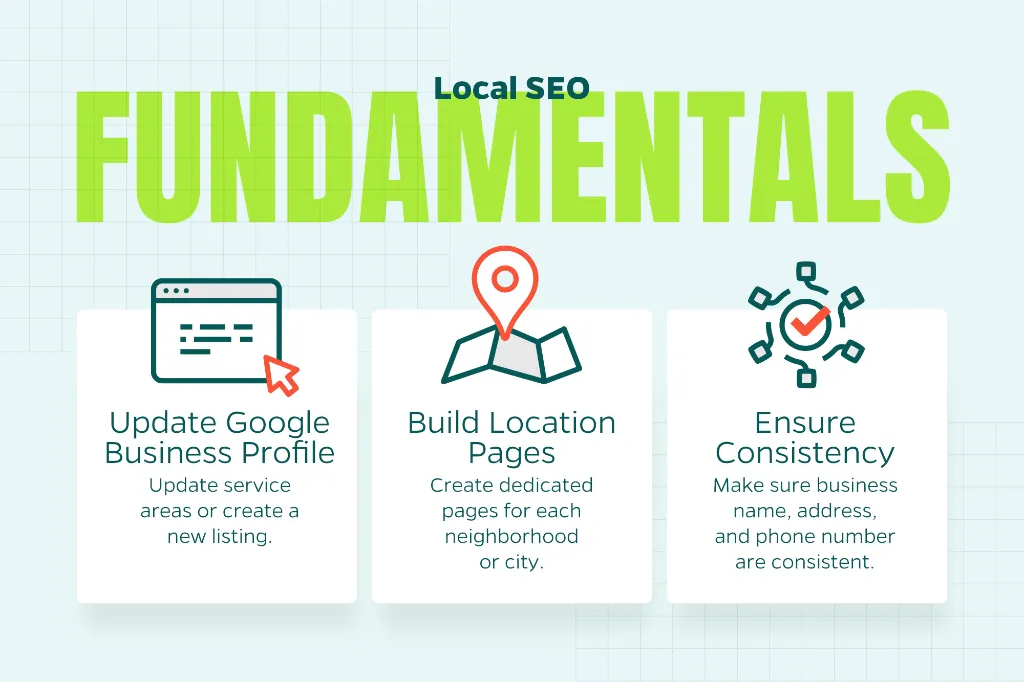
These steps will lay the groundwork for everything else you do in the new market.
Build Local Authority Through Directories and Partnerships
New neighborhoods often have their own local directories, neighborhood association websites, and community groups that residents trust more than a national search result. Getting listed in these hyperlocal directories signals to both search engines and homeowners that you’re a legitimate, established presence.
Beyond directories, consider forming partnerships with other local businesses that share your customer base. A pest control company might team up with a landscaping service, while an HVAC contractor could build a referral relationship with a local real estate agent. These partnerships create a steady stream of word-of-mouth leads that paid advertising simply can’t replicate.
Use Hyperlocal Content to Show You Understand the Area
Homeowners want to hire a company that understands their specific situation, not a generic service provider. Content marketing that speaks directly to the new neighborhood’s characteristics helps establish that connection. Here are a few examples:
- An HVAC company writing about how older homes in a historic district often need updated ductwork
- A pest control company addressing the specific pests common to a region’s climate or vegetation
- A plumbing company referencing local water hardness levels and their effect on pipes and appliances
This kind of content does a couple things. It supports your local SEO efforts while also reassuring potential customers that you know the area well enough to handle their specific needs.
Lean on Reviews to Build Trust Quickly
Reviews are very important for home services companies, especially when you’re new to the area. Prospective customers who have never heard of your company will look to reviews as a stand-in for the reputation you haven’t built yet locally.
After completing jobs in the new service area, make review requests part of your standard follow-up process. Responding to every review shows you’re engaged and accountable, which matters when you don’t yet have a long track record in the neighborhood.
It also helps to feature these new reviews prominently on the location pages you create for the area. Seeing feedback from actual neighbors, rather than generic testimonials from across town, gives homeowners the confidence that you understand what their specific street, climate, or housing stock requires.
Use Targeted Paid Advertising to Accelerate Visibility
Organic visibility takes time to build, which is where paid advertising fills the gap. Geotargeted pay-per-click campaigns let you put your business in front of homeowners in the new service area immediately, rather than waiting months for your SEO strategy to mature.
When launching ads in a new neighborhood, keep your targeting tight. A narrow radius around your new service boundary, combined with messaging that calls out the specific area by name, tends to perform better than broad campaigns that try to cover too much ground too soon. As you collect data on which neighborhoods convert best, you can expand your radius with more confidence.
Track Performance by Specific Neighborhood
One mistake home services companies make when expanding is lumping new service areas into their existing performance metrics. If you can’t see how a specific neighborhood is performing, you can’t tell whether your expansion strategy is working.
Set up call tracking, conversion tracking, and reporting that breaks results down by service area. This level of detail helps you identify which neighborhoods are responding well to your marketing and which ones may need a different approach. If you do need to change things up, you could try more local content, different ad messaging, or additional directory listings.
Give the Strategy Time to Compound
It’s tempting to judge a new service area after a few weeks. Unfortunately, local trust tends to build in layers rather than all at once. Directory listings need time to get indexed, location pages need time to climb in search rankings, and review counts need time to grow to a level that feels reassuring to a homeowner comparing options.
A reasonable approach is to commit to three to six months of consistent effort before making major changes to the strategy. Paid advertising can carry the weight in those early weeks while organic visibility and local reputation catch up. Once both are working together, the cost of acquiring new customers in that neighborhood typically starts to decline.
Need Help?
Ready to build a marketing strategy for your next service area? Contact Straight North to learn how our team can help you expand with confidence.