

Launching a new website without SEO is a little like remodeling a busy airport while flights are still arriving. The new terminal may look fantastic, but if the gates move, the signs disappear, and no one updates the flight maps, travelers end up lost.
The same thing happens during a website redesign. Search engines rely on your site’s structure, URLs, internal links, and content to understand what each page is about. When those elements change without a strategy, rankings and traffic can disappear almost overnight.
A successful redesign isn’t measured by how different it looks. It’s measured by whether it performs better than the one it replaced. That’s why SEO belongs in every phase of the redesign from planning and migration to launch and beyond.
Why SEO Should Never Be an Afterthought in a Website Redesign
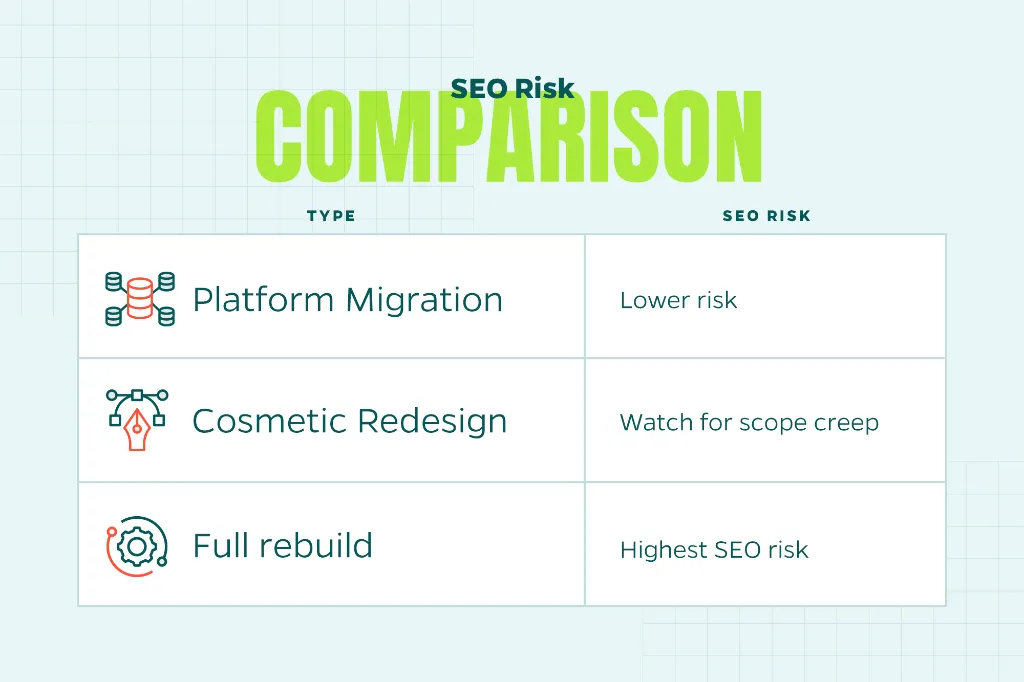
Whether your website is undergoing a platform migration, a cosmetic redesign, or a complete rebuild, these tips are for you.
Google and AI search rely on signals like your URLs, navigation, page content, internal links, technical architecture, and crawlability to understand and rank your website. Those signals have helped build your organic visibility, leads, and revenue over time. Changing them without considering the SEO impact can quickly undo years of progress.
Many redesigns begin as simple visual refreshes but gradually expand to include changes to your site’s architecture. That kind of scope creep is where SEO problems often begin.
A website redesign can be a powerful SEO opportunity, but only when search visibility is built into the project from the start. Bringing SEO in after design or development is complete often means undoing finished work, increasing costs, delaying launch, and putting existing rankings at risk.
Know What’s Already Working
The first objective of any redesign is protecting the organic performance you’ve already earned. Growth comes after preservation.
Before making changes to your website, take inventory of what’s already working. Every high-ranking page, qualified lead, backlink, and conversion represents time and effort you’ve invested in building your online presence. Without a clear baseline, it’s impossible to know whether your redesign preserved those gains or erased them.
Start by identifying your top-performing pages. Document the keywords they rank for, where your organic conversions come from, and which pages have earned valuable backlinks. These insights should influence everything from your sitemap and content strategy to your URL structure.
Tools like Google Analytics 4 (GA4) and Google Search Console provide the data needed to establish these benchmarks before development begins. Recording your organic performance gives you a point of comparison after launch and helps quickly identify any issues that need attention.
The goal isn’t simply to redesign your website. You need to protect the authority and visibility you’ve already earned while creating opportunities to improve it.
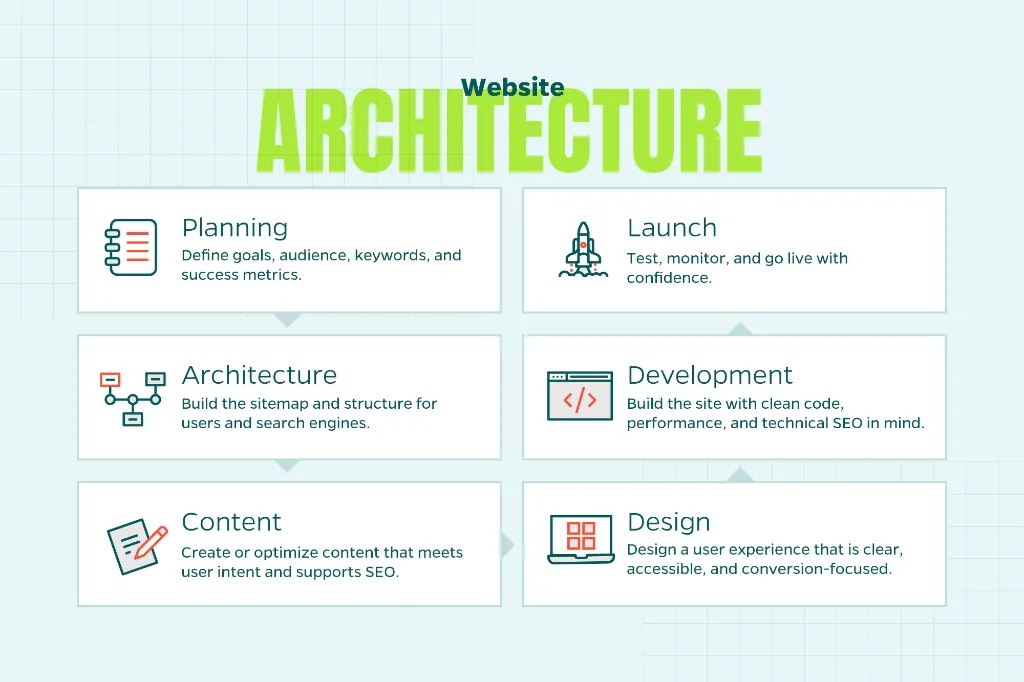
Build the Site Architecture Before You Design It
When possible, preserve these foundational elements for pages that already generate organic traffic:
- Existing pages from the sitemap
- Navigation
- Keyword themes
- User journeys
- Information architecture
These decisions shouldn’t happen in isolation. When SEO and UX shape your site architecture together, the result is a website that’s easier to navigate, easier to understand, and better positioned to perform after launch.
URLs, 301 Redirects, and SEO: What You Need to Know
Whenever possible, keep your existing URLs when launching a new site. If a URL must change but the page still covers the same topic and contains substantially the same content, implement a 301 redirect at the individual page level from the old URL to the new one. It directs visitors and search engines to the correct page, helps Google update its index with the new URL, and preserves as much authority as possible. A properly implemented 301 redirect also helps transfer much of the page’s existing authority, including the value built through backlinks, to the new URL.
Not every removed page should be redirected. If a page no longer exists and there isn’t a closely related replacement, it’s often better to return a 404 or 410 status than redirect visitors to an unrelated page. Redirects should only point to pages that provide a relevant experience for users.
Keep in mind that a 301 redirect preserves the location of a page, not necessarily its rankings. If the content changes significantly, Google may treat it as a different page, and rankings can shift accordingly. That’s why maintaining content consistency is just as important as implementing redirects correctly.
Content Mirroring: The #1 Way to Preserve Rankings During a Redesign
The single most important thing that needs to be done to maintain existing rankings and traffic is to make sure that all page content (for any page bringing in organic search traffic) is identical from the old site to the new site.
Every page should closely mirror its existing title tag, meta description, heading tags, body content, and internal links. Overlooking these elements can result in avoidable SEO losses that require costly recovery efforts after launch.
Modern Website Redesign SEO: E-E-A-T, Core Web Vitals & AI Content
Today’s websites need to do more than preserve existing SEO performance. Search engines have become better at understanding context, intent, and authority, while AI-powered search experiences are changing how content is surfaced and cited. Your website needs to be built for both.
Start with search intent. Every page should answer the questions your audience is actually asking rather than simply targeting individual keywords. High-quality, helpful content that demonstrates Experience, Expertise, Authoritativeness, and Trustworthiness (E-E-A-T) is more likely to earn visibility in traditional search results and AI-generated responses alike.
From there, focus on the technical foundation. Core Web Vitals help ensure your site loads quickly and provides a smooth user experience, while structured data gives search engines additional context about your content. A thoughtful internal linking strategy helps users and crawlers understand how your content is connected, and strong entity optimization reinforces your brand, products, services, and subject matter expertise.
Finally, remember that your content is no longer being read only by people. It also needs to be easy for search engines and AI assistants to interpret and reference. Clear, well-structured content improves machine readability without sacrificing the user experience.
Build your website so people can use it, search engines can understand it, and AI platforms can confidently reference it. By combining a strong technical foundation with authoritative, user-focused content, you’ll be better positioned for today’s search landscape and whatever comes next.
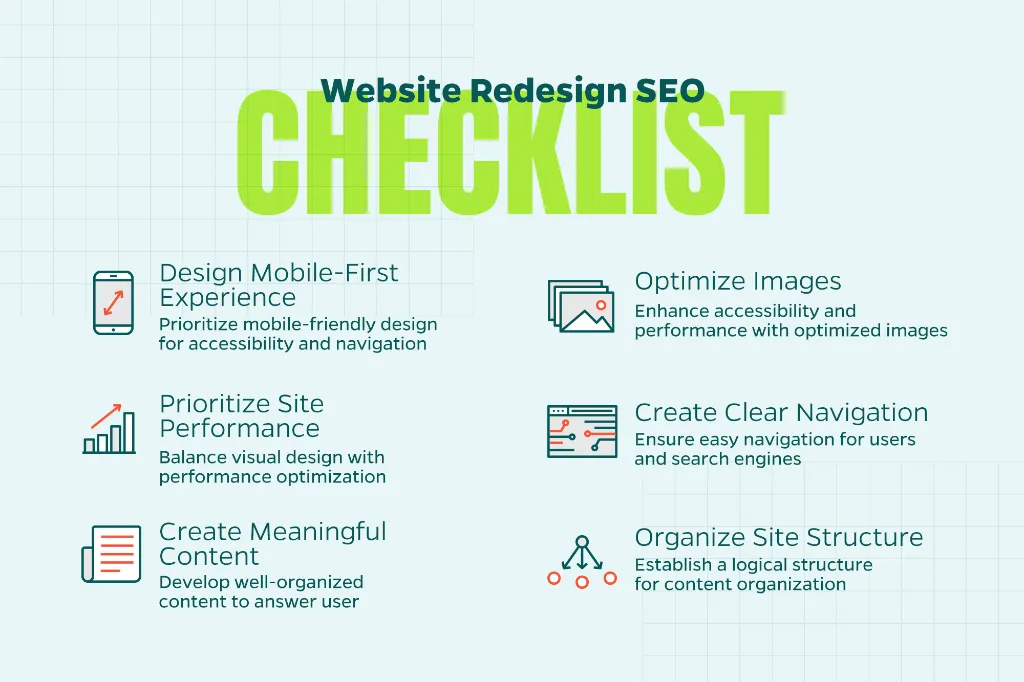
Website Redesign SEO Checklist for Content, Design & Development
Successful website redesigns don’t happen in silos. SEO, content, design, and development all influence how well your website performs after launch. When these teams collaborate from the beginning, it’s much easier to create a website that delivers a better experience for users while maintaining organic visibility.
Technical SEO Before Launch
By the time your new website reaches development, most of the strategic SEO decisions should already be in place. The focus now shifts to validating that everything has been implemented correctly before the site goes live.
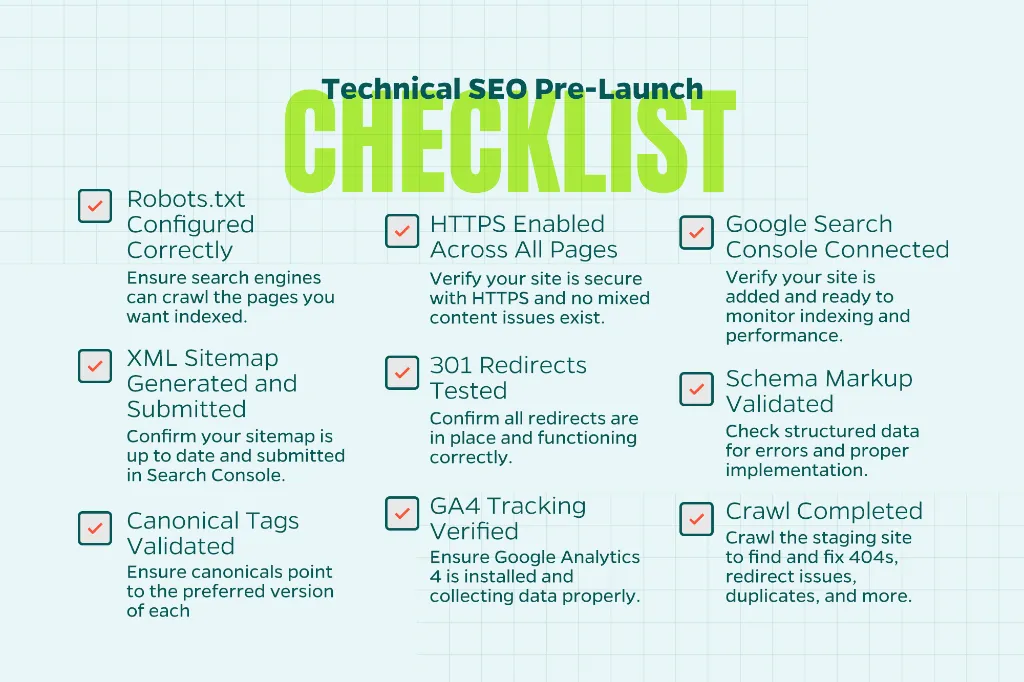
A thorough pre-launch review gives your website the best chance. More importantly, it helps ensure search engines, and increasingly AI-powered search experiences, can accurately understand and surface your content from day one.
Launch Day SEO Checklist: What to Verify Before and After Going Live
Launching a new website is the moment to confirm everything is working as intended. Even small oversights can affect your site’s visibility, tracking, and user experience, so it’s worth taking the time to verify that every critical SEO element made the transition successfully.
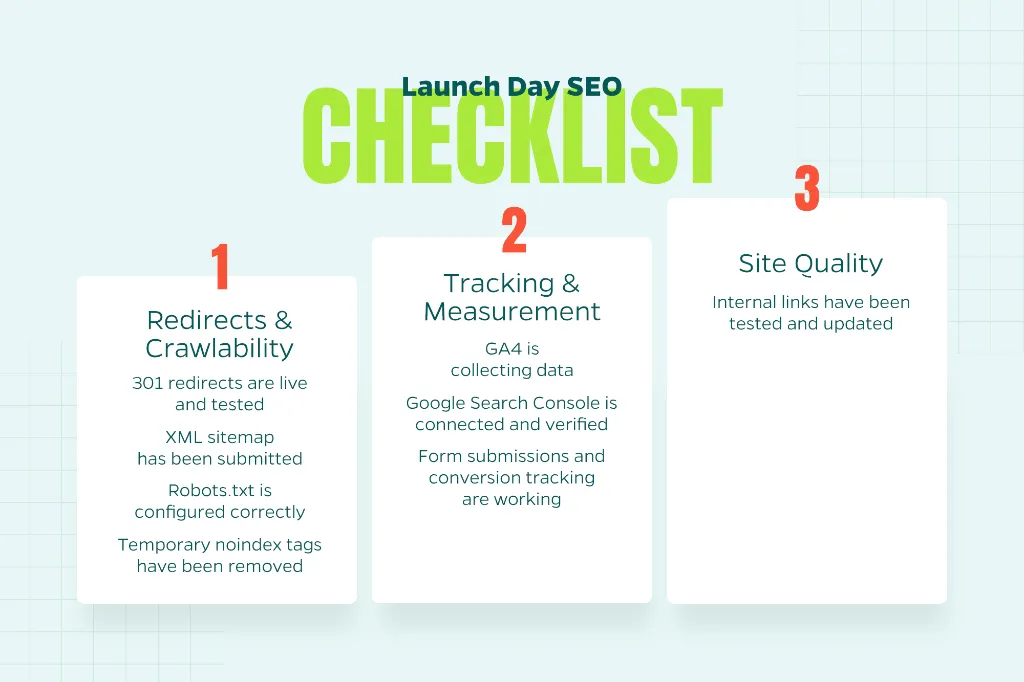
Redirects & Crawlability
☐ 301 redirects are live and tested
☐ XML sitemap has been submitted
☐ Robots.txt is configured correctly
☐ Temporary noindex tags have been removed
Tracking & Measurement
☐ GA4 is collecting data
☐ Google Search Console is connected and verified
☐ Form submissions are being received via email and/or into your CRM
☐ All necessary conversion tracking codes are in place and tested
Site Quality
☐ Final scan for broken links completed and internal links updated
While it’s normal to see some ranking fluctuations after launch, these checks help ensure search engines can accurately interpret and surface your site’s content as quickly as possible.
What Happens After Launch? Post-Launch SEO Checklist
Going live marks the beginning of optimization. Even the most carefully planned website redesign may experience minor ranking fluctuations as search engines crawl, index, and evaluate the new site. That’s normal. The key is monitoring performance closely so you can distinguish temporary fluctuations from issues that require attention.
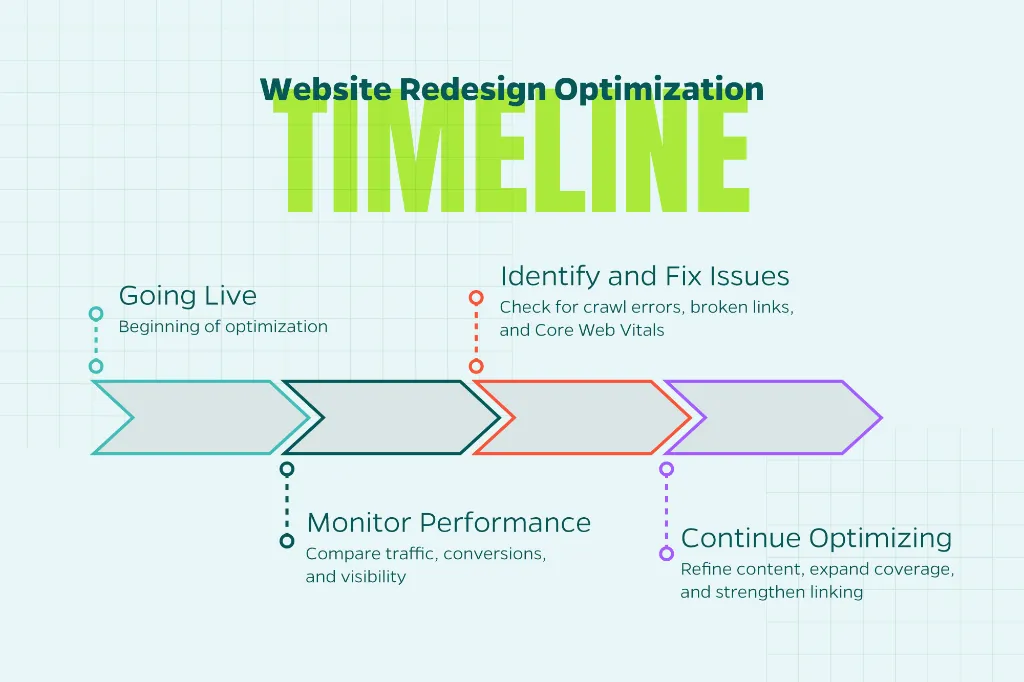
Monitor Performance
☐ Compare organic traffic, conversions, and search visibility against your pre-launch benchmarks.
☐ Review Google Analytics 4 (GA4) and Google Search Console for unexpected changes.
Identify and Fix Issues
☐ Check for crawl and indexing errors.
☐ Resolve broken links and redirect issues.
☐ Monitor page performance and Core Web Vitals.
Continue Optimizing
☐ Refine page content based on user behavior and performance.
☐ Expand content to better address search intent and topic coverage.
☐ Strengthen internal linking across related pages.
☐ Test updates to titles, metadata, and calls to action.
Launch isn’t the finish line. It’s the foundation for everything that comes next. The most successful websites continue to evolve through ongoing measurement, optimization, and content improvements long after the new site goes live.
A Website Redesign Is More Than a New Look
A successful website redesign isn’t measured by how different it looks. It’s measured by how well it performs. When SEO shapes the project from planning through launch, a redesign becomes an opportunity to increase visibility, improve user experience, and build a stronger foundation for future growth. The result isn’t just a better-looking website. It’s a website that’s built to be found, trusted, and chosen.