
LinkedIn is a different kind of platform. The audience skews professional, the targeting is precise, and the cost of entry is notably higher than most other digital channels. That combination can feel intimidating at first. Yet, for B2B companies in the right market, it also means the quality of engagement tends to justify the spend. Before you commit any money, though, it helps to understand how LinkedIn advertising works and what a realistic budget looks like.
This guide breaks down the core components of a LinkedIn marketing budget. We will explore what drives costs and how to think about allocating resources. This will enable you to better use the platform to generate leads and build brand visibility.
Why LinkedIn Costs More Than Other Platforms
The first thing marketers notice when they explore LinkedIn advertising is the cost. Average cost-per-click (CPC) on LinkedIn typically ranges from $5 to $15, and in competitive B2B categories it can climb higher. By comparison, Google and Meta often run significantly lower CPCs. So why does LinkedIn command a premium?
The answer is audience specificity. LinkedIn allows you to target by job title, seniority level, company size, industry, and even specific companies. If your goal is to reach a VP of Operations at a mid-size manufacturing firm, LinkedIn is one of the few places where you can do that with real precision. That kind of targeting carries a higher price tag, and for most B2B marketers, it’s worth it.
LinkedIn also sets a minimum daily budget for campaigns. It is typically around $10 per day. This means there’s a practical floor to what you can spend. Running a meaningful test requires committing at least a few hundred dollars per month, and a competitive campaign usually demands considerably more.
Core Cost Components
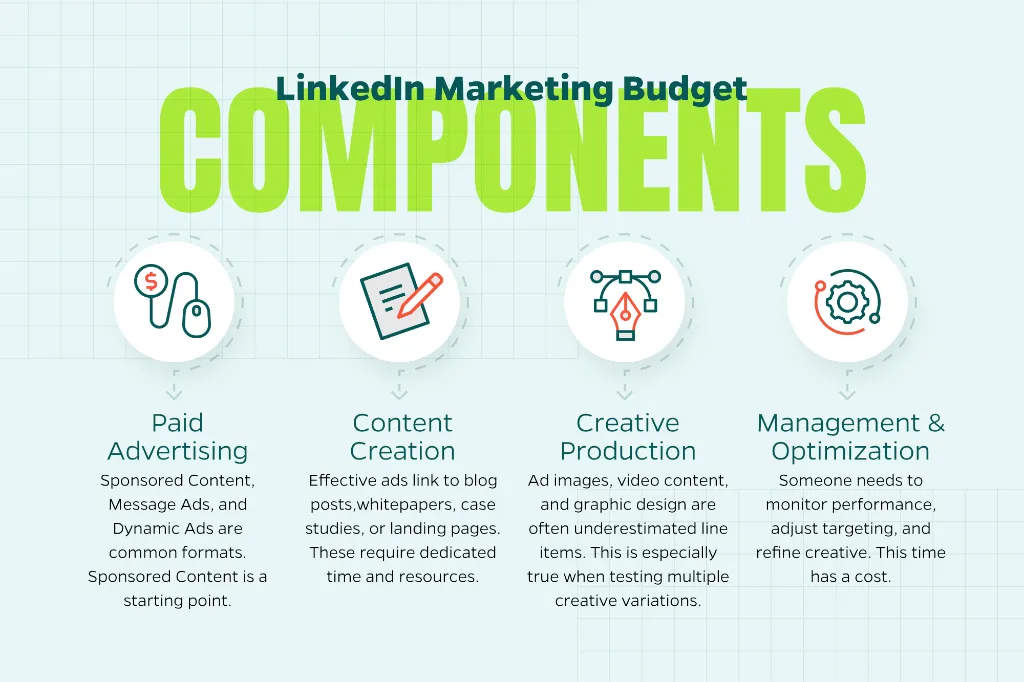
A LinkedIn marketing budget isn’t just ad spend. There are several areas that typically require investment. We will outline those areas below:
- Paid advertising. Sponsored Content, Message Ads, and Dynamic Ads are the most common formats. Sponsored Content, which consists of promoted posts appearing in the LinkedIn feed, tends to be the starting point for most campaigns.
- Content creation. LinkedIn rewards substance. Effective ads often link to blog posts, whitepapers, case studies, or landing pages that require dedicated time and resources to produce.
- Creative production. Ad images, video content, and graphic design are often underestimated line items, especially if you’re testing multiple creative variations.
- Management and optimization. Whether in-house or through an agency, someone needs to monitor performance, adjust targeting, and refine creative. That time has a cost.
What Does a Realistic Budget Look Like?
Budget ranges vary widely depending on company size, objectives, and how aggressively you want to compete. That said, here are some general benchmarks to orient your planning.
For companies just getting started, a monthly ad spend of $1,500 to $3,000 is often the minimum to gather meaningful data. At this level, you can test one or two audience segments and a handful of creative variations. This gives you enough data to learn what resonates before scaling up.
Mid-tier campaigns, where LinkedIn is a consistent part of the marketing mix, often run between $5,000 and $15,000 per month in ad spend. At this range, you have room to pursue multiple audience segments, run A/B tests, and support the campaign with retargeting efforts.
Enterprise-level programs focus on aggressive lead generation or brand awareness goals across multiple verticals. They can run $20,000 per month or more. For organizations in this category, LinkedIn often functions as a primary demand-generation channel, not a supplemental one.
How to Allocate Your Budget Strategically
Once you’ve established a budget, the next question is how to divide it. Below are a few allocation principles that tend to hold up well in practice.
Lead with testing. In the early months, resist the urge to pour everything into a single campaign. Set aside 20 to 30 percent of your budget specifically for testing different audiences, ad formats, and messaging. The insights you gain are worth more than a few extra impressions on an unproven campaign.
Pair ads with content. LinkedIn ads perform better when they point to something useful such as a well-written guide, a case study, or a landing page with a compelling offer. Budgeting for content creation alongside your ad spend is what makes the advertising worthwhile.
Build in retargeting. Most people who see your ad won’t convert on the first exposure. Allocating a portion of your budget — maybe 15 to 25 percent — toward retargeting website visitors or video viewers can meaningfully improve overall return on investment.
Think in quarters, not months. LinkedIn marketing builds momentum over time. A campaign that looks underwhelming at week four may tell a very different story at week twelve, once the algorithm has had time to optimize and you’ve refined your targeting based on early data.
Measuring Value Beyond Cost-Per-Click
CPC is a useful metric, but it shouldn’t be the primary lens for evaluating LinkedIn performance. What matters more is cost-per-lead (CPL) and, ultimately, the revenue generated from those leads. LinkedIn tends to surface higher-quality prospects. These are people with buying authority and relevant roles. Consequently, a higher CPL may still represent a lower cost-per-acquisition compared to cheaper channels that generate more volume but less intent.
Tracking performance requires connecting your LinkedIn campaigns to your CRM so you can follow leads through the full sales cycle. Without that visibility, it’s difficult to make the case for continued investment or to know where to optimize.
It’s also worth noting that LinkedIn has real brand-building value that doesn’t always show up in direct lead attribution. Consistent visibility in a professional feed builds familiarity with your company over time. This tends to shorten sales cycles and improve close rates when the time comes.
Is LinkedIn the Right Investment for Your Business?
LinkedIn isn’t the right fit for every company. If your average deal size is relatively small or your sales cycle is short, the higher cost-per-click may not make sense for you. But for B2B companies selling complex solutions, long-cycle services, or high-value products, LinkedIn is often one of the most direct paths to the decision-makers who matter.
The key is going in with clear objectives, a realistic budget, and a plan to measure results consistently. LinkedIn rewards patience and precision. Companies that treat it as a long-term investment rather than a quick-return channel tend to see the strongest results.
Need Help?
Want to talk through what a LinkedIn marketing budget should look like for your business? Contact Straight North. We help B2B companies build and manage LinkedIn strategies that deliver measurable results.