



Creating quality content takes time, budget, and creative energy. So, it’s important to get as much mileage as possible out of every piece you produce. That’s the core idea behind content repurposing. You take existing assets and adapt them for new formats, audiences, or channels.
Repurposing is a smart, intentional strategy that extends the life of your best work while reinforcing your messaging across multiple touchpoints. When done well, it can significantly improve your content ROI without requiring a proportional increase in resources.
Why Repurposing Content Deserves a Spot in Your Strategy
Most marketing teams work with finite resources. You can only produce so many original blog posts, videos, and white papers in a quarter. Repurposing lets you stretch that output further by transforming one strong piece of content into several related assets.
By repurposing content, you are also extending your reach. Different people consume content in different ways. A reader who skips your blog might stop for an infographic on LinkedIn. A prospect who ignores email newsletters might watch a short video summary of that same content on YouTube. Repurposing puts your ideas in front of more people in their preferred formats.
Beyond format preference, timing matters too. Your audience can’t pay always attention to what you are releasing. A reader might miss your original blog post because they were heads-down on a deadline that week, traveling, or simply overwhelmed by their inbox. Repurposing that content weeks or months later gives you a second chance to reach people who would have valued your content but missed it. Don’t think of it as repeating yourself; you’re just giving them another chance to see your work.
Finally, consistency builds credibility. When your audience encounters the same key messages in a blog post, a podcast episode, and a social media series, those ideas stick. Repurposing is one of the most practical ways to achieve a reinforcing presence.
Strong Candidates for Repurposing
Not every piece of content is worth repurposing, and that’s fine. Your goal should be to identify your highest-performing or most substantive assets and build from there. A few types of content that tend to repurpose well include:
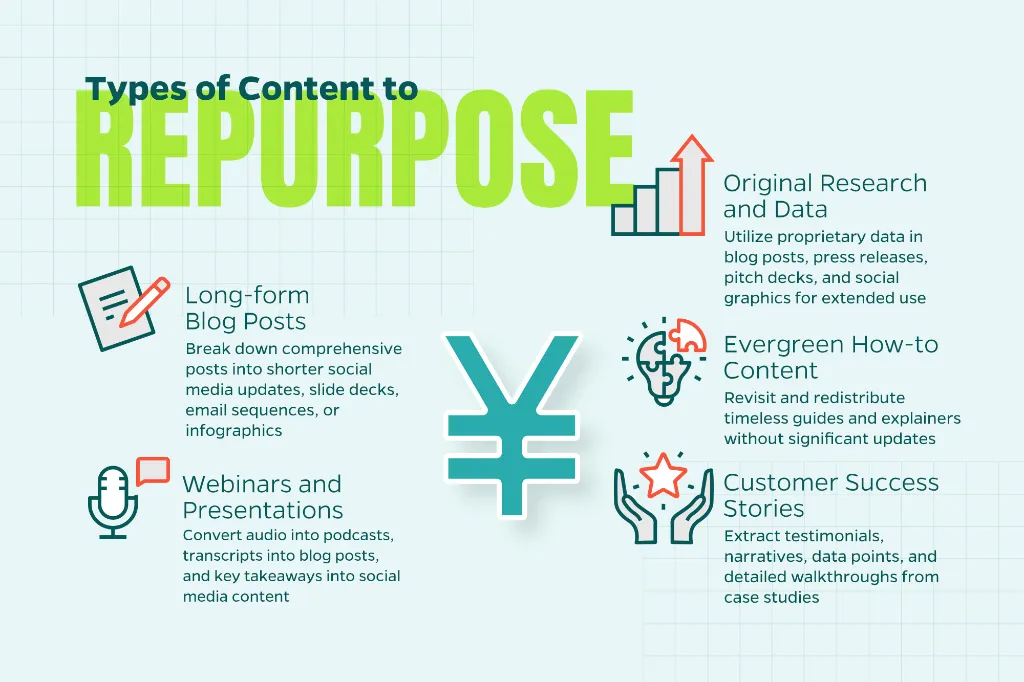
- Long-form blog posts and guides. Blogs work naturally as source material. A comprehensive post on a topic can be broken into a series of shorter social posts, turned into a slide deck, adapted into an email sequence, or condensed into an infographic.
- Webinars and recorded presentations. The audio can become a podcast episode. Transcripts can be edited into blog posts. Key takeaways can fuel a week’s worth of social content. A single 45-minute webinar can power an entire repurposing campaign.
- Original research and data. If you’ve invested in producing proprietary data — through surveys, audits, or case studies — that material has a long shelf life. Charts and statistics can appear in blog posts, press releases, pitch decks, and social graphics across months or even years.
- Evergreen how-to content. Topics that don’t age quickly are ideal for repurposing because you can revisit and redistribute them without heavy updates. Step-by-step guides and foundational explainers hold their value long after their original publication date.
- Customer success stories and case studies. These assets often contain multiple angles worth exploring. A single case study might yield a short-form testimonial for social media, a problem-solution narrative for your email list, a data point for a presentation, and a detailed walkthrough for your blog. The richness of real customer stories makes them particularly well-suited for multi-format treatment.
Common Repurposing Formats
The specific formats you use will depend on your audience and channels, but below are some of the most reliable repurposing moves.
- Turning a blog post into a LinkedIn article or email newsletter is one of the simplest starting points. You’re working with content that already has structure and substance — it just needs to be reformatted for a different context and trimmed to fit reader expectations on that channel.
- Video content opens a lot of options. Short clips pulled from longer recordings work well on social platforms. Transcripts can be cleaned up and published as standalone articles. Even a short explainer video can be turned into a blog post with embedded visuals.
- Slide decks and visual summaries are underused repurposing formats. Taking a data-heavy report or a long-form guide and distilling it into a well-designed visual presentation makes the information more accessible and shareable.
- Quote graphics and pull-out statistics deserve mention here as well. If you’ve published a piece with compelling data points or memorable statements, isolating those elements as standalone visuals can drive significant engagement on social channels. These bite-sized assets are easy to consume and share, and they often direct traffic back to the original source material when used strategically.
- Compilation posts are another option worth considering. If you’ve published several related articles on a topic, a roundup post that links them together with fresh connecting commentary can drive traffic back to older material while providing value for readers who are new to the subject.
A Few Things to Keep in Mind
Repurposing is not a copy-and-paste exercise. Each format has its own conventions, and audiences have expectations for what they encounter on a given channel. A LinkedIn post should not read like a blog post. A video script should not feel like a white paper. Adapting your content means genuinely reworking it, not just moving it.
Context matters significantly. The same core message will need different framing depending on where it appears. A casual, conversational tone might work perfectly for Instagram but fall flat in a formal email to enterprise prospects. Effective repurposing means respecting the norms and expectations of each platform while maintaining your brand voice.
It’s also worth auditing your existing content library before you start. You may have assets sitting on your site that performed well at launch and then quietly faded from view. Strong evergreen content is often the best place to start a repurposing effort. You’ve already done the hard work of researching and writing it.
Finally, track what’s working. Repurposing, like any content strategy, benefits from data. Pay attention to how different formats perform across channels. Over time, you’ll develop a clearer sense of which repurposing combinations drive the most engagement and contribute to the pipeline. You might discover that your audience loves video summaries but ignores infographics, or that LinkedIn carousels consistently outperform static posts. Let performance inform your repurposing priorities going forward.
Need Help Repurposing Content?
The most effective content teams don’t think about repurposing as an afterthought. They build it into their planning process from the start. If you’re looking to build a more strategic approach to content repurposing, Straight North can help. Contact us today to learn how we can help maximize the value of your content investment.