


A five-star rating is great to have. But a business with five reviews from three years ago and one with fifty reviews trickling in every month tell Google two very different stories. Only one of them signals a business that customers are actively choosing right now. That steady drip of new feedback is called review velocity, and it plays a bigger role in local search rankings than most business owners realize.
If your local SEO strategy stops at “collect reviews and move on,” you’re leaving one of the more accessible ranking signals on the table. Here’s what review velocity means, why it carries weight with both Google and customers, and how to build a review pace that keeps paying off.
What is Review Velocity?
Review velocity refers to the rate at which a business collects new reviews over time, rather than the total count sitting on its profile. A landscaping company with 80 reviews spread evenly over the last two years has a healthier velocity than a competitor with 200 reviews, most of which arrived during a single promotional push four years ago and nearly none since.
Google’s algorithms pay attention to this pace because it doubles as a freshness signal. A business earning new reviews regularly appears to be operating, serving customers, and staying relevant. One that went quiet after an early burst can look stagnant, even if the underlying business is thriving.
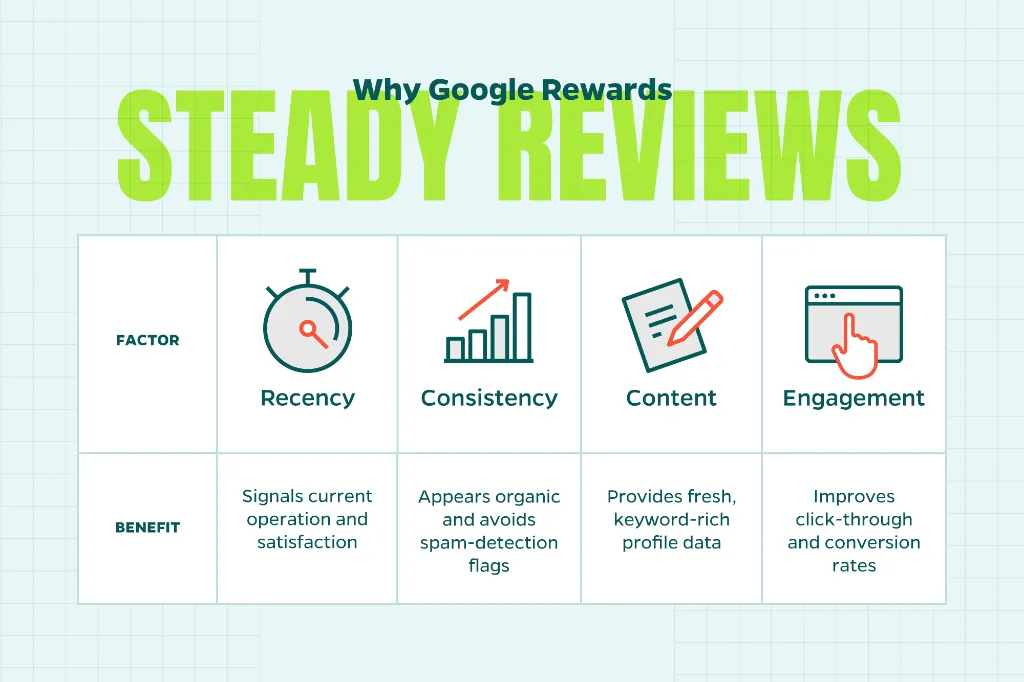
Why Google Rewards a Steady Pace
Local search ranking factors are famously murky, but review signals sit near the top of nearly every study on the subject. Review velocity contributes to that ranking picture in a few specific ways:
- Recency as a trust signal: Recent reviews tell Google’s algorithm that the business is currently operating and satisfying people, not coasting on a reputation built years ago.
- Consistency over spikes: A slow, steady flow of reviews looks organic. A sudden surge of twenty reviews in one week, followed by silence, can look engineered. This raises red flags for Google’s spam-detection systems.
- More content to work with: Reviews often contain the exact phrases customers use to describe services and locations, feeding fresh, keyword-rich content into a Google Business Profile without any extra work from the marketing team.
- Stronger click-through and conversion rates: Shoppers scanning a map pack tend to favor listings with recent activity, since a review from last month feels more reliable than one from 2021.
The Trust Factor Behind the Rankings
Rankings aside, review velocity shapes how a business comes across to the people reading it. Most consumers scroll past the total star rating and check the dates. A profile with reviews dated across the past few weeks reads as a business that’s busy, dependable, and worth a call today. A profile where the newest review is a couple years old raises a quiet question: is this place even still around?
That hesitation matters most for service businesses — home repair, healthcare, legal services — where the cost of picking the wrong provider feels high. Customers use recent reviews as a shortcut for “someone like me just had a good experience here,” and that shortcut only works if the reviews keep coming.
Building a Sustainable Review Pace
The goal isn’t to chase a review a day. It’s to build a repeatable process that keeps new feedback flowing without relying on one-off campaigns. Here are a few approaches that tend to work well:
- Ask at the right moment: Request a review right after a service is completed or a purchase is made, when the experience is still fresh and satisfaction is at its peak.
- Automate the request, not the message: Text or email follow-ups can be triggered automatically through a CRM or scheduling tool, but keep the wording personal so it doesn’t read like a mass blast.
- Spread requests across your customer base: Rather than emailing every past customer on the same day, stagger requests across weeks so new reviews land on a rolling basis instead of all at once.
- Make leaving a review effortless: A direct link to the review form, sent through a text message or QR code, removes friction that would otherwise cause a happy customer to put it off and forget.
- Train frontline staff to ask: Technicians, front-desk staff, and account managers are often better positioned than a follow-up email to ask for a review in the moment, especially after a visibly positive interaction.
Mistakes That Undercut Review Velocity
A few habits quietly work against the steady pace businesses are trying to build. Review gating, which is sorting customers by their expected rating and only asking the happy ones to post publicly, violates most platform policies and can result in reviews being filtered out or removed entirely. Buying reviews or trading them for discounts creates a burst that looks unnatural and can trigger a platform’s spam filters. And going silent for months after an initial push, then scrambling to catch up with a flurry of requests, recreates the exact spike-and-drought pattern that undermines the trust signal in the first place.
The businesses that benefit most from review velocity treat it as an ongoing habit built into daily operations, not a task assigned once a quarter.
A Small Habit with Outsized Returns
Review velocity won’t replace the fundamentals of local SEO. An optimized Google Business Profile, accurate citations, and quality backlinks still matter enormously. But it’s one of the few ranking factors a business can influence almost entirely through its own day-to-day operations, without waiting on an algorithm update or a competitor’s misstep. Building a steady, believable flow of new reviews takes little more than a consistent process and a bit of follow-through. The payoff shows up in both search rankings and the confidence of every customer scrolling through a map pack before they pick up the phone.
Need Help?
Want help turning review generation into a consistent part of your local SEO strategy? Contact Straight North to learn how we can help.