



Our lives run on repeatable sequences that make sense: our own personal order of operations. Wake up, shower, get dressed. Or maybe you get up, let the dogs out, feed them, then start getting ready. Over time, these small behaviors become routines that create predictability and a feeling of control.
For years, SEO operated with a similar predictable flow. Traditional KPIs followed a predictable, chronological pattern: rank → traffic → conversions. Ranking led to visibility, visibility produced traffic, and traffic created conversion opportunities. In turn, user behavior mapped neatly to this journey: people searched → saw the brand → clicked → learned → converted.
But that pattern is shifting.
I recently chatted with AI and Search SEO expert Tom Lustina about how SEO is evolving, and why visibility has become the most critical part of the game.
“You couldn’t get conversion without traffic, and you couldn’t get traffic without rank.”
Why Traditional KPIs Used to Work So Well
Traditional KPIs made sense because they matched real user behavior. Everything depended on a simple chain: rank leads to traffic, and traffic leads to conversions.
Imagine you’re online looking for a new microwave. You type in, “top microwave brands,” skim the rankings, and click the one that catches your eye. Now you’re on the brand’s site, reading, comparing, and getting answers. At that point, a conversion could happen naturally at any stage.
For years, this was the standard flow: predictable, linear, and easy to measure. As the landscape continues to change, so do the KPIs.
How SEO KPIs Are Changing
The zero-click search has changed the game for user behavior. Today, users often learn what they need directly on the results page, especially through:
- Featured snippets
- AI Overviews
- SERP enhancements
- AI Mode/other AI platforms
Because users can learn so much without leaving the SERP, the decision to connect with a brand now happens before the click. They keep seeing the brand, the brand keeps answering their questions, and trust is built right there on the results page.
Today, instead of having to click through to a site to learn, a user learns on the results page. So, there are no longer clicks in order to learn. You’re learning on the results page, and that user is deciding to connect with the brand because they keep seeing that brand in the results because that brand is answering their questions, there is a decision on the results page to connect with that brand. So then, what’s happening is that user is clicking through specifically to connect with that brand. And that might be within that search there, or it might be within a brand search. We’re seeing brand searches go up, we’re also seeing homepage traffic go up, which is clear evidence of that behavior, that a decision is being made to connect with the brand on a results page, and then that click is when they are ready to connect to the brand.
So, what does that mean for the traffic coming to your site?
How Conversions Still Happen With Less Traffic
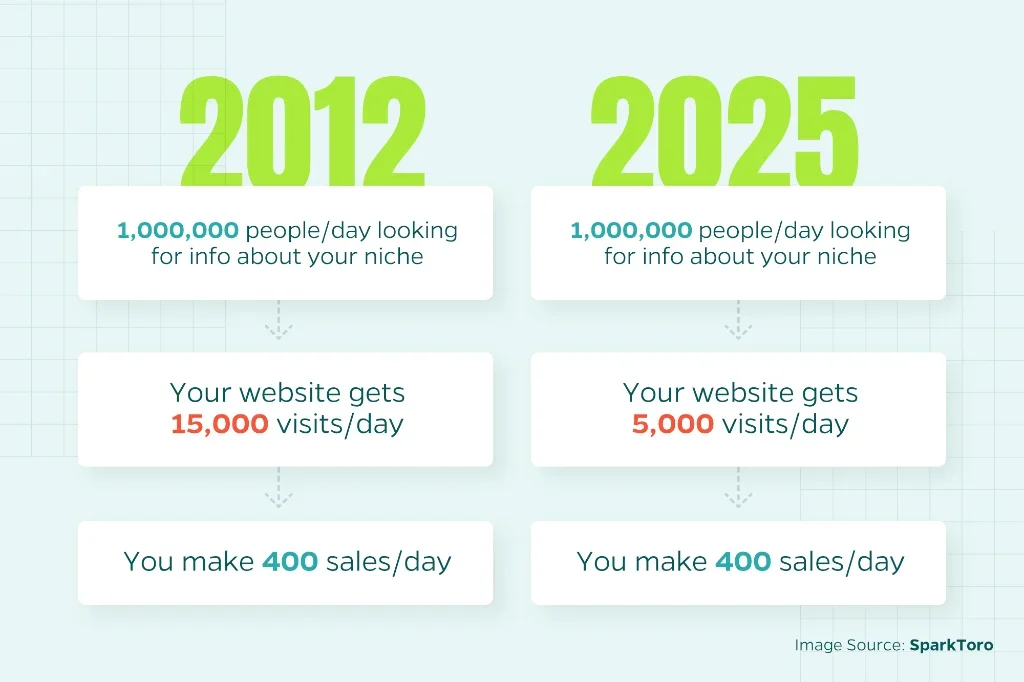
It’s not that the size of the search audience has changed, it’s that learning now happens on the SERP instead of your website.
SparkToro has this great visual to help emphasize this point. And you look at, say, the same vertical, same amount of people searching 10 years ago, or 15 years ago, versus today, if there’s a million people searching within your vertical and you’re ranking well, 15,000 of those people might end up on your site and learn more. Those 15,000 people, maybe 400 of those people are going to decide to connect to you, and there’s your conversion. Let’s say today, it’s those same million people, they’re learning on the results page, and you’re involved in that. You’re ranking well, so they’re learning from you, but it’s on the results page from those people, 5,000 of those people are going to come to your site instead of the 15,000. And then, let’s say, 400 of them connect. So, it’s still that same path, it’s just way less dependent on the traffic. You ultimately do not have to click through to the site unless you’re ready to connect. So, you’re a way more qualified user regardless of the amount of traffic. You’re ultimately going to end up with the same amount of conversion, hopefully even more, but it’s still based on that same pool and being visible to that pool, rather than them coming to your site to learn, they’re learning on their results page.
What this means:
- Same total audience
- Same pool of potential buyers
- Fewer site visits (because people learn off-site)
- But the same, or higher, conversions
Because users click only when ready, the traffic you do get is significantly more qualified.
Can Conversions Happen Without Traffic?
Simply said, “yes.” We very well might be heading from zero click to zero human traffic. We are already seeing conversion with less traffic. That’s in part because of agentic search.
Agentic Search (AI Doing Multi-Query Research Automatically)
Consider query fan-out. ChatGPT and AI mode are searching on your behalf. A single user question can trigger 15–30 separate searches, all processed by AI and synthesized into one complete, authoritative answer rather than singular quoted text.
Now consider agentic browsing taking it one step further: the AI agent will complete a shopping or form-filling task entirely for a human.
Agentic Browsing: AI Literally Clicking, Navigating, and Shopping for You
While it may seem far away wherein the human is removed from the equation, it’s already in the works. Picture shopping for sheets: queen-sized, 1,000 thread count, navy blue. You enter the criteria, and the AI agent scans your favorite shopping site, finds the best option, places it in your shopping cart, and prompts you to place the order. This already happens within Atlas, ChatGPT’s browser.
It will take time for humans to be comfortable with AI completing an entire purchase journey on their behalf, so today we can watch within browser for reassurance and then complete the final click by hand. In the future, you won’t need to watch. AI will just autonomously perform conversions for you.
“It’s not just less traffic, it’s no longer a need for human traffic, because we will become so reliant and comfortable with agentic behavior to actually handle the conversion on our behalf.”
When this happens, we’ll also need to update our analytics models to include “agentic attribution” or something similar, as it will eventually supplement traffic-based metrics.
KPIs will change even more with the agentic search and browsing, so SEO experts will need to adapt as well.
Tying Conversions to SEO
Even in an AI-driven, zero human traffic world, SEO’s purpose will remain the same: Be visible everywhere decisions are made.
As agentic behavior increases, analytics will adapt. We don’t yet know what “agentic attribution” will look like, but we know what matters today:
But it still will be that same visibility game for us. It’s still our job to make sure, through focusing on fanout, that we’re visible for all of the different searches that ultimately lead to a conversion. And from an authority standpoint, we’re still within all of those different sources where the AI platform is acting on your behalf. So, if you’re allowing… if your audience is allowing an AI platform to act on your behalf on a certain site, you need to be there. So then, what results is, you’re on the results page because of query fan-out. You’re also in all of those sources, all of those places where that agent might act on your behalf, which is still the same SEO game that it always should have been.
The SEO game remains rooted in:
- Authority
- Relevance
- Topical completeness
- Visibility across the query fan-out
Why Brands Should Still Care About SEO
Decisions still happen on the SERP. It could be a human browsing, or it could be an AI agent browsing. Whatever the case, visibility remains fundamental.
If you’re not present where and when learning happens, you’re not considered when decisions happen.
How Do You Know SEO Is Working for Your Brand?
The next generation of KPIs will focus on:
Visibility Metrics (Today’s KPIs)
- Theme visibility
- Impression share
- Query coverage
- Ranking across the query fan-out
- Share of voice in zero-click experiences
Agentic Attribution (Future KPI)
Metrics that measure how often AI systems:
- Access your content
- Represent your brand
- Use your information to complete tasks
- Perform conversions without a human click
Over time, analytics will need to separate human clicks from AI-initiated actions, giving us a clearer path to attribution.
Key Takeaways
- Traditional KPIs (rank → traffic → conversions) no longer reflect how people search.
- Zero-click search means users learn on the results page, not your website.
- Conversions can remain stable even with much less traffic because visitors are more qualified.
- Agentic search/browsing will drive conversions without human clicks.
- SEO is now a visibility game, and future analytics will measure AI-driven (agentic) attribution.
Users still want to look at the shopping cart and then click. At some point, we’ll be totally comfortable with all of this, and not need to look at the shopping cart anymore. And that could already happen today, but it’s human comfort getting there versus AI technology being there.