


Every business wants more leads. But the days of simply running ads and hoping people call you are long in the past. Today’s buyers do their homework before they ever reach out to a company, and they tend to gravitate toward brands that offer real value along the way. That’s where long-form content like white papers, guides, and eBooks comes in. Used strategically, these assets do two things at once: they establish your authority and give prospects a reason to share their contact information with you.
Have you been sitting on the idea of building these content assets but aren’t sure where to start? Or have you created them before but haven’t gotten the results you expected? No matter your background, this post will walk you through why these forms of content marketing work and why.
Why Long-Form Content Generates Leads
Short-form content — blog posts, social media updates, short videos — is great for building awareness and keeping your brand visible. But it rarely gives someone a compelling enough reason to hand over their email address. Long-form content is different. A well-crafted white paper or eBook signals that you have something substantial to offer. Something worth a small exchange of information.
The exchange of offering contact information for content is the core of what marketers call a “lead magnet.” You create something genuinely useful, you gate it behind a simple form, and in return, you get a qualified lead. Someone who downloads a guide titled “The B2B Buyer’s Guide to Choosing an IT Services Partner” is almost certainly further along in the buying process than someone who clicks on a general blog post. That self-selection is enormously valuable. You are receiving information from someone who is swiftly becoming a qualified lead.
These assets also have staying power. A good white paper can generate leads for months or even years after it is published, especially if it’s optimized for search and promoted consistently.
White Papers, Guides, and eBooks: What’s the Difference?
White papers, guides, and eBooks are often used interchangeably, but they do serve different purposes. Understanding those unique use cases can help you choose the right format for your goal.
White papers are research-heavy documents that take a deep dive into a specific problem or industry topic. They work best when you’re trying to establish thought leadership or support a complex buying decision. A white paper might analyze industry data, compare approaches to a challenge, or lay out a compelling case for a particular solution. They tend to appeal to decision-makers who want substance before they commit.
Guides are more practical and action oriented. Think of guides as instructional content — the kind of thing someone bookmarks and uses as a reference. A guide might walk a reader through a step-by-step process, explain how to evaluate vendors, or outline a framework for approaching a challenge. They’re highly shareable and work well across a range of industries.
eBooks tend to be longer, more visually designed, and written in a more accessible tone. They’re a good fit when you want to educate an audience on a broader topic or provide comprehensive coverage of a particular subject. eBooks often do well at the top of the funnel, drawing in prospects who are just beginning to explore a topic.
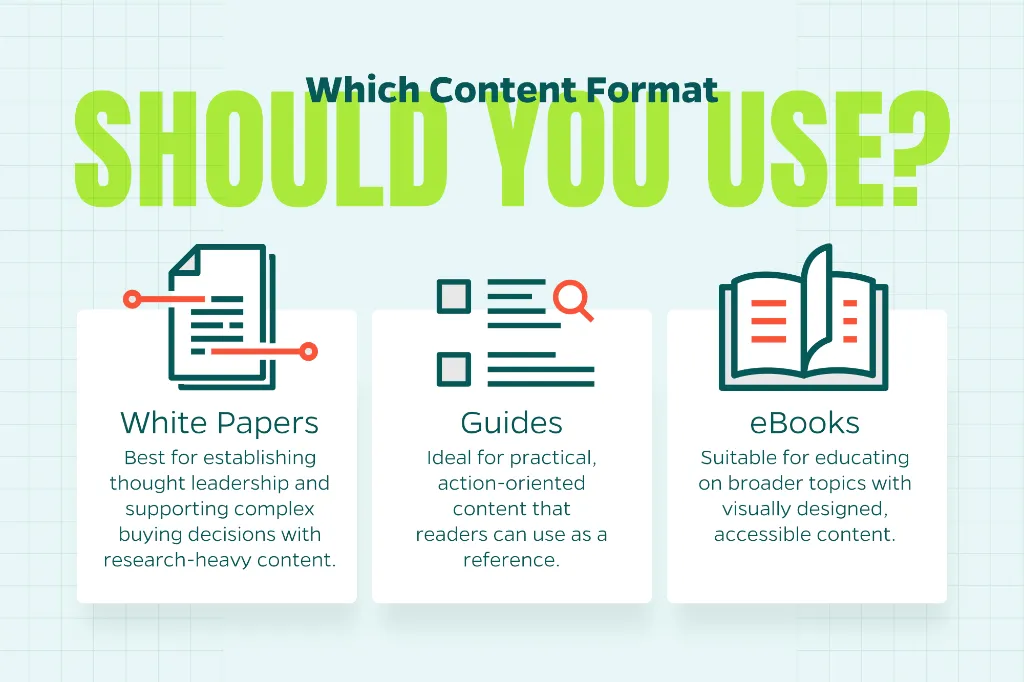
So, what is the right choice between these formats? Obviously, that depends on your audience. You should consider where they are in the buying journey and what you’re trying to accomplish. Often, a smart content strategy uses all three.
Making Your Content Worth the Download
A lot of companies go wrong by creating content that’s more of a sales brochure than a useful resource. Readers spot that immediately, and it destroys credibility rather than building it. If your eBook is merely a long pitch for your services, people won’t finish reading it — and they certainly won’t remember you favorably.
The content that performs best genuinely solves a problem or answers a question your target audience is wrestling with. That means starting with your audience before you start writing. Here are a few examples:
- What do your best customers struggle with?
- What questions come up repeatedly in sales calls?
- What does someone need to understand before they’re ready to buy from you?
Those are the seeds of strong lead magnet content.
Once you’ve landed on a topic, the execution matters just as much as the idea. Poorly written, disorganized, or visually unappealing content reflects negatively on your brand. Investing in professional writing and design can separate assets that convert from ones that collect digital dust.
Building Your Lead Capture Strategy
Creating the content is only half the battle. You also need a smart system for capturing and following up with the leads it generates.
Start with a dedicated landing page for each asset. This page should clearly explain what the reader will get, why it’s valuable, and what to expect after they submit their information. Keep the form simple — typically, name and email address are enough to get started. The more fields you add, the lower your conversion rate will be.
Once someone downloads your asset, following up matters enormously. A well-timed email sequence can provide additional value. For example, you could offer your prospect related articles, a case study, or an invitation to connect. This can nurture that lead from awareness to consideration without being pushy. The goal is to stay helpful and relevant, not to pounce the moment someone fills out a form.
Think carefully about where you promote your lead magnets, too. Your blog is an obvious channel, but consider social media, email newsletters, paid campaigns, and even partnerships with industry publications. Each additional channel expands your reach and increases the return on the content you’ve already created.
Measuring What’s Working
Like any marketing investment, long-form content needs to be tracked. Landing page conversion rates, download volume, and email engagement metrics will tell you whether your assets are resonating. Further down the funnel, you’ll want to know how many of those leads are progressing to conversations and, ultimately, becoming customers.
If an asset isn’t performing, the problem could be the topic, the title, the landing page copy, the promotional channels, or some combination of these. Approach it like any other marketing experiment — identify the variable, test a change, and measure the result. Over time, you’ll develop a clearer picture of what your audience responds to and can build your content strategy around what works.
Tying It All Together
Creating content matters in 2026 as much as ever. White papers, guides, and eBooks require thoughtful planning, quality execution, and a solid distribution strategy. But when done well, they’re among the most effective tools available for attracting qualified prospects and moving them through the funnel.
The businesses that win with this type of content are the ones that commit to genuine value. They write for their audience, not for themselves. They invest in quality. And they treat each piece of content as part of a larger strategy rather than a one-off project. If your business is ready to build content assets that generate leads, the strategy is clear.
Want to Learn More About Marketing Lead Generation?
If you are interested in how Straight North can help your digital marketing efforts, contact us today.