



If you work in manufacturing, distribution, or another industrial sector, explaining what you do is hard to convey in writing. Complex machinery, multistep processes, and highly technical products don’t always translate well to an informational brochure. That’s why video has become one of the most effective marketing tools available to industrial companies. Video shows rather than tells. In a field where clarity matters, that distinction makes an enormous impact.
In the article below, we will explain why video works so well for industrial marketing and offer best practices on how to best use it to your advantage.
Why Video Works for Industrial Marketing
Industrial buyers are thorough. They research extensively, consult multiple stakeholders, and evaluate vendors carefully before committing to a purchase decision. By the time someone reaches out to your sales team, they’ve likely already formed an opinion about whether your company can do the job.
Video accelerates that evaluation process in your favor. A two-minute plant tour can demonstrate capabilities that would take 10 pages of copy to describe — and even then, the written version wouldn’t be as convincing. Seeing equipment in motion, hearing from engineers on the floor, or watching a product withstand a stress test builds confidence in a way that static content simply cannot.
There’s also a practical benefit to your SEO strategy. Search engines give preferential treatment to pages that keep visitors engaged. Video is one of the most reliable ways to extend time on page. When your prospects spend more time on your site watching a capabilities video or a product demo, it sends a positive signal that can improve your search rankings over time.
Video Types That Perform Well in Industrial Marketing
Not every video format is the right fit for every goal. Here’s a look at the formats that tend to generate the most traction for industrial companies.
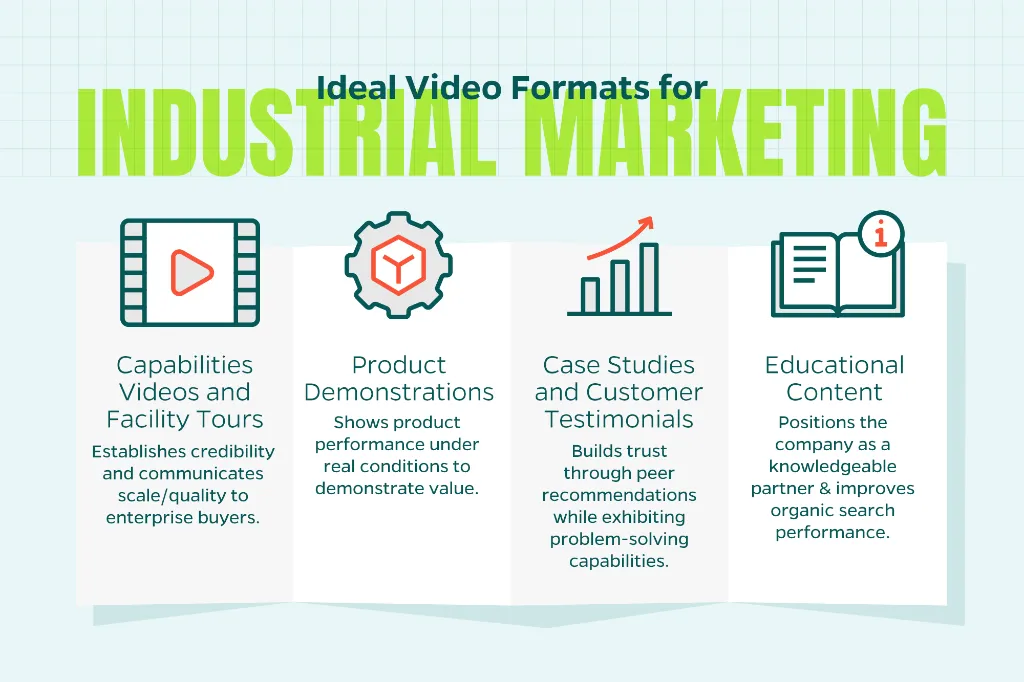
Capabilities Videos and Facility Tours
These videos establish credibility with prospects. A well-produced facility tour communicates scale, equipment quality, and operational discipline. It’s one of the most persuasive things you can put on your website, particularly if you’re targeting enterprise-level buyers who are assessing supplier risk.
Product Demonstrations
If your product has a performance story — load capacity, precision tolerances, speed, durability — you should show it. Product demo videos are particularly effective for industrial distributors and manufacturers because they eliminate ambiguity. When a buyer can see exactly how something performs under real conditions, it removes objections early in the sales cycle.
Case Studies and Customer Testimonials
Industrial buyers trust peers. A customer testimonial from a recognizable company in their industry carries far more weight than any claim you make about yourself. Video case studies that walk through a specific problem and explain how your team solved it are especially compelling, because they mirror the evaluation process a new prospect is already going through.
Educational Content
Informational videos can teach something useful. This could include how to maintain a piece of equipment, how to troubleshoot a common issue, or how to select the right specification for a given application. These videos position your company as a knowledgeable partner rather than just a vendor. They also tend to perform well in organic search, particularly when they’re aligned with the questions your customers are already typing into Google.
Where to Distribute Your Videos
Creating the video is only half the equation. Where you put it matters just as much.
Your website should be the primary destination. Embedding video on relevant service or product pages keeps it contextually relevant and gives it the best chance of influencing a buying decision at the right moment. YouTube is also worth investing in. As the second-largest search engine in the world, industrial buyers absolutely use it to research suppliers and products.
LinkedIn is another strong channel for industrial companies, particularly when the goal is to reach procurement managers, engineers, or operations leaders. Short video clips shared as organic posts or promoted through paid campaigns can expand your reach into accounts that wouldn’t have found you otherwise.
Don’t overlook email, either. Including a video link in a nurture sequence or a follow-up email to a prospect can increase engagement significantly. Even the word “video” in a subject line tends to lift open rates.
Common Concerns and How to Address Them
Many industrial companies put off video marketing because they assume it’s too expensive, too complicated, or too time-consuming. Those concerns are understandable, but they’re often overstated.
Production quality matters, but it doesn’t have to mean a Hollywood budget. A clean facility, good lighting, and a clear narrative can go a long way. What undermines credibility isn’t modest production values — it’s poor audio, disorganized messaging, or video that doesn’t answer the questions your audience’s questions.
It’s also worth recognizing that a single shoot can yield multiple pieces of content. One facility tour can be edited into a full-length version for your website, a shorter cut for LinkedIn, and several clip segments for email or paid ads. That kind of content leverage makes the investment go considerably further.
Getting Started
The most practical first step is identifying the question your buyers ask most often. What do they need to understand before they feel comfortable reaching out? Build your first video around answering that question clearly and confidently.
From there, think about where that video fits within your broader marketing funnel. A capabilities overview belongs near the top. A detailed product demo or customer testimonial is more appropriate for buyers who are already considering you. Matching the right video to the right stage of the buying process is what turns views into leads.
Industrial companies that commit to video marketing consistently report stronger website engagement, shorter sales cycles, and better-qualified leads. The barrier to entry is lower than most assume, and the payoff compounds over time as your video library grows.
Need Help?
Ready to build a video marketing strategy for your industrial company? Contact Straight North to learn how we can help.