
Messenger ads have become a powerful tool for business. Why? Consumers want real conversations with brands. Not generic messages. Not impersonal ad experiences. Actual dialogue.
As part of Meta’s advertising ecosystem, Messenger gives advertisers the ability to reach customers where real conversations are happening—in a private, immediate, and familiar environment. When done well, Messenger ads blend automation with human connection to create an experience that feels personal at scale.
In this guide, we’ll break down how Messenger ads work and why they matter. You’ll learn how to use these ads to build relationships, capture leads, and drive real results.
Why Messenger Ads Matter Today
Messenger has more than a billion monthly active users globally, with many checking the platform several times per day. People use Messenger to communicate with friends, family, coworkers, and even brands. That makes it an ideal environment for high-intent, one-to-one conversations.
More importantly, messaging has become a preferred communication method for younger audiences and mobile users. Consumers expect real-time assistance, quick answers, and low-friction interactions. Messenger delivers on those expectations better than most channels.
Messenger ads take this one step further by letting brands start or continue conversations directly in the app. Instead of sending users to a landing page or form, these ads open a conversation thread. This creates an instant pathway to engagement.
What are Messenger Ads?
Messenger ads are placements that appear across Meta’s platforms (Facebook, Instagram, Stories, Reels, Marketplace) and open a conversation in Messenger when the user clicks on them.
They fall under two primary categories:
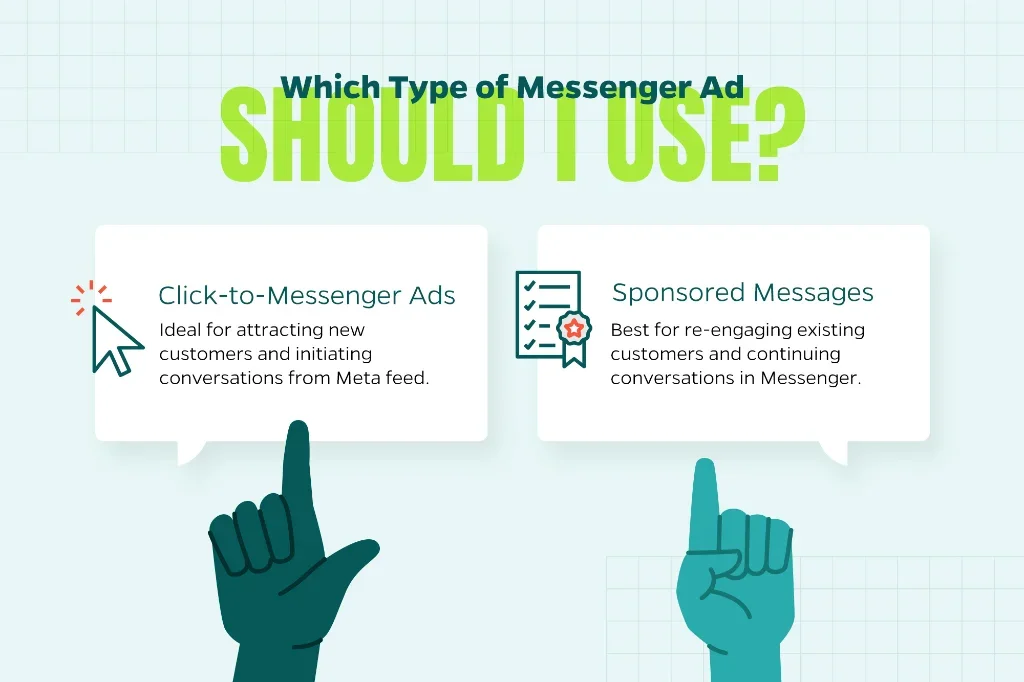
1. Click-to-Messenger Ads
These ads appear in the Meta feed or other placement areas with a call-to-action such as “Send Message.” When a user clicks, they are taken directly into a Messenger conversation with your business. You can then use:
- Automated responses
- Pre-built chat flows
- Human chat agents
- Lead forms
- Website links
- Product catalogs
- Appointment booking prompts
Click-to-Messenger ads are ideal for lead generation, customer inquiries, sales conversations, and customer service.
2. Sponsored Messages
These messages appear directly inside a user’s Messenger inbox. They allow businesses to re-engage people who have previously interacted with them on Messenger. Sponsored messages are perfect for:
- Promotions
- Product updates
- Abandoned-cart reminders
- Personalized offers
- Follow-ups
Because sponsored messages go directly into the inbox, they feel more personal. That said, they must be used carefully to avoid the perception of “spamming” users.
Why Messenger Ads Work So Well
Messenger ads are effective because they solve several common marketing challenges at once.
They Reduce Friction. Instead of sending users to a landing page where they might bounce, Messenger ads open a conversation in a familiar environment. That alone dramatically boosts engagement.
They Create Real-Time Interaction. Users get answers quickly. Businesses can ask qualifying questions, provide recommendations, or resolve objections in real time—leading to stronger conversions.
They Feel Personal. Messenger ads mimic natural conversation. They replace static forms with dialogue. And because many businesses use automation, they can personalize experiences at scale.
They Support Full-Funnel Marketing. Messenger lets businesses guide prospects through every stage. You can introduce your brand and share content at the top of the funnel. You can qualify leads and nurture interest in the middle. And you can drive purchases, bookings, and demos at the bottom. All of this can be done without switching platforms.
Where Messenger Ads Fit in Modern Marketing Strategy
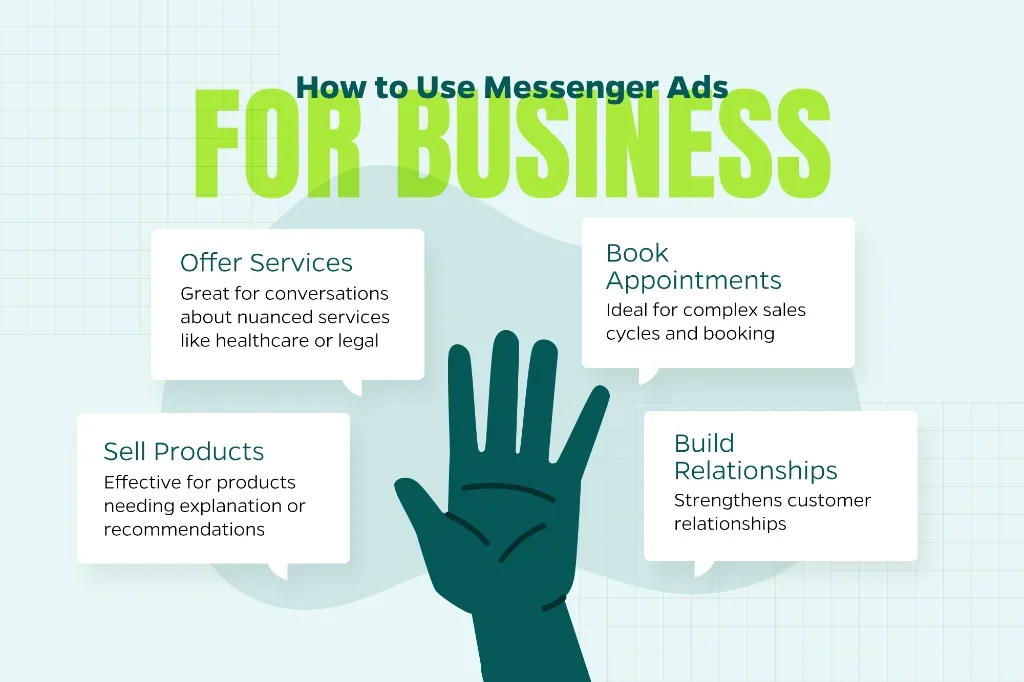
Messenger ads are particularly effective for businesses whose objectives mirror the ones described below:
- Sell products requiring explanation or recommendations
- Offer services that benefit from conversation (such as home services, healthcare, legal, or financial)
- Need to book appointments or demos, or have complex sales cycles
- Want to build stronger relationships with customers
Messenger ads complement other Meta formats. For example, someone may click a Reels ad, view your profile, and then connect with your brand through Messenger to ask questions. Messenger becomes the bridge between ad engagement and conversion.
How to Set Up Effective Messenger Ad Campaigns
A strong Messenger ad isn’t just about the creative or call-to-action. It should convert after a user clicks. To better achieve that goal, take heed of the points listed below.
1. Define the Role of Conversation in Your Funnel
Before building a Messenger ad, determine what you want the conversation to accomplish. Are you capturing leads? Providing quotes? Answering FAQs? Selling a product? Solving customer service problems? Re-engaging lapsed customers? A well-defined objective will guide your automation flows, scripts, and creative.
2. Build Clear and Helpful Chat Flows
Once a user clicks your ad, the Messenger experience needs to be smooth and intuitive. The first message should acknowledge the user, set expectations, and ask a simple question to keep the interaction going.
From there, design a flow that guides users toward your goal with options like “Browse Products,” “Get a Free Quote,” “Book an Appointment,” or “Talk to a Specialist.” A well-structured chat flow reduces abandonment and ensures consistent communication.
3. Blend Automation with Human Support
Automation makes Messenger scalable. But humans make it authentic. A strong approach is hybrid: use automation for FAQs, lead capture, qualifying questions, and routing. Then, bring in human agents for detailed answers, complex problems, or high-value leads. This combination gives users the responsiveness they want and the expertise they need.
4. Create Compelling Messenger-Focused Ad Creative
Messenger ads should set the expectation of conversation. Your creative and messaging should communicate that users can ask questions, that help is available right away, and that they’ll get a more personalized response than on a website. Businesses that clearly promise a helpful conversation tend to generate higher-quality interactions.
5. Use Lead Qualification to Improve Performance
One of Messenger ads’ biggest advantages is efficient qualification. Instead of sending users to long forms, you can capture essential details conversationally—budget, timeline, interests, pain points, service needs, location. This gives sales teams better information and reduces time wasted on low-quality leads.
6. Optimize for Speed and Responsiveness
Consumers expect businesses to respond quickly in messaging environments. Slow replies can cause drop-offs. Use instant automated responses, train your team to monitor Messenger, set business hours in the app, and use saved replies for common questions. Messenger is a “now” channel. You should treat it as such.
7. Leverage Sponsored Messages for Re-Engagement
Sponsored messages are underused but extremely effective for nurturing. Send promos to previous purchasers, re-engage warm leads, follow up on abandoned conversations, share seasonal offers, or introduce new products. However, businesses must pace these messages responsibly. Overuse can feel intrusive. A helpful rule: send sponsored messages only when you have truly valuable information to share.
Best Practices for Successful Messenger Ad Campaigns
Start Conversations, Don’t Pressure Users
The most effective Messenger ads invite users into a dialogue. They focus on helping, not pushing. Ask questions, offer resources, and provide options. The more natural the conversation feels, the more users will engage.
Personalize Interactions Based on User Behavior
Messenger integrates with Meta’s targeting tools, making personalization easier. You can adjust conversation prompts, recommendations, offers, and follow-up messages based on user segments or actions they’ve taken previously.
Keep Chat Flows Short and Intuitive
People lose interest quickly. Avoid long walls of text or multi-step forms disguised as chats. Keep your flows simple, clear, task-oriented, and interactive. If users feel stuck, give them an option to talk to a human.
Be Transparent About How Messaging Works
Let users know whether they’re interacting with automation, how long it may take for a human to reply, and what kind of help they can expect. Clarity builds trust from the first interaction.
Track Conversation Metrics—Not Just Click Metrics
Messenger campaigns require different KPIs than traditional ads. Important metrics include response rate, quality of conversations, lead qualification rate, drop-off points in the chat flow, average reply time, and conversion rate from conversation to sale or appointment. Marketers who analyze conversation data consistently outperform those who only look at clicks or impressions.
Align Sales and Marketing Teams
Messenger often sits in the gray area between marketing and sales. That’s why alignment is crucial. Sales needs visibility into chats, marketing needs feedback on lead quality, teams should define when a lead transitions from marketing to sales, and everyone should understand the chat script and automation flow. When teams are aligned, Messenger becomes one of the most efficient tools for closing deals.
Examples of How Businesses Use Messenger Ads Successfully
Ecommerce brands use Messenger ads to answer product questions, recommend items, promote sales, or recover abandoned carts.
Service-based businesses generate quotes, book appointments, and offer consultations. This approach is ideal for home services, dental, legal, or financial fields.
Local businesses share hours, availability, pricing, and location details instantly.
B2B companies use Messenger to qualify leads more efficiently than traditional forms and connect prospects to sales reps faster.
Healthcare providers answer questions, schedule appointments, and share service information in a private, secure environment.
The Future of Messenger Advertising
Messenger is quickly becoming a central hub for conversational AI, automated customer service, and real-time sales assistance. As Meta continues to invest in messaging tools—including AI chatbots, advanced lead forms, and commerce integrations—Messenger ads will only become more powerful.
Consumers are gravitating toward brands that respond instantly, personalize communication, and make buying easier. Messenger allows businesses to provide that experience at scale.
Final Thoughts
Messenger ads offer something rare in digital marketing: direct, personal dialogue with your audience. They combine the reach of Meta with the intimacy of messaging, creating a channel where businesses can build trust, earn loyalty, and remove friction from the path to purchase.
Want help getting started? Reach out to Straight North. We can help you with a digital marketing plan tailored specifically to your needs.