

It can be difficult to attribute which marketing channel is most responsible for your success. Your Meta ads dashboard says that it is responsible for 50 conversions. Google Analytics shows it should be recognized for 35 of those sales. Your CRM credits email with 20 of the same transactions. The math doesn’t add up. Somehow, though, all three platforms are technically correct.
Welcome to modern marketing attribution. The same conversion can be claimed by multiple channels. Privacy updates have reduced tracking visibility and trying to find a single “source of truth” feels unattainable.
The frustration is real, but the solution isn’t picking one platform’s numbers over another. You should understand why these discrepancies exist and build an attribution framework that turns conflicting data into strategic clarity.
Let’s break down how conversion attribution works across Meta and other channels. We will explore why it’s become more complex and how to build an approach that supports smarter decision-making.
Why Attribution is So Challenging Today
At its core, attribution answers one question: which marketing efforts deserve credit for a conversion?
That question used to be straightforward. A user clicked an ad, filled out a form, done. Now, that same user might:
- See a Meta ad on their phone
- Google your brand a week later
- Click a paid search ad
- Visit your site again via organic search
- Convert after opening an email
Each platform wants credit. Each tool uses different rules. And privacy changes have made it harder to see what happens between touchpoints.
The result is conflicting data and unclear insights.
How Meta Handles Conversion Attribution
Meta (the parent company of social media behemoths like Facebook and Instagram) uses its own attribution framework that operates separately from tools like Google Analytics or your CRM.
Default Attribution Windows
Meta typically attributes conversions based on:
- 7-day click
- 1-day view
This means if someone clicks a Meta ad and converts within seven days—or views an ad and converts within one day—Meta counts that conversion, even if another channel played a role later.
Modeled Conversions and Aggregated Data
With privacy updates like iOS tracking limitations, Meta increasingly relies on modeled data and aggregated reporting. This helps estimate performance trends, but it also means Meta’s numbers may not match what you see elsewhere.
That doesn’t make Meta’s data “wrong.” it just reflects Meta’s view of the world.
Why Other Channels Tell a Different Story
Other platforms use different attribution logic:
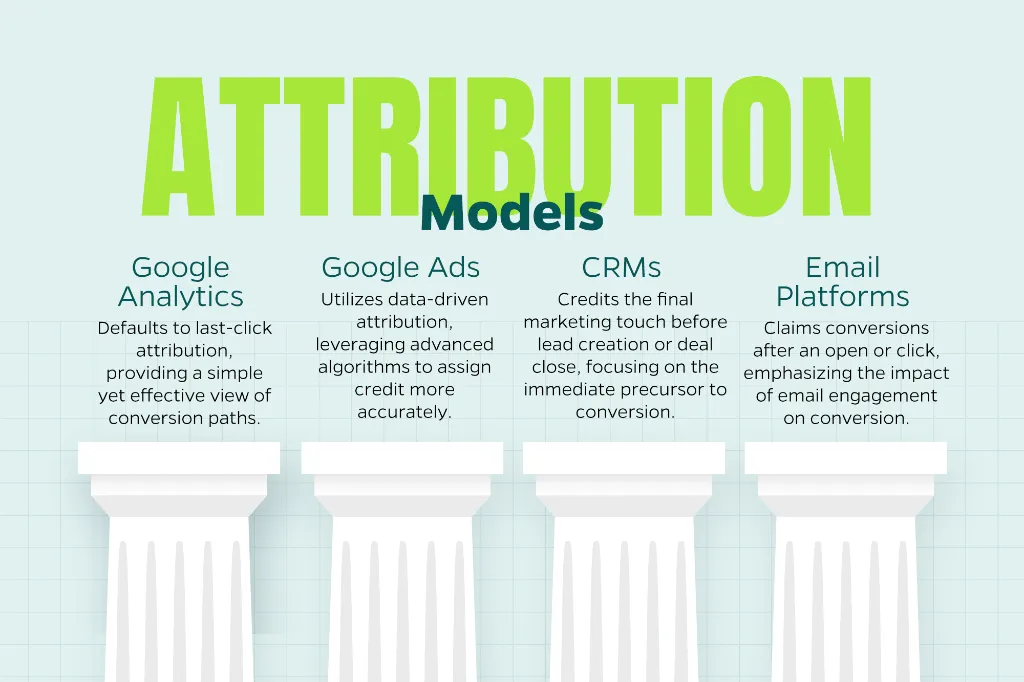
- Google Analytics often defaults to last-click attribution (unless you customize it)
- Google Ads may use data-driven attribution
- CRMs typically credit the final marketing touch before lead creation or deal close
- Email platforms often claim conversions that occur after an open or click
Each system answers a slightly different question. The mistake is assuming they should all match.
Common Attribution Pitfalls to Avoid
Before we get into solutions, let’s call out a few traps marketers often fall into.
Comparing Platforms 1:1
Meta conversions will almost never match Google Analytics conversions exactly. That’s expected. Comparing them as if they should align leads to faulty conclusions and worse budget decisions.
Overvaluing Last-Click Data
Last-click attribution favors bottom-funnel channels like branded search or direct traffic. That can make upper-funnel channels like Meta look less valuable than they are.
Optimizing to One Metric Only
Focusing exclusively on platform-reported ROAS or CPA can cause teams to ignore lead quality, pipeline influence, or assisted conversions—metrics that often matter more.
A Smarter Way to Attribute Conversions Across Channels
So how do you make sense of all this? The answer isn’t finding a “perfect” attribution model. It’s building a practical one that fits your business.
1. Define What Attribution Needs to Do for You
Start by aligning on the purpose of attribution. Is it meant to:
- Guide budget allocation?
- Evaluate channel performance?
- Understand the full buyer journey?
- Report ROI to leadership?
Your answer shapes which models you’ll prioritize and which metrics you’ll track. Without this clarity, attribution becomes a data exercise that doesn’t drive decisions.
2. Use Multiple Attribution Models (On Purpose)
Rather than relying on a single model, look at performance through multiple views:
- Platform attribution (Meta, Google Ads) for optimization
- Last-click or data-driven attribution for efficiency
- Assisted conversions for influence
When you triangulate across multiple views, patterns emerge that individual models can’t reveal. This layered perspective helps you separate signal from noise and make smarter investment decisions.
3. Anchor Reporting in One Source of Truth
Choose one primary system—often Google Analytics or your CRM—to serve as your reporting anchor. This creates consistency, even if you still reference platform-specific data for tactical decisions.
Your anchor doesn’t need to be “right” in an absolute sense. It just needs to be consistent. This gives stakeholders a stable benchmark while allowing you to layer in platform-specific insights where they add context.
4. Connect Marketing Data to Business Outcomes
Whenever possible, tie conversions back to:
- Qualified leads
- Opportunities
- Revenue
Attribution should ultimately connect to revenue impact, not just activity metrics. When you trace conversions through the full pipeline—from initial touch to closed deal—you gain a true understanding of which channels deliver profitable growth, not just high-volume traffic.
This helps prevent over-investing in channels that drive volume but not value.
How Meta Fits into a Holistic Attribution Strategy
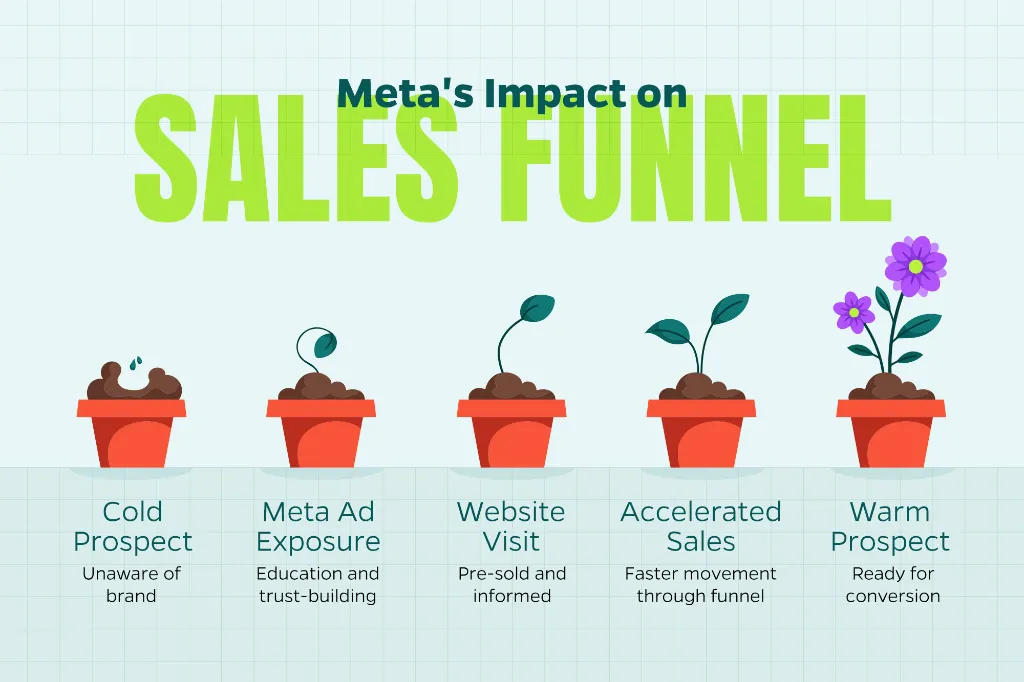
Meta plays a fundamentally different role than bottom-funnel channels like branded search or retargeting. It excels at reaching cold audiences, building awareness, and creating the demand that other channels ultimately capture. Understanding this distinction is critical. Meta doesn’t just assist conversions, it often creates the conditions that make them possible.
When Meta is working effectively, its impact ripples across your entire marketing ecosystem:
- Branded search lift: Users exposed to Meta ads are significantly more likely to search for your brand directly. This drives high-intent traffic that Google Ads or organic search gets credit for, even though Meta initiated the interest.
- Improved conversion rates across channels: Prospects who’ve seen your Meta ads arrive on your site pre-sold and more informed. They convert at higher rates regardless of the final click source, because Meta has already done the heavy lifting of education and trust-building.
- Accelerated sales velocity: When prospects enter your funnel already aware and warmed up by Meta, they move through the buying process faster. What might have been a 90-day sales cycle becomes 60 days. This is a difference that compounds across your entire pipeline.
- Enhanced retargeting performance: Meta campaigns expand your retargeting pools with qualified prospects. The larger, warmer your retargeting audience, the more efficient your remarketing becomes across all platforms. Yet, Meta often doesn’t get credit for seeding that audience.
If you pause or scale back Meta and see branded search, organic traffic, or email conversion rates decline weeks later, that’s evidence of Meta’s halo effect. Last-click attribution misses this entirely. That is why marketers who rely solely on it systematically underinvest in awareness channels and wonder why their overall marketing efficiency plateaus.
Setting Realistic Expectations with Stakeholders
One of the most important (and overlooked) parts of attribution is communication.
Executives and clients need directional clarity. Be transparent about:
- What your attribution model captures well
- What it can’t fully see
- Why numbers differ across platforms
When expectations are set correctly, attribution becomes a decision-support tool instead of a source of confusion.
Final Thoughts
Attributing conversions across Meta and other channels is about understanding roles.
Meta, search, email, and organic traffic all contribute differently across the buyer journey. The goal is to recognize those contributions, not force them into a single, misleading metric.
With the right mindset, tools, and expectations, attribution can move from a reporting headache to a strategic advantage. It can help you invest with confidence across your entire marketing mix.
Need help building an attribution strategy that works for your business? Contact Straight North to discuss how we can help you make sense of your data and optimize your marketing performance across all channels.