

For marketers running campaigns on Meta platforms like Facebook and Instagram, the ripple effects of recent privacy changes have been significant. From Apple’s App Tracking Transparency to the demise of third-party cookies, advertisers face a fundamentally different landscape shaped by growing consumer privacy awareness.
While these shifts have introduced new challenges, they’ve also pushed advertisers toward smarter, more resilient strategies. Let’s explore how privacy changes are influencing Meta advertising and what your business can do to adapt and thrive.
The Evolving Privacy Landscape
Several major developments have reshaped how data is collected and used in digital advertising. Apple’s ATT update gave users more control over app tracking. The result has been clear: fewer people are opting in to share cross-app data. Meanwhile, browsers have tightened restrictions on third-party cookies, and regulators worldwide have introduced stricter privacy frameworks like GDPR and CCPA.
For Meta advertisers, these changes have reduced the amount of user-level data available for targeting and measurement. Attribution windows have shortened, tracking signals are less consistent, and traditional remarketing pools may be smaller than before. This doesn’t mean effective advertising is impossible. It just requires a shift in mindset and tactics.
How Privacy Changes Impact Targeting
One of the most noticeable impacts has been on audience targeting. Highly granular targeting options that relied heavily on third-party tracking signals are less reliable now. As a result, advertisers are leaning more on first-party data and Meta’s machine learning capabilities.
Broad targeting was once viewed as imprecise. Now, it has become increasingly effective when paired with strong creative and Meta’s optimization algorithms. Instead of over-segmenting audiences, many advertisers are consolidating campaigns and allowing Meta’s systems to identify high-value users based on performance signals.
Custom audiences built from first-party data — such as website visitors, CRM lists, and customer email databases — are more valuable than ever. Businesses that invest in collecting and organizing their own data are better positioned to maintain consistent targeting capabilities despite external privacy constraints.
Measurement and Attribution in a Privacy-First World
Accurate measurement is essential for optimizing ad spend. Yet, privacy changes have complicated attribution. With fewer observable user actions, you may notice discrepancies between platform reporting and your own analytics tools.
Meta has responded with solutions like Aggregated Event Measurement (AEM) and modeled conversions, which use statistical techniques to estimate performance where direct tracking is limited. While these tools may feel less concrete than traditional pixel tracking, they still provide actionable insights when interpreted correctly.
The key is focusing on broader performance trends rather than individual data points. Incrementality testing, lift studies, and a stronger emphasis on business outcomes — such as revenue growth and customer acquisition cost — can help paint a clearer picture of campaign effectiveness.
The Growing Importance of First-Party Data
If there’s one consistent theme in privacy-driven advertising changes, it’s this: first-party data has become your most valuable asset. Businesses that actively collect customer information through website interactions, lead forms, email subscriptions, and loyalty programs gain a strategic advantage.
Meta’s Conversions API (CAPI) is a critical tool in this environment. By sending event data directly from your server rather than relying solely on browser-based tracking, CAPI improves data reliability and helps fill gaps created by privacy restrictions. When implemented correctly, it can significantly enhance measurement accuracy and campaign optimization.
However, technology alone isn’t enough. You must also prioritize transparent data practices and build trust with your audiences. Clear consent mechanisms and honest communication about how data is used strengthen customer relationships while supporting your marketing goals.
Creative Strategy Matters More Than Ever
As targeting signals become less granular, creative quality plays a larger role in campaign success. Strong messaging, compelling visuals, and clear value propositions help ads resonate with the right audiences even when targeting is broader.
Many advertisers are adopting creative testing frameworks that emphasize rapid experimentation. By running multiple variations of ad copy, imagery, and formats, you can quickly identify what drives engagement and conversions. Video content, user-generated content, and authentic storytelling tend to perform particularly well, as they foster trust and relatability.
In a privacy-first landscape, the advertisers who win are those who focus on delivering real value to users rather than relying solely on hyper-targeted tactics.
Best Practices for Adapting Your Meta Strategy
To stay competitive as privacy standards continue to evolve, consider these practical steps:
Invest in first-party data infrastructure. Strengthen your CRM systems, email capture strategies, and customer data organization. The more quality data you own, the less vulnerable you are to external changes.
Implement Meta Conversions API. Work with your technical team or agency partners to improve tracking resilience and measurement accuracy.
Simplify campaign structures. Consolidate audiences and budgets to give Meta’s algorithms more data to work with and better optimization opportunities.
Prioritize creative testing. Continuously experiment with new formats, messaging angles, and visual approaches. What worked last quarter may not work today.
Focus on holistic measurement. Evaluate campaigns based on overall business impact — not just platform metrics. Look at the full customer journey and lifetime value.
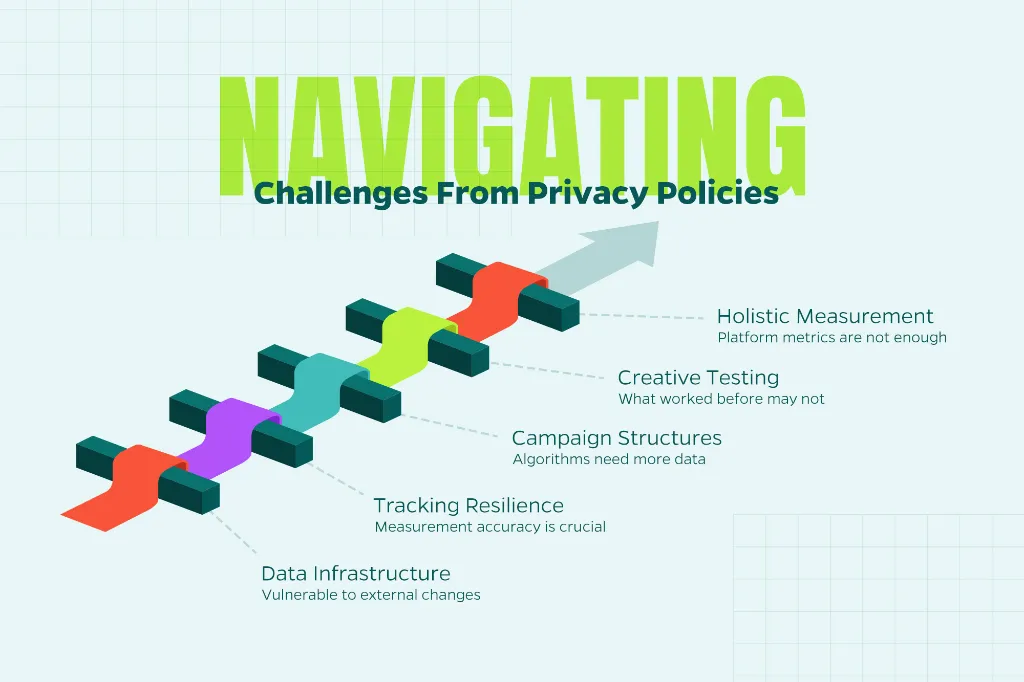
These practices help create a more durable advertising framework that can withstand ongoing changes in the privacy landscape.
Looking Ahead: Opportunity in Adaptation
Privacy regulations and platform policies will continue to evolve, and some uncertainty is likely to remain part of the digital advertising landscape. Yet history shows that marketers who adapt quickly often gain a competitive edge.
By embracing first-party data, leveraging advanced measurement tools, and elevating creative strategy, you can build Meta campaigns that are both privacy-conscious and performance-driven. Rather than viewing privacy changes as purely restrictive, forward-thinking advertisers see them as an opportunity to refine their approach and create more meaningful connections with their audiences.
Need help navigating the new privacy landscape and optimizing your Meta advertising strategy? Contact Straight North today to learn how we can help your business adapt and thrive in this evolving digital environment.