




Key Takeaways
- Attribution remains important: 75% consider it mission critical or very important.
- AI is increasing uncertainty: 53% said AI and zero-click search reduced their attribution confidence.
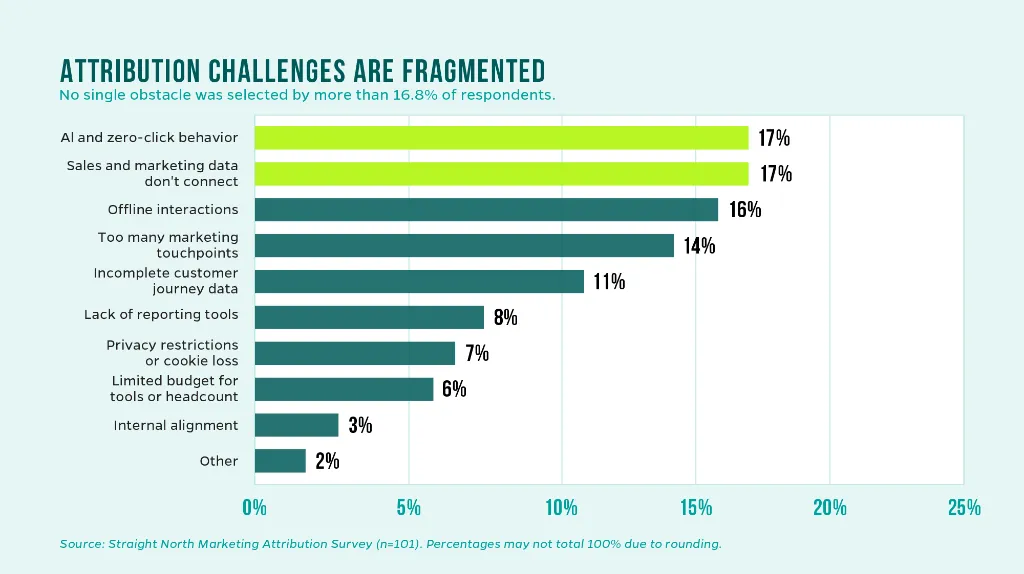
- Attribution challenges are fragmented: No single obstacle was selected by more than 17% of respondents.
- Marketers are adapting: 88 of 101 respondents (87%) account for un-trackable influence in some way, including 30 who have a formal process.
- Stronger attribution draws on direct data, indirect indicators, and customer feedback.
Marketing attribution has always required judgment. Today, it requires a more strategic way to interpret incomplete data.
The central challenge is no longer simply deciding which channel receives credit. It is evaluating influence when much of the customer journey happens outside conventional tracking.
AI-generated answers and zero-click search have widened those blind spots. Someone can discover a company, research its services, and make a decision without generating a trackable website visit. Offline conversations, word of mouth, privacy restrictions, and disconnected sales and marketing systems obscure even more of the journey.
At Straight North, we wanted to know how marketers are responding. Is their confidence holding up? Can they still tie revenue to specific channels? And how are they accounting for influence that never shows up in a dashboard?
We surveyed 101 marketing professionals to find out. We asked about their attribution priorities, practices, tools, and biggest obstacles.
The findings point to a broader change in practice. Marketers are not abandoning attribution as customer paths become less linear and trackable. They are supplementing direct data with indirect signals, qualitative observations, and customer feedback.
For marketers, the implication is clear: better attribution will not come from finding one perfect metric. It will come from evaluating several imperfect signals through a consistent process.
About the 2026 Marketing Attribution Survey
Results are based on a 2026 survey of 101 B2B and B2C marketers and reflect self-reported responses. The marketers represent organizations of various sizes and a range of marketing staffing models. Percentages are rounded to the nearest whole number, so totals may not always equal 100%.
About 18% worked for organizations with 10 or fewer employees, about half (51%) represented organizations with 11 to 200 employees, and the remaining 31% worked for organizations with more than 200 employees.
Respondents also represented a range of marketing structures, including one-person departments, small and large in-house teams, outsourced teams, and organizations without dedicated marketing staff.
Marketing Attribution Remains a Business Priority
The loss of visibility has not reduced the need for attribution. Teams still need evidence to make and defend marketing decisions, even when that evidence is incomplete.
Three-quarters of respondents described marketing attribution as mission critical or very important to their business. In a separate question, 73% said improving attribution would be a high or moderate priority during the next 12 months.
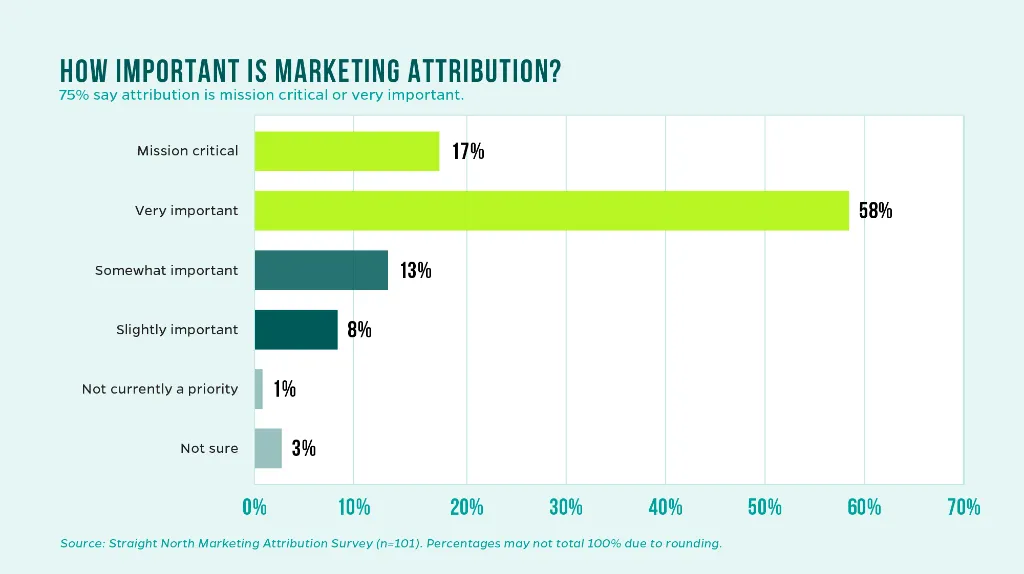
Attribution matters because it supports decisions across marketing, not just budget allocation. Even when organizations cannot trace every interaction, they can use attribution data to guide content strategy, executive reporting, and campaign optimization.
Among the 93 respondents who currently use attribution data (and could select more than one use), 51% apply it to content strategy, 45% use it for executive reporting, and 42% use it for campaign optimization. It also supports sales enablement, forecasting, and customer journey analysis. With attribution influencing decisions across so many areas, any gaps in the process can affect the entire marketing organization.
The Biggest Marketing Attribution Challenges in 2026
Attribution does not break down in one predictable place. Organizations face different gaps depending on their channels, technology, customer interactions, and internal processes.
No single attribution challenge dominated the responses. AI and zero-click behavior tied with disconnected sales and marketing data for the top spot at 17% each. Offline interactions followed at 16%, while 14% selected the growing number of marketing touchpoints.
How AI and Zero-Click Search Affect Attribution
AI is a pervasive source of uncertainty, but it is not every organization’s primary operational barrier. More than half of respondents said AI and zero-click search reduced their confidence, and 37% identified AI search as one of the hardest channels to measure. Yet when asked to select one primary challenge, respondents split across AI, disconnected data, offline interactions, and other gaps.
This distinction matters because the wrong fix can add cost without improving the evidence. AI is changing the measurement environment, but organizations may get more value from connecting sales and marketing data, capturing offline activity, or improving customer journey records than from adding another analytics tool.
The first step toward stronger attribution is to identify the gap that most limits a real decision. A new tool will not solve a problem rooted in disconnected data, inconsistent processes, or interactions that leave no trackable trail.
How Marketers Measure Influence They Can’t Track
The clearest sign of adaptation appears in how organizations evaluate marketing influence without a trackable website visit.
Altogether, 88 of 101 respondents (87%) account for un-trackable influence in some way including the following:
- through a formal process (30%)
- indirect-metric estimates (31%)
- qualitative discussion (21%)
- direct customer questions (5%)
The remaining respondents either do not currently account for this influence or are unsure how their organization handles it.
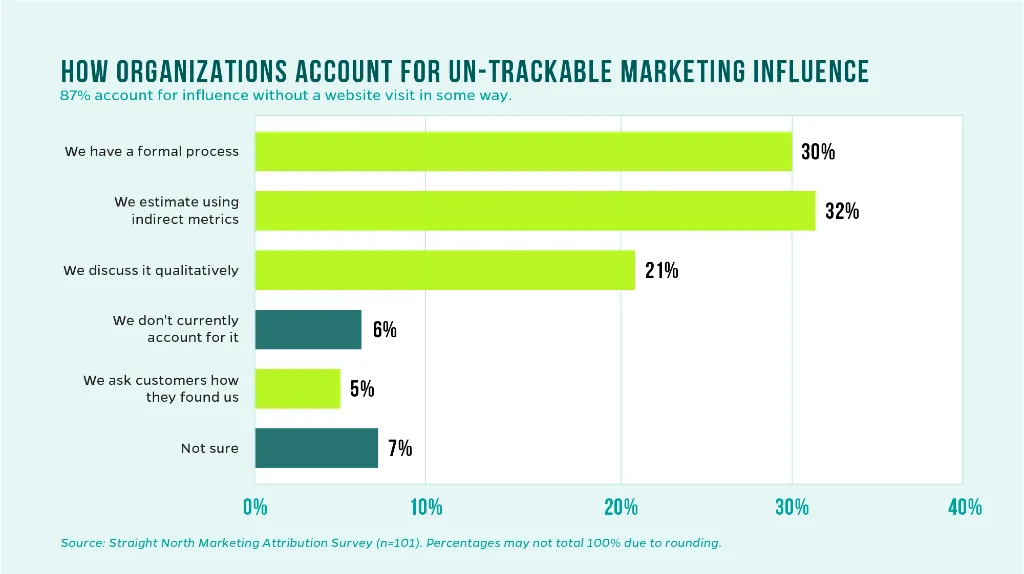
The breakdown suggests that most organizations are trying to account for un-trackable influence, but only a minority have turned that effort into a formal process. That makes the gap less about whether marketers recognize the problem and more about whether they have a repeatable way to evaluate the evidence.
A direct website conversion may provide strong evidence. Growth in branded searches, greater AI visibility, increased engagement, or customer comments may provide supporting evidence. Each signal has limitations, but several signals pointing in the same direction can create a credible picture of marketing’s influence.
The Most Common Marketing Attribution Models
The fragmentation extends to the models marketers use. No primary attribution model dominated the responses, reinforcing that organizations need different approaches for different customer journeys and business decisions.
Multi-touch attribution was the most common primary model, selected by 26 respondents. Marketing mix modeling followed with 20 respondents, while 16 used first-touch attribution, 14 used last-touch attribution, and six used AI-powered attribution.
The remaining respondents either ask customers how they found the business, use no formal attribution model, or are unsure which model their organization uses. Because each respondent selected one primary approach, the categories account for all 101 responses.
AI is more commonly used to support attribution analysis than to serve as the primary model for assigning credit. While 22% of respondents use an AI-powered analytics platform among their attribution tools, only six identified AI-powered attribution as their primary model.
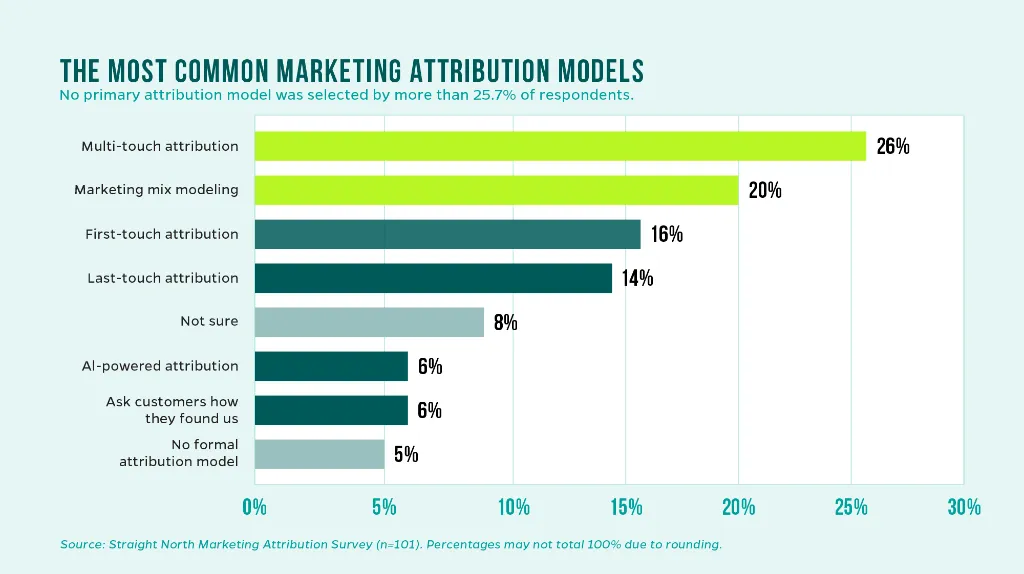
The practical takeaway is that organizations should choose an attribution model based on the decisions they need to make, the length of their customer journey, and the quality of their available data rather than assuming one model is universally superior.
How to Improve Marketing Attribution: 5 Evidence-Based Practices
A modern attribution program should operate as an evidence system, not simply as a credit-assignment formula. The following five practices turn incomplete signals into more consistent decisions:
1. Define the decision first.
Start by identifying what the analysis needs to inform. Budget planning, content strategy, campaign optimization, and executive reporting may require different information. Without a defined decision, teams can produce more attribution data without producing a clearer answer.
2. Separate observed, inferred, and reported influence.
Classify evidence according to how it was collected. Observed evidence includes recorded clicks, calls, and conversions. Inferred evidence includes changes in branded search, engagement, or visibility. Reported evidence comes directly from customer feedback.
These categories can work together, but they should not be treated as equally precise. Naming the evidence type helps decision-makers understand what a conclusion can and cannot support.
3. Connect marketing and sales information.
Compare analytics and platform data with CRM records, call tracking, sales feedback, and completed revenue. Closing avoidable gaps between existing systems can be more valuable than adding another standalone tool because it connects marketing activity to business outcomes already on record.
4. Formalize customer feedback.
Ask customers how they first heard about the business and what influenced their decision. Use consistent questions so responses can be reviewed alongside digital data. Customer-reported evidence does not replace behavioral data, but it can reveal influences that tracking misses entirely.
5. Assign confidence levels.
Not every conclusion carries the same level of certainty. Label findings based on the quantity and quality of the supporting evidence. Give more weight to conclusions supported by several independent signals than to those based on one indirect metric.
The Future of Marketing Attribution: Better Evidence, Not Perfect Tracking
Attribution is becoming harder because marketing influence is spreading across more channels and more of the customer’s research happens outside the view of conventional analytics.
Marketers are adapting by supplementing trackable activity with indirect metrics, qualitative observations, and customer feedback. The next step is to turn these disparate practices into a consistent process that enables better decision-making.
The strongest attribution programs will not be the ones that claim to measure everything. They will be the ones that understand what each signal can prove, how much weight it deserves, and when the evidence is strong enough to act.