
Artificial intelligence has been changing the way we work and live for much longer than most people realize. What feels like an overnight transformation has been decades in the making. Back in the 1950s, Alan Turing posed a simple but profound question: Can machines think? That question set the stage for everything we’re seeing now.
Tools like ChatGPT have pushed AI into the spotlight, reinforcing where it exists and its accessibility. Today, it’s embedded directly into how marketers plan, create, analyze, and optimize their work.
That shift raises a natural question: what does AI actually mean for marketing teams right now?
To answer that, we surveyed 100 marketers across roles, industries, and company sizes. The takeaway is clear: AI isn’t replacing marketers. It’s fundamentally changing how marketing work gets done.
A Quick Look at Who We Surveyed
Before diving into the results, it’s worth understanding who these insights come from.
Methodology note: Results are based on a 2026 survey of 100 B2B marketers and reflect self-reported responses.
Our respondents spanned a wide range of roles, from individual contributors (37%) to managers (26%) and team leads (12%), with the remainder made up of directors, executives, and business owners. Company sizes varied as well, though mid-sized and enterprise organizations made up a significant portion of the sample.
Marketing teams themselves were equally diverse, ranging from small groups to departments with 25+ employees.
This group reflects a mix of strategic decision-makers and hands-on practitioners. That combination matters.
With that context in mind, the data reveals a clear shift in how marketing teams are operating today.
AI Is Reshaping How Marketing Work Gets Done
83% of marketing teams are already using AI, making it a present-day standard, not a future trend.
AI adoption is no longer a differentiator. It’s the baseline.
But widespread adoption doesn’t mean widespread transformation. While most teams are using AI in some capacity, far fewer have fully integrated it into how their marketing actually operates.
Only 29% of marketing teams say AI is fully integrated into their workflows.
This gap is where the real opportunity — and competitive advantage — exists.
The divide is no longer between teams that use AI and those that don’t. It’s between teams that use AI tactically and those that have operationalized it.
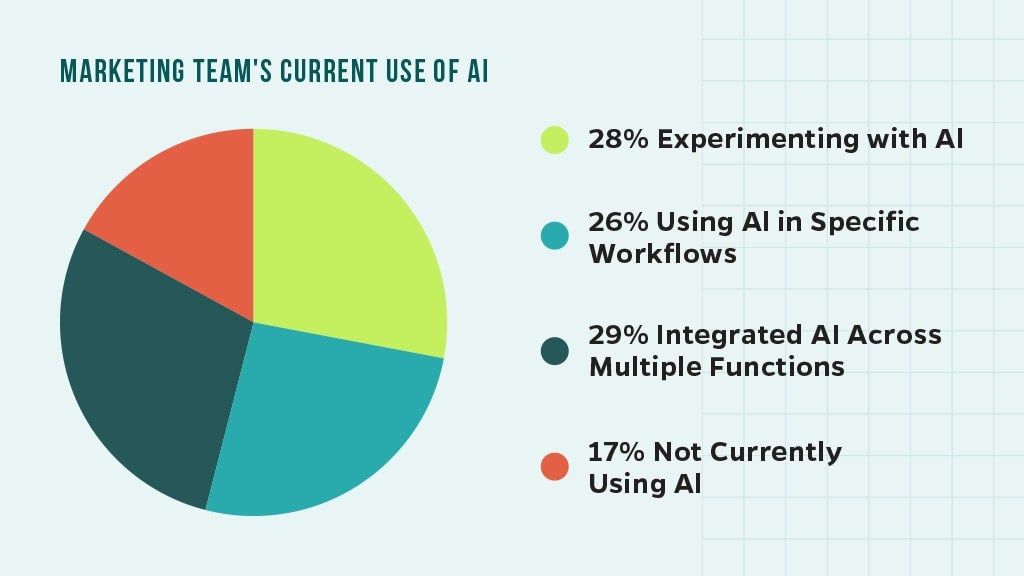
While these figures confirm that AI is firmly established in modern marketing, they also reveal a more important insight: implementation alone is not the differentiator. Organizations vary significantly in how intentionally and strategically they apply AI.
Many teams are using AI in isolated ways: content drafting, quick analysis, or one-off tasks. Fewer have embedded it into workflows, decision-making, and ongoing operations.
This creates a growing gap between:
- Teams using AI as a tool
- Teams using AI as infrastructure
The latter are building repeatable systems, standardizing workflows, and aligning AI with strategy.
That’s where long-term advantage will come from.
That shift in how AI is used naturally raises a second question: how is it changing the structure of marketing teams themselves?
AI Isn’t Replacing Marketers — It’s Expanding Their Roles
Perhaps the most telling data comes from workforce trends:
47% of organizations are upskilling existing employees, signaling that AI is driving internal capability building rather than replacement.
At the same time:
- 31% are hiring for new AI-related skills
- 31% report needing fewer team members
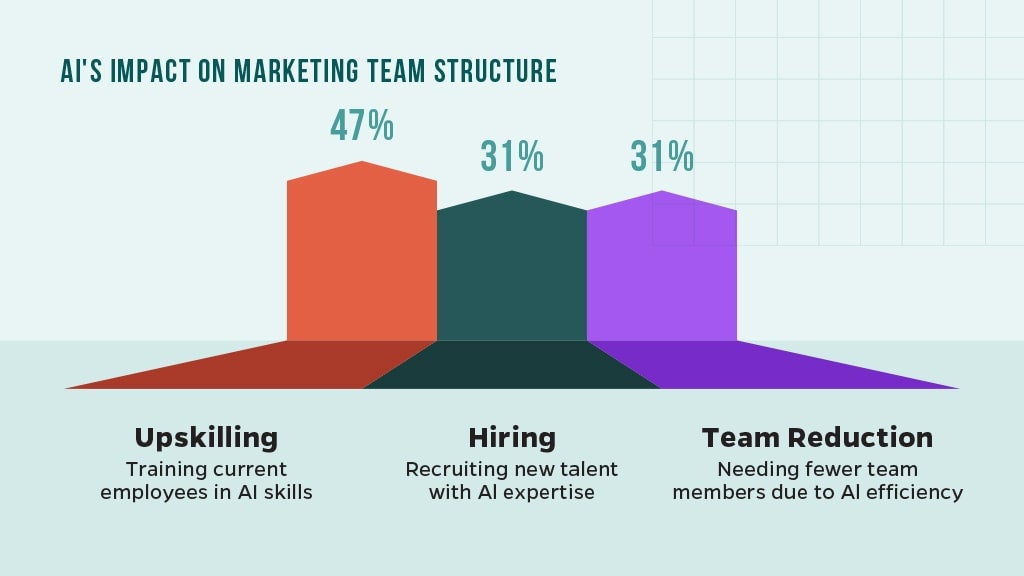
70% say AI has not reduced the need for human roles, reinforcing that AI is augmenting — not eliminating — marketing talent.
It may mean fewer net-new hires or backfills, not necessarily fewer responsibilities.
The bigger shift is happening in where the work gets done. In many teams, the work may shift from producing every asset manually to directing systems, reviewing outputs, and making higher-leverage decisions.
AI continues to take on more executional work, and marketers are being elevated into roles that require more oversight and strategic thinking. This shift signals an important transition: success with AI won’t come from having the tools alone, but from building teams that know how to guide and use them effectively.
AI doesn’t reduce the need for talent. It changes what that talent needs to do.
As roles evolve, so does the type of work AI is being applied to.
AI Is Changing How Marketing Teams Operate
51% use AI for data analysis and reporting, showing its biggest impact is on decision-making, not just execution.
AI is being adopted across core marketing functions, especially in areas that improve team efficiency and execution.
Other top use cases include:
- Email marketing (49%)
- Content creation (41%)
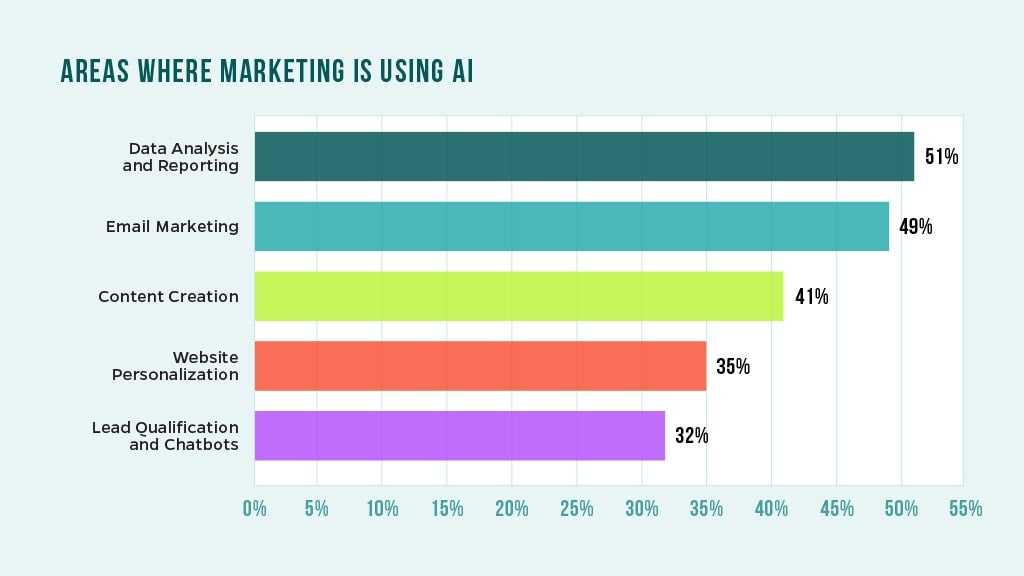
SEO and paid media (30%) lag in AI adoption because they require more human judgment and accountability. But that’s the point. AI is handling the repeatable work, giving marketers more time to focus on the areas where expertise matters most.
This distribution highlights an important shift: AI isn’t just helping teams produce more. It’s becoming a foundational part of how marketing team organize and execute their work giving them more time to think strategically.
Marketers are prioritizing AI in repeatable, structured tasks where speed and pattern recognition drive immediate value. From data analysis to content production and email workflows, AI is helping teams process information faster, uncover insights, and make more informed decisions.
But implementation and usage only tell part of the story. The bigger question is whether these changes are translating into measurable results.
Impact of AI on Marketing Performance
Nearly 50% of surveyed marketers say AI has improved content quality.
AI is delivering measurable improvements in other areas as well:
- Team efficiency (45%)
- Research and insights (44%)
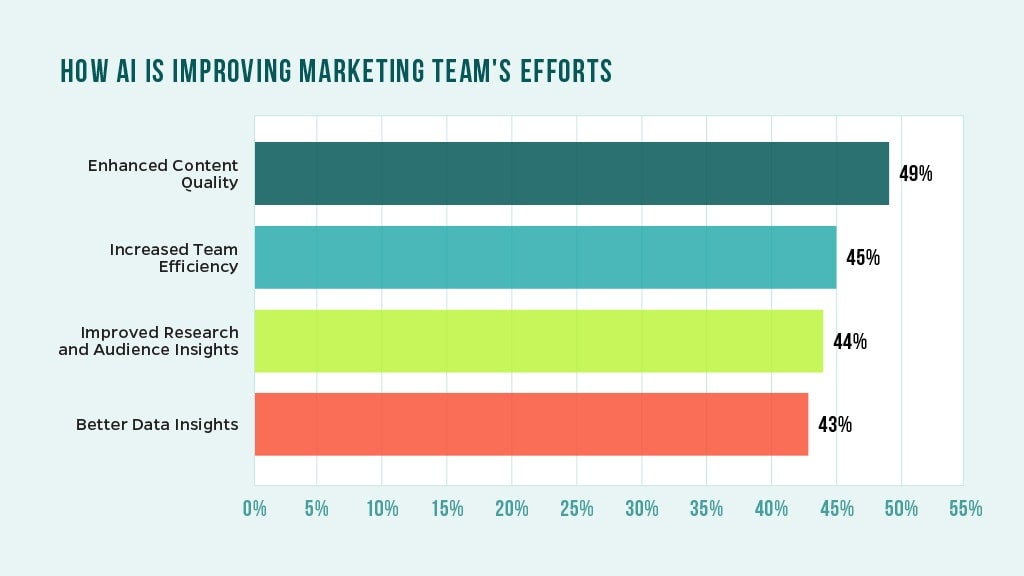
However, only 17% report improvements in SEO performance, indicating that performance optimization may lag behind operational gains.
This gap matters.
AI is making teams faster and more capable, but performance channels with longer feedback loops and higher complexity aren’t seeing the same immediate impact.
Many teams also use AI more for areas that can have a bigger compounding impact such as drafting than for technical SEO, internal linking, or content pruning.
Teams are becoming more efficient and better informed, but those improvements aren’t always translating directly into measurable outcomes like SEO performance — at least not yet.
This is a key transition point.
It indicates that where foundational investments (SEO, content, websites) compound over time, AI’s biggest long-term impact may not be immediate performance spikes, but better systems that lead to better outcomes over time.
That gap between capability and performance helps explain why many teams are still facing challenges.
The Bottleneck Isn’t Technology — It’s Strategy
38% of marketers say their biggest challenge is understanding how to use AI effectively, reinforcing that the barrier isn’t access to AI.
Despite widespread consumption, marketers are still navigating several challenges. The primary challenges aren’t technical. They’re operational and strategic.
- Maintaining brand voice (34%)
- Ensuring accuracy (33%)
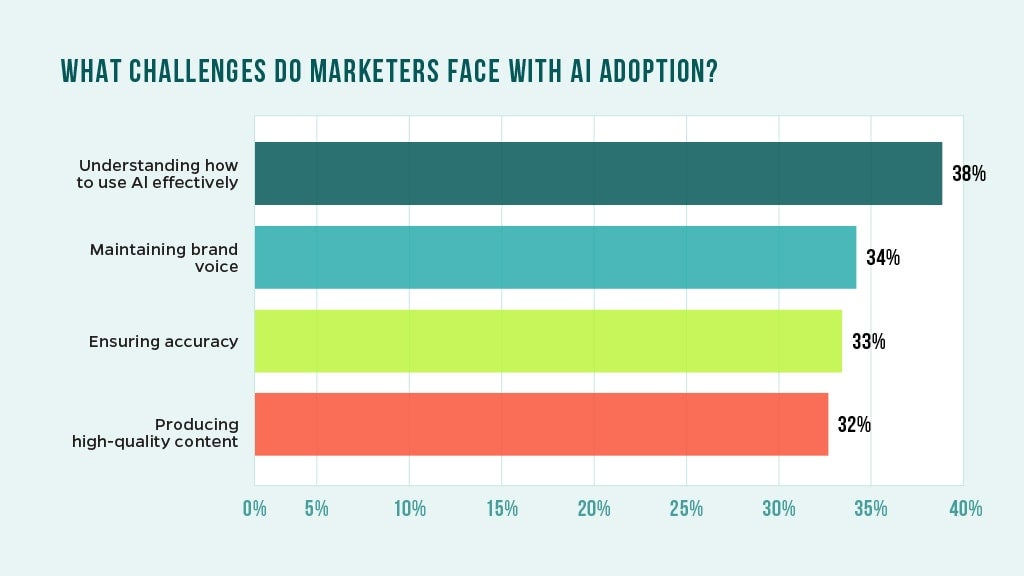
It also suggests that success with AI depends less on access to tools and more on how well organizations define processes, guardrails, and expectations around their use.
This mirrors a broader shift across marketing: tools are becoming more powerful and accessible, but success depends on how well teams integrate them. Success depends on defining clear workflows, quality standards, and guardrails for use.
AI doesn’t eliminate complexity. It shifts where that complexity lives.
These challenges are also reshaping how organizations think about external support.
AI Is Changing the Role of Marketing Partners
Only 22% of organizations want to reduce reliance on external vendors, indicating that AI is shifting vendor roles toward strategy, not replacing them.
Organizations now look to vendors for:
- Strategic guidance (51%)
- Specialized expertise (49%)
- Help navigating AI advancements (49%)
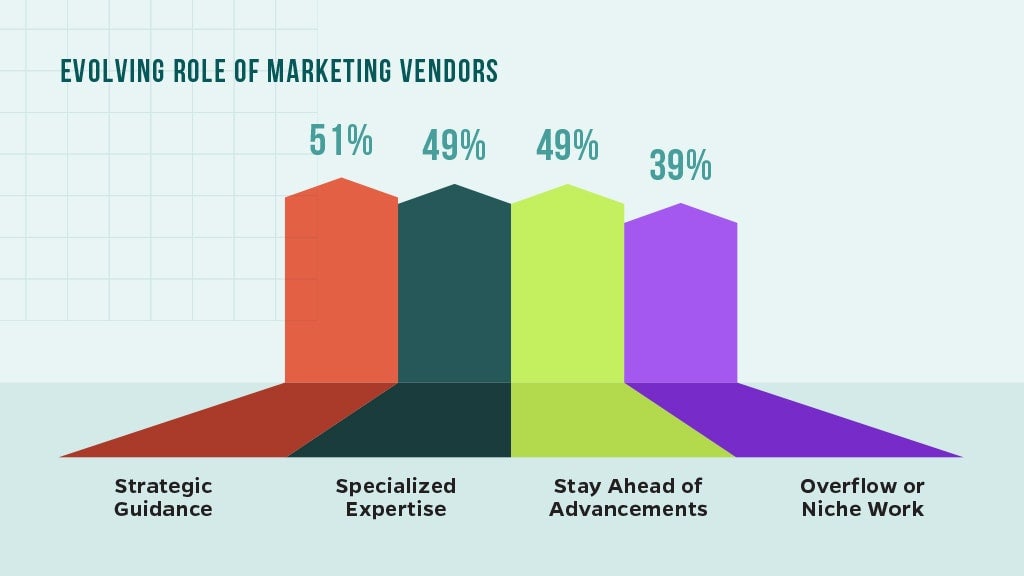
In other words, teams increasingly want partners who can help with AI-enabled strategy and operating models (governance, workflow design, measurement, and experimentation).
This reflects a shift in how organizations derive value from partners. As execution becomes more automated, strategy becomes more valuable.
Expectations are changing. Organizations aren’t moving away from partners. They’re repositioning how they are using them.
As both internal teams and external partners evolve, the next phase of AI in marketing becomes clearer.
The Future Isn’t AI Adoption — It’s AI Maturity
71% of marketers expect AI usage to increase over the next year, but the real shift will come from integration not just more tools.
Most organizations are still early in their AI journey.
This points to a shift in what comes next. The next phase of AI won’t be defined by expansion or trying new tools, but by integration. Organizations will need to move beyond surface-level use cases and focus on operationalizing AI across their business. That means embedding AI into workflows, establishing governance and quality standards, and aligning teams and overall strategy around its use.
Only 29% have fully integrated AI, despite widespread adoption — revealing a major opportunity for competitive advantage.
As AI becomes a baseline capability, execution will become easier but standing out will become more difficult.
Taken together, these shifts point to a broader transformation in how marketing creates value.
Final Thought: AI Is Changing How Value Is Created
If there’s one theme that stands out, it’s this:
AI isn’t transforming marketing through sudden disruption. It’s driving practical, incremental progress.
It’s driving a more fundamental shift:
- Teams are becoming more skilled and technical
- Execution is becoming more accessible
- Strategy is becoming more important
The organizations that succeed won’t be the ones that adopt AI fastest.
They’ll be the ones that rethink how their teams work and invest in the people behind the tools.
Key Insights
- AI adoption is widespread, but integration is still limited
- Upskilling — not firing — is the primary response to AI
- AI improves efficiency and quality faster than performance
- Strategy and execution are separating, changing the role of teams and vendors