

In industrial marketing, a landing page has one job: turn interest into action. Whether that action is requesting a quote, downloading a spec sheet, or starting a conversation with your sales team, the landing page is where curiosity becomes commitment.
At Straight North, we’ve worked with manufacturers, distributors, and industrial service providers long enough to know that industrial buyers aren’t casual browsers. They’re engineers, procurement managers, plant supervisors, and executives researching with purpose. When they land on your page, they’re looking for three things: clarity, credibility, and a fast path to the information they need.
Here are the landing page best practices we recommend for manufacturers looking to improve their marketing strategy, generate more qualified leads, and maximize ROI.
1. Lead with a Clear, Specific Value Proposition
Industrial buyers don’t have time for vague marketing language. Your headline should immediately answer one question: “What does this company do for me?”
Compare two examples:
- “Innovative Solutions for Modern Industry”
- “Custom CNC Machining for Aerospace Companies”
The second example wins because it’s specific. It tells visitors exactly what you offer and hints at your expertise. On an industrial landing page, clarity beats cleverness every time.
Your sub-headline should expand on that value. Use it to define your ideal customer or highlight a key differentiator like certifications, turnaround time, or specialized capabilities.
2. Align the Page with Search Intent
Most industrial landing pages are tied to paid search or SEO campaigns, which means alignment with keywords and intent is critical.
If someone searches for “industrial water filtration systems for food processing,” your landing page should repeat that core phrase naturally, demonstrate clear experience serving the food processing industry, provide relevant technical details, and offer a logical next step like a consultation or system assessment.
Generic pages lead to high bounce rates. Focused pages convert.
When landing pages match intent, they improve Quality Score and ad performance while building trust with serious buyers who feel understood.
3. Speak to Engineers and Decision-Makers
Industrial marketing often requires speaking to multiple stakeholders. Engineers care about specifications and tolerances. Procurement teams care about pricing and reliability. Executives care about ROI and risk mitigation.
A strong landing page addresses these perspectives without overwhelming the reader. For example, it can include technical specifications in a scannable format, highlight certifications like ISO or industry standards, explain business benefits such as reduced downtime or lower total cost of ownership, and offer downloadable resources for deeper evaluation.
Additionally, effective landing pages should skip the fluff and replace generic claims with measurable proof. Instead of “high quality manufacturing,” say “99.7% on-time delivery rate across 5,000+ annual production runs.”
4. Keep the Layout Clean and Scannable
Industrial buyers often review multiple vendors in a short timeframe. Make your landing page easy to navigate with clear section headers, bullet points for features and benefits, short paragraphs, visual hierarchy that guides the eye, and prominent calls to action above the fold and throughout the page.
Remember that white space isn’t wasted space. It helps visitors focus on what matters. Avoid cluttered layouts filled with excessive stock imagery or long blocks of dense text. A clean design reinforces professionalism and competence.
5. Use Strong, Relevant Visuals
In industrial marketing, visuals aren’t decoration. They’re proof. Include photos of your facility, images of your equipment, product close-ups, diagrams or process visuals, and short explainer videos when appropriate. Real photography outperforms generic stock images because it builds authenticity. When prospects can see your machinery, your team, and your environment, they gain confidence in your capabilities.
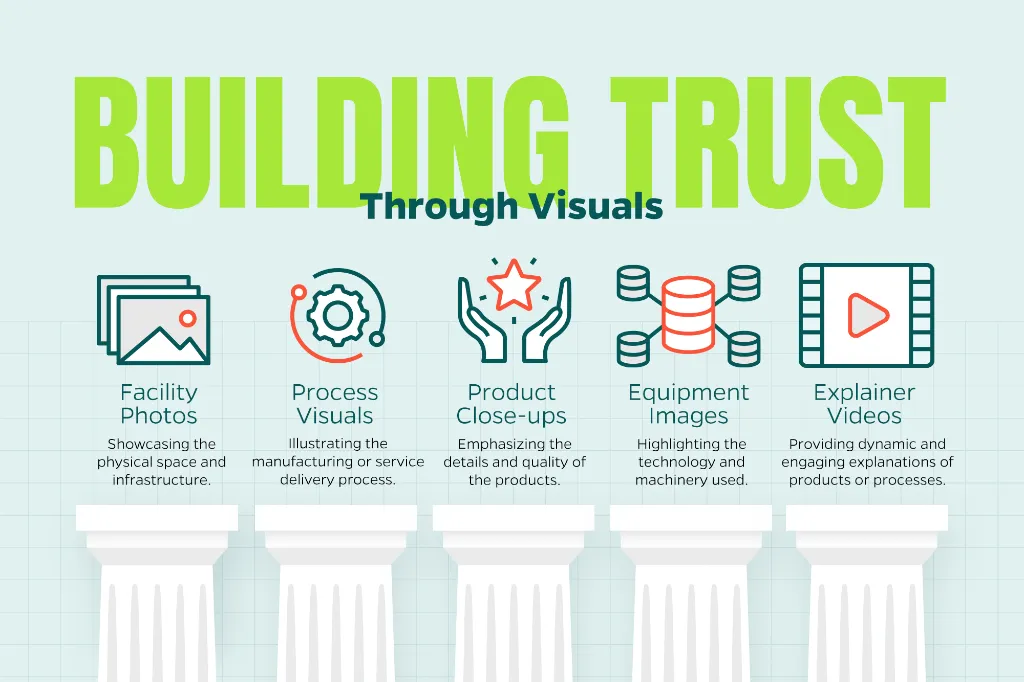
If you serve highly regulated or technical industries, visuals can also demonstrate compliance and quality control in ways that words alone cannot.
6. Build Credibility with Social Proof
Trust is a major factor in industrial purchasing decisions. Contracts are large, timelines are long, and risk is real.
Your landing page should reduce perceived risk by showcasing client logos, testimonials from recognized companies, case studies with measurable outcomes, certifications and affiliations, years in business, and safety records.
Case studies are especially powerful. We recommend offering a brief summary outlining the challenge, your solution, and the results that move a prospect closer to contacting your team. Whenever possible, you should quantify results. Percentages, time savings, and cost reductions carry weight with industrial buyers.
7. Make the Call to Action Clear and Compelling
Your call to action should be direct and aligned with the buyer’s stage in the process. Common CTAs for industrial landing pages include Request a Quote, Schedule a Consultation, Download Technical Specifications, Speak with an Engineer, and Get a Custom Assessment.
Place your primary CTA prominently near the top of the page and repeat it at logical intervals. Use buttons that stand out visually from the rest of the page.
If the buying cycle is long, consider offering a lower-commitment CTA like downloading a guide or whitepaper in exchange for contact information.
8. Optimize Forms for Conversions
Long forms can discourage prospects. Short forms can reduce lead quality. The right balance depends on your sales process. In many industrial markets, a slightly longer form is acceptable because buyers expect to provide project details. However, every field should have a purpose.
Ask only for information your sales team will use, group related fields logically, make required fields clear, and provide reassurance about data privacy. If you need detailed project specifications, consider using a progressive approach. Start with basic contact information and gather additional details during follow-up conversations.
9. Address Common Objections Proactively
Industrial buyers often share similar concerns: Can this company handle our volume? Do they understand our industry? What’s their lead time? How do they ensure quality? What happens if something goes wrong?
Use your landing page to address these questions before they’re asked. A short FAQ section can be effective. Plus, you can include a brief paragraph outlining your process from consultation to delivery. Transparency reduces friction and accelerates decision-making.
10. Measure, Test, and Refine
No landing page should remain static. Track key metrics like conversion rate, cost per lead, bounce rate, time on page, and form completion rate. Run A/B tests on headlines, calls to action, imagery, and form length. Even small changes can lead to significant improvements over time.
Industrial marketing often involves lower traffic volumes than consumer campaigns, which makes each visitor more valuable. Continuous optimization ensures you’re making the most of that traffic.
The Bottom Line
An effective industrial landing page isn’t flashy. It’s focused. It speaks directly to a defined audience, aligns with search intent, provides technical depth without overwhelming, builds trust through proof, and makes the next step obvious.
When these elements work together, the result isn’t just more leads but better leads. Prospects who contact you through a well-structured landing page are typically more informed and further along in the buying journey. That means more productive sales conversations and stronger close rates.
Ready to improve your industrial landing pages? Contact Straight North today. Our team can evaluate your current pages, identify opportunities for improvement, and build high-converting landing experiences tailored to your industry.