





Key takeaways:
- Treat search volume as a guide, not the final decision-maker.
- Balance broad search demand with specific customer questions.
- Combine search data, business knowledge, and subject matter expertise.
- Look beyond impressions to clicks, engagement, and conversions.
- Leave room for niche topics, emerging questions, and original ideas.
Search volume can make content planning look easy. Find the biggest keywords. Build pages around them. Wait for traffic. Simple, right?
Not quite. A high-volume topic may reach the wrong audience, fall outside your business’s strengths, or put your site against competitors it cannot realistically outrank. A big number says people are searching. It does not say the topic is right for your business.
AI-powered search adds another layer of uncertainty. Marketers want to know what people are asking ChatGPT, Google AI Overviews, and other generative platforms. The problem is that reliable prompt-volume data remains limited. Prompts vary, answers change, and tracking tools only reveal part of the picture.
So, how do you use data without letting it run the strategy?
Straight North SEO and GEO Strategist Bryan Paravola treats search volume as a compass. It reveals real interest, related questions, and potential opportunities. But it cannot choose the destination. Audience needs, business priorities, and industry expertise still decide where the content should go.
Build SEO and GEO Strategy on Demonstrated Interest
Search volume gives you a useful way to ground and validate new content ideas. It can confirm whether people are interested in a topic and provide a sense of how broad that interest may be. Query-level data from Google Search Console adds another layer by revealing the questions and phrases already bringing people to your site.
Together, these signals help determine whether a topic has enough demonstrated interest to support content and how much space it deserves. A broad theme with consistent demand may support its own page, while related questions can shape the depth and structure of that resource. The data does not make the decision, but it helps confirm that the strategy begins with a real audience need.
Bryan explains why search volume should inform that decision without making it for you:

We want to use search volume and search volume data as a way to help give us clues as to, you know, general levels of interest in a topic and things like that. But we also don’t want to get too locked into the idea that a topic is worth creating or not worth creating, or, you know, content is worth creating just based solely off of the reported search volume data either. You know, if there’s good, helpful content that you want to put out into the world, that you want to put out onto your website, you know, we don’t want to discourage that just because, you know, maybe you’re not seeing the search volume for it. Likewise, you know, you don’t want to go too far the other way and, you know, only put out content that you’re seeing search volume for and, you know, miss out on other opportunities to provide good content.
Search volume does not capture every worthwhile idea. A topic may answer an important customer question, demonstrate specialized knowledge, or address an emerging need before keyword tools detect it. Use the data to validate known demand without treating the absence of volume as proof that no audience exists.
That’s where traditional search data can provide a firmer foundation for GEO. Marketers can’t reliably measure how often people enter a particular prompt into an AI platform, and the wording can vary from one person to the next. Search volume and query data offer clearer evidence of the broader topics people care about.
Start with that demonstrated interest. Then, use customer questions, business priorities, and subject matter expertise to build content that answers the topic fully. Good GEO still begins with sound SEO principles.
Balance Search Volume With Relevance
When building a content plan, you will often set goals around reaching a larger audience. That can make high-volume keywords look like the obvious choice. More searches should mean more opportunities to attract visitors, right?
Not always. High-volume terms can be broad, highly competitive, or disconnected from what your business offers. They may bring more people to your site without bringing the right people.
Lower-volume topics can offer a different kind of value. Someone using a specific search term often knows exactly what they need. The audience may be smaller, but the topic may align more closely with your services and your customers’ questions.
Still, there is a limit to how specific you should get. If you build a separate page around every narrow keyword or possible AI prompt, some pages may never earn meaningful visibility. You could also end up with multiple pages covering nearly the same subject.
A better approach is to build around a relevant, broader topic, then address specific questions within it. This gives the page enough breadth to earn visibility while still serving the people most likely to find the information useful.
“Search volume is a compass that can point you in the right direction, but it’s not going to tell you exactly what topics to create.”
Senior SEO & GEO Strategist | Onsite SEO & GEO Expert
The numbers provide direction. Your audience, business goals, and industry knowledge determine where the content should go.
Combine Search Data With Business Knowledge
Search data can tell you what people type into a search bar. It cannot tell you everything your business knows about its customers, services, or industry. A strong content strategy brings both sources of information together.
Bryan explains why chasing visibility without considering the customer can take your strategy off course:

Yeah, so I think the key is that you don’t want to get too focused on creating an SEO strategy that’s sole purpose is to only create content that’s gonna do well on Google, or, you know, do well on LLMs, and you’re not even really thinking about the target customer that you’re looking to create content for in the first place. The goal is to sort of, you know, have a blend of those two things and strike a balance between real SM… or real industry expertise from, you know, subject matter experts within an industry, and use that expertise to try to answer questions that people are asking.
Start by listening to the people closest to your customers. Sales teams hear the questions people ask before making a decision. Service teams know where customers run into problems. Subject matter experts understand the technical details, industry changes, and practical considerations that keyword tools often miss.
That knowledge can reveal topics tied directly to your company’s services, priorities, and areas of genuine expertise. Search data can then help validate those ideas. It may show how people phrase a question, how much interest exists, or whether the topic belongs on its own page or within a broader resource.
Not every worthwhile idea will appear in keyword tools, especially when a topic is new or customers use inconsistent language to describe it. Business knowledge helps surface those gaps, while search data can connect them to established themes and familiar language. The result is content grounded in evidence without being limited to what the tools already measure.
Recognize When Search Data May Be Misleading
A sudden spike in impressions can look like a win. It may mean your page is reaching a much larger audience, but it could also mean the activity in Google Search Console does not represent real people.
Bryan recommends looking closely at whether the pattern appears natural:
If you see, you know, just all of a sudden, you know, hundreds of impressions on one day, and then it drops right back down the next day, or if you’re just seeing, you know, like, you know, you’re getting the same level of impressions every single day in a pattern that seems sort of unnatural. Or even just, like, if you’re seeing a lot of impressions for, you know, a really long query that’s, like, an entire sentence, or even, like, a full paragraph, or something that seems like an AI prompt, that can be clues that it’s probably more likely coming from a bot or an automated tool that’s doing some type of, you know, prompt tracking or something like that. So, just be wary of impressions that seem unnatural. You can never really be 100% sure when you’re looking at data in Search Console that it’s coming from a real human. You know, sometimes clicks and impressions can be coming from bots, but there are certain clues that can sort of tell you for sure what’s not human, and what’s automated traffic.
Bots, scrapers, and automated prompt-monitoring tools can create impressions that look like growing search demand. Warning signs may include abrupt spikes, identical daily impression counts, no corresponding clicks, or unusually long queries that resemble complete AI prompts.
These patterns do not always prove the activity is automated. They do give you a reason to investigate before changing your strategy. Look at clicks, engagement, and conversions to determine whether the increased visibility is reaching a meaningful audience.
Look Beyond Impressions to Find Meaningful Reach
Once you know the impression data looks credible, the next question is whether that visibility has value. Impressions show that your content appeared. They do not show whether anyone found it useful.
Clicks are a good place to start. If people choose your result, the page is likely ranking prominently enough and matching their needs closely enough to earn their attention. From there, look at what they do next. Do they explore a service page, request more information, or take another meaningful action?
When possible, connect that activity to conversions, revenue, and return on investment. Perfect attribution may not always be possible, especially when someone interacts with several pieces of content before taking action. You can still look for evidence that greater visibility is contributing to stronger overall performance.
Not every article will generate conversions directly, nor should it. Informational content may answer an early question, introduce your expertise, or strengthen your authority around a broader topic. Its value may appear through assisted conversions, improved visibility for related pages, or stronger performance across the site.
Impression growth should be viewed in that larger context. If it does not contribute to clicks, engagement, conversions, or broader visibility, it may be little more than a vanity metric.
Turn Search Demand Into Goal-Oriented Content Clusters
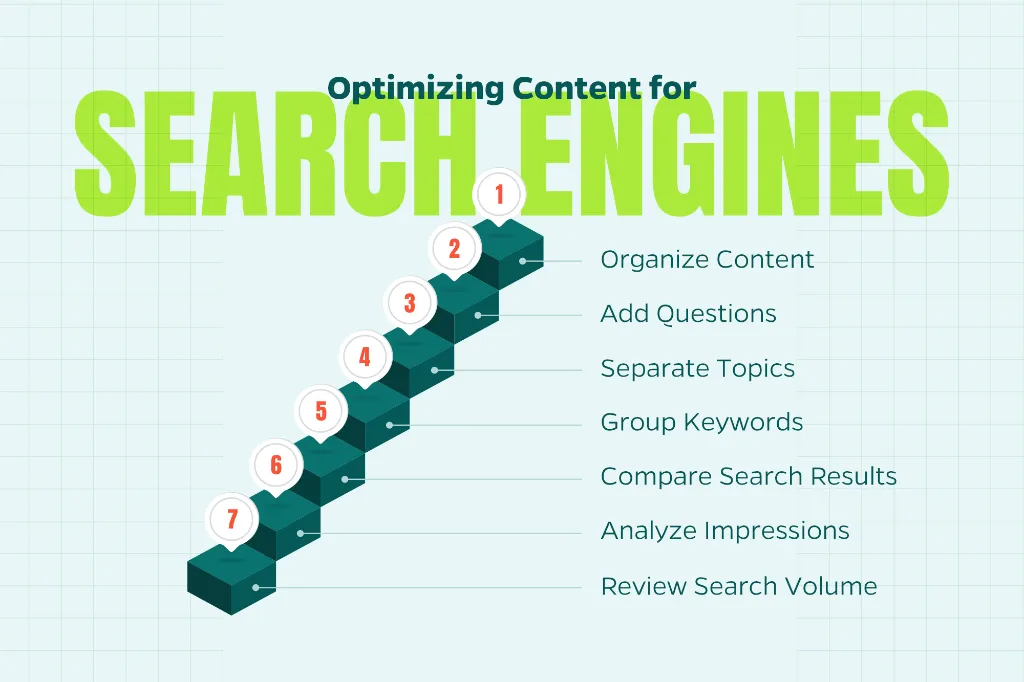
There is no single workflow for deciding which topics need their own pages and which belong together. A useful approach combines search volume, query-level impression data, and a review of Google’s results for related terms. Together, those signals can show whether keywords share the same intent or call for different content.
Here is one practical workflow:
- Review search volume to identify topics with established demand.
- Analyze query-level impressions in Google Search Console to see how people are finding the site.
- Search related terms and compare the pages and answers Google returns.
- Group keywords when the results indicate a shared search intent.
- Separate topics when Google consistently returns different page types or answers.
- Add questions gathered from customers and subject matter experts.
- Organize related content so people can move between topics naturally.
LLMs make this process less predictable. People can ask the same basic question in many ways, adding different details, context, preferences, and follow-up instructions. Those variations can change both the sources an LLM considers and the answer it produces. You can’t group prompts by comparing a consistent set of results as easily as you can with traditional search.
Traditional search patterns still offer useful clues. They can help identify broader themes and related questions that may also matter in generative search. However, they provide a starting point, not a definitive map of every prompt someone might enter or every answer an LLM might return.
The goal is not to create a separate page for every keyword or prompt variation. Instead, build a connected set of useful resources that addresses distinct questions without duplicating content, confusing users, or wasting time and effort.
Building new content is only half the equation. Existing pages need the same data discipline.
Decide Whether an Underperforming Page Needs a Refresh or a Pivot
Before changing an underperforming page, begin with one question: Does the business still need to be visible for this topic?
Bryan explains why that decision should come before any revisions:

So, I think the first thing, if you have a page that seems to be underperforming, is, you know, you… the first thing before you even do anything else would just be ask yourself, you know, is… is this a topic that… you know, we can’t live without. Is this a topic that we need to rank for? Is this, you know, are these keywords that we need to be ranking for? And if so, that’s when you start looking at, okay, you know, what can we do? If not, sometimes you might just find out, you know, hey, this topic is just not as relevant to us as it used to be, or, you know, unfortunately, for whatever reason, due to, you know, algorithm changes, maybe we’re just not going to be able to rank well anymore, we’re not going to be able to show up in LLMs.
If the topic still matters, evaluate the page in three stages: the topic, the content, and the way the content establishes credibility.
First, look at the topic itself. Does it still align with the business and the questions customers ask? Has search intent changed? Search volume alone will not tell you whether the site can realistically compete. A popular keyword may offer plenty of traffic potential but also place the page against much stronger competitors.
Next, review the content for practical ways to improve it:
- Fill major informational gaps.
- Update outdated information.
- Remove repetitive or unnecessary copy.
- Restructure the page so answers are easier to find.
- Add FAQs that address related customer questions.
Finally, look beyond the written copy. A page may provide the right information without giving readers or search engines enough reason to trust it. Consider how well the page demonstrates E-E-A-T: experience, expertise, authoritativeness, and trustworthiness.
You can strengthen those signals by adding:
- Customer testimonials or reviews that demonstrate firsthand experience
- Links to relevant case studies
- Evidence supporting important claims
- An author bio that establishes relevant credentials or experience
- Citations from credible sources
These additions do more than make the page appear polished. They help show who created the content, what qualifies that person to address the topic, and what evidence supports the information provided.
Look Beyond Volume Before Retiring a Page
If an underperforming page has little search volume, removing it may seem like the obvious choice. Before you do, consider the role the page plays beyond direct traffic. It may answer a recurring customer question, support a core service, strengthen a related content cluster, or provide context that AI systems can use.
Compare the page’s purpose with its performance. If the topic still matters but the page attracts little engagement, refresh or reposition it around a more relevant question. If another page already addresses the same intent, consolidate them. If the topic no longer supports the business or the audience, a redirect or removal may be the better choice.
Low volume can also reflect an emerging topic or language customers have not settled on yet. In that case, insights from sales, service, and subject matter experts may be a stronger signal than the keyword estimate alone.
The decision is not whether the keyword is large enough. It is whether the page contributes something useful to the broader strategy. That question turns an isolated traffic problem into a deliberate choice about what to improve, combine, or retire.
Bring the Signals Together
Search volume can validate interest, but it cannot build your entire content plan. Query data shows how people are searching, business knowledge reveals what they truly need, and performance data helps determine whether visibility is producing meaningful results.
Bringing those signals together creates a stronger foundation for both SEO and GEO. It allows you to pursue demonstrated demand without overlooking niche questions, emerging topics, or original ideas that only your business is equipped to address.
The strongest SEO and GEO strategies use data to validate opportunities, then rely on audience needs, business goals, and industry expertise to decide which ones deserve attention.