


A good blog helps you connect with patients who are already looking for your services. It’s a straightforward way to answer the questions people are typing into search engines and start building trust before they pick up the phone. When you write clearly about symptoms, treatments, and what to expect at your practice, you make it easier for someone to choose you. Done consistently, your blog becomes a go-to resource that brings in patients who are interested in your care. In this article, we offer your healthcare organization some blogging best practices.
Identify Questions Patients Are Asking
Before you write anything, you need to know what questions your prospective patients are asking online. This is where keyword research becomes essential.
Think about the concerns that come up repeatedly in your practice. Patients searching for a practitioner in your area might type something like “family doctor accepting new patients in [city]” or “when should I see a doctor for back pain.” Those searches represent real intent. Blog content that answers those questions directly has a much better chance of connecting with the right audience.
A few reliable ways to uncover patient search behavior include:
- Review your front desk questions. The calls and inquiries your staff fields every week represent a catalog of blog ideas. If patients are asking it on the phone, they are searching for it online.
- Use Google’s “People Also Ask” feature. Search a condition or service you treat and look at the related questions that surface. These are real queries from real users.
- Lean into location-based keywords. Phrases that include your city, neighborhood, or region help your content rank for local searches.
Write for People, Not Search Engines
One of the most common mistakes organizations make in healthcare marketing is producing content that reads like it was written for an algorithm. Keyword stuffing, overly clinical language, and generic information do not build the kind of trust that moves someone to book an appointment.
Your blog should sound like your practice: informed, approachable, and helpful. A post explaining the difference between urgent care and the emergency room, for instance, should be written the way you would explain it to a patient sitting across from you. Clear, direct, and free of unnecessary jargon.
This approach also supports your E-E-A-T signals (Experience, Expertise, Authoritativeness, Trustworthiness), which is a framework Google uses to evaluate the credibility of health-related content. Posts authored or reviewed by licensed practitioners and free of misleading or exaggerated claims are far more likely to perform well in search and earn patient trust.
Cover Topics That Map to the Patient Journey
Not every reader is ready to book an appointment. Some are still figuring out whether they have a problem worth addressing. Others are comparing providers. A well-rounded blog speaks to patients at every stage of that decision process.
Consider organizing your content around three broad categories:
- Awareness content addresses symptoms, conditions, and general health questions. These posts attract a wide audience and often drive significant organic traffic.
- Consideration content helps patients understand their options including different treatment approaches, what to expect from a procedure, or how to choose a specialist.
- Decision content focuses on your practice specifically; what makes your team qualified, what the patient experience looks like, and how to get started.
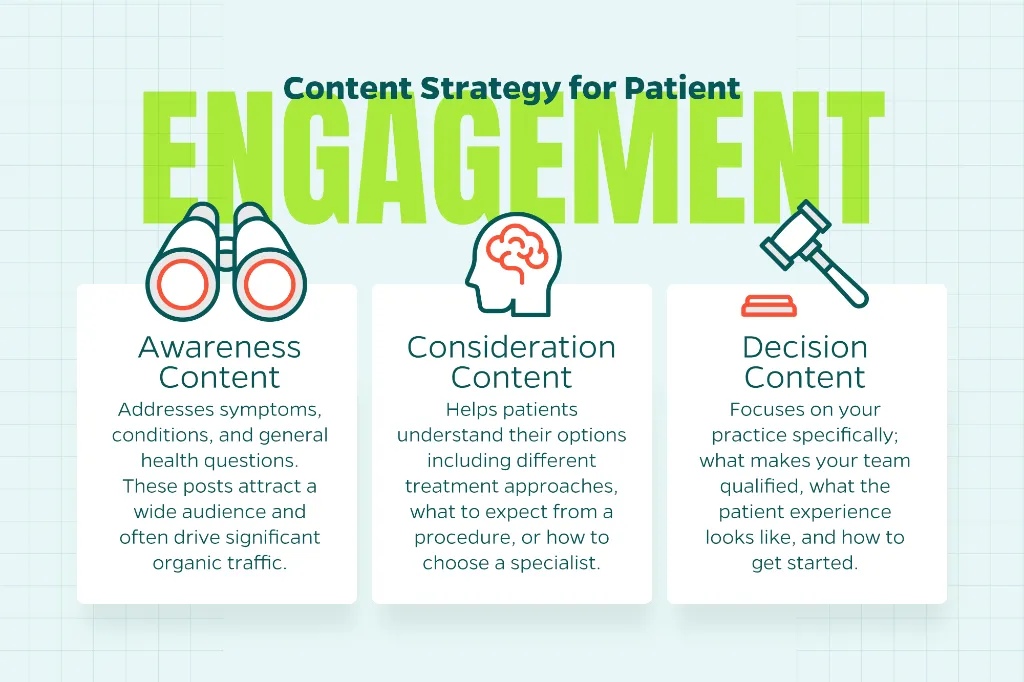
When you have content across all three stages, you are building a relationship with prospective patients long before they reach out. This means they are arriving with more confidence and less hesitation.
Be Consistent Without Burning Out
One of the biggest obstacles to effective healthcare blogging is sustainability. Clinics start strong, publish a few posts, then go quiet for months. That inconsistency undermines both search performance and patient perception.
You do not need to publish weekly to see results. A realistic, consistent cadence — even two or three posts per month — is far more valuable than a burst of content followed by silence. The key is building a workflow that fits your team’s capacity.
A few practical ways to keep the content engine running include:
- Repurpose existing materials. Patient handouts, FAQs from your website, and provider presentations can all be adapted into blog posts with relatively little effort.
- Batch your writing. Dedicate a block of time once a month to drafting multiple posts at once, then schedule them to publish over the coming weeks.
- Involve your providers. A 15-minute conversation with a physician or nurse practitioner about a common patient concern can become the foundation of a strong post.
Optimize Every Post for Search and Conversion
Great writing is only part of the equation. Each post should also be set up to perform well technically and to guide readers toward a next step.
On the technical side, that means using your target keyword in the title, the first paragraph, at least one subheading, and the meta description. It also means writing descriptive alt text for any images and making sure your page loads quickly on mobile. Since most health-related searches now happen on mobile devices, this is where you will see the greatest impact.
On the conversion side, every post should include a clear, natural call to action. That might be an invitation to request an appointment, a link to a relevant service page, or a prompt to sign up for your patient newsletter. Do not assume readers will find their way to the next step on their own.
Track What is Working
Blogging without measurement is guesswork. Even a basic review of your analytics every month — which posts are driving traffic, where readers are coming from, how long they are staying on the page — gives you the information you need to keep improving.
If you are using Google Analytics 4, pay attention to engagement rate and average engagement time on your blog posts. These metrics tell you whether readers are consuming your content or bouncing immediately. Posts with strong engagement are worth expanding or updating. Posts that consistently underperform may need a different angle or a more specific keyword target.
Put Your Blog to Work
A blog that is built around real patient questions, written with authority, and published consistently can be one of your most valuable patient acquisition tools. It works around the clock, reaching people at the exact moment they are looking for the care you provide.
Need Help?
If you would like help developing a healthcare content strategy that drives qualified traffic and converts readers into patients, contact Straight North. We work with healthcare organizations to build digital marketing programs that deliver measurable results.