

To get tutoring clients, make it easy for families to find and evaluate you, ask satisfied parents for referrals and reviews, and build relationships in your community. Test advertising selectively, but focus just as much on replying quickly, converting introductory lessons into ongoing bookings, and measuring which channels bring paying students.
A practical tutoring marketing plan has five parts:
- Get found through local search and a clear website.
- Generate trust through referrals, reviews, and community relationships.
- Show your teaching approach through useful content and selective advertising.
- Turn inquiries into first lessons and recurring packages.
- Track booked students and retention, not just clicks or leads.
Build a Home Base: Google Business Profile and a Simple Website
Every family considering your services should be able to find one reliable place to check what you teach, whom you help, and how to book. Start with a Google Business Profile if your business qualifies under Google’s eligibility rules, and a simple tutoring website. You do not need a large site to communicate your value.
- Describe your niche in the first sentence: “SAT math tutoring for high school juniors in Naperville” is clearer than “all subjects, all ages.”
- List subjects, grade levels, teaching format, service area, availability, and rates or starting prices.
- Include instructor qualifications, authentic photos, parent testimonials, and one prominent booking or inquiry button.
- Keep your business name, contact information, and teaching details consistent across your site and listings.
Eligible service-area businesses can hide their street address on Google Business Profile and display a service area instead. However, an online-only business without eligible in-person customer contact should not assume it qualifies for a profile. See Straight North’s guide to local SEO for more on location-based visibility.
Turn Happy Families Into Referrals
Word of mouth works because parents are choosing someone they trust with their child’s progress. The best moment to ask for a referral is immediately after a meaningful milestone: a stronger report card, a passed exam, a confident performance, or a successful first term.
Make the request specific and easy to share. For example, tell a parent you have openings for two middle-school math students and invite them to forward your booking link. A tutoring referral program can offer a session credit to an existing family and a welcome credit to the new family, provided the arrangement fits your margins and applicable rules.
Referral partners extend beyond parents. Introduce yourself to classroom teachers, school counselors, homeschool networks, and tutors who specialize in different subjects or have full calendars. Explain exactly which students you serve so referrals are relevant rather than random.
Earn Reviews Every Month, Not Once
A steady stream of recent, detailed reviews gives families more useful evidence than a one-time collection drive. Ask at the end of a successful package or term, then make the process routine. There is no universal review count that guarantees bookings; relevance, recency, and credibility matter more than chasing an arbitrary target.
Invite parents to describe their experience in their own words, including the subject or grade when appropriate, without scripting praise or pressuring them to disclose a child’s private information. Request honest reviews, never reviews in exchange for rewards. With permission, feature selected testimonials on your website and social channels. For more context, see https://www.straightnorth.com/blog/why-review-velocity-matters-for-local-seo/.
Show Up When Parents Ask AI Search for a Tutor
When parents ask ChatGPT or Google’s AI search experiences for a chemistry tutor nearby, your website is only one potential source of information. AI-generated recommendations can also reflect business listings, reviews, directories, and other public references. No tactic guarantees that an AI system will name or cite a tutor, but clear, verifiable information improves the odds that families and search tools can understand your offering.
“Parents may search by neighborhood, suburb, commute route or a very specific need like preschool, test prep or after-school tutoring,” says Bob Hand, a Straight North Senior SEO & GEO Strategist. That variation makes specificity valuable: a tutor should describe both the student’s need and the geography or online format they serve.
“Parents may search by neighborhood, suburb, commute route or a very specific need like preschool, test prep or after-school tutoring.”

- Publish a short “who I help” statement naming subjects, grade levels, teaching format, location or service area, and approximate pricing.
- Use the same business name and service descriptions on your site, eligible Google profile, professional directories, and tutoring marketplace pages.
- Keep hours, availability, and contact details current; remove outdated or contradictory listings.
- Earn authentic reviews that naturally mention relevant subjects and experiences.
- Answer common questions about credentials, lesson structure, scheduling, and progress reporting in plain language.
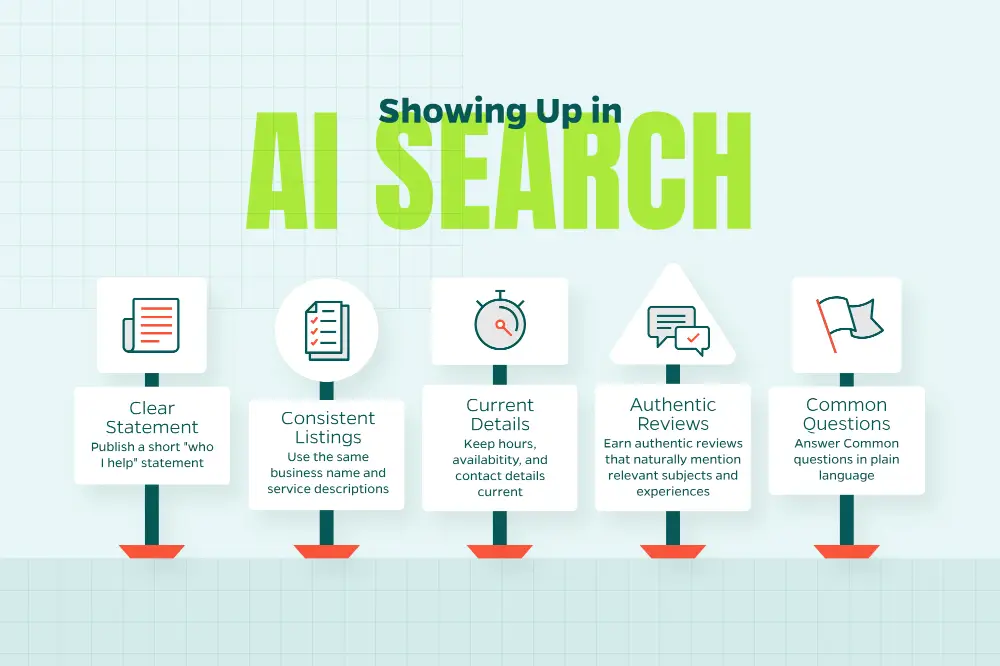
Treat your website and third-party reputation as one connected project. A polished claim such as “best tutor in town” is less persuasive than consistent, independently supported descriptions of what you teach and whom you have helped. AI visibility is a reason to improve trust signals, not to promise placement in an answer.
Get Local: Schools, Community Groups, and Flyers
Local tutoring clients often come from places where parents already spend time. Relationships with schools and community organizations can put your services in front of families with a timely need, without requiring a large advertising budget.
- Offer counselors, PTA groups, and after-school coordinators a concise description of your specialties and booking process.
- Ask libraries, community centers, and youth organizations about permitted bulletin boards or newsletter listings.
- Make tutoring flyers specific: “Algebra I support for grades 8–9,” a service area, and a QR code leading directly to scheduling.
- Host a short study-skills workshop or test-preparation evening that gives families useful help before asking them to book.
Respect school solicitation policies, and avoid implying a school endorses your business unless it has agreed to do so.
Use Social Media to Show How You Teach
Social media should help parents picture the learning experience, not merely display promotional offers. Post a brief explanation of a common math mistake, a reading exercise, or a rehearsal tip. With appropriate permission, share a student achievement or a behind-the-scenes look at your lesson approach.
Choose one or two platforms that local parents use instead of posting everywhere. In parent Facebook groups, answer questions helpfully and follow the group’s promotional rules. Give interested families a direct path from the post to your schedule or inquiry page.
Decide Whether Tutoring Marketplaces Are Worth the Fee
Tutoring marketplaces can help a new instructor reach families before an independent website has traction. They may also provide a familiar booking experience and an early source of feedback. The trade-off is platform fees, competition, and reduced control over how customers find you.
According to Wyzant’s tutor fee guidance cited in the October 2026 research brief, the platform retains 25% of a tutor’s posted lesson rate, leaving 75% for the tutor; terms and exceptions should be checked before publication. Compare the net income and retention of marketplace students with clients you acquire independently.
A marketplace can be a useful starting channel, but build referrals, your website, and direct inquiries in parallel. Follow the platform’s rules regarding communication and bookings.
Test Paid Ads Small Before You Scale
Paid advertising can work when the audience, offer, and booking experience are tightly defined. Search ads can reach parents actively looking for “math tutor near me,” while Facebook and Instagram ads may introduce a local studio to families who are not yet searching.
“Before you set an advertising budget, you need to understand who you’re trying to reach, where they are and how they search,” says David Ohm, Director of Paid Advertising at Straight North. That means estimating demand for a particular subject and location before selecting a spend level.
“Before you set an advertising budget, you need to understand who you’re trying to reach, where they are and how they search.”

Start with a limited monthly test, a handful of high-intent search terms, and a landing page that explains the offer and makes booking simple. Exclude irrelevant searches, monitor actual inquiries, and avoid increasing spend until booked students justify the cost. Adjust timing around back-to-school periods, report cards, entrance exams, and final-exam season.
Turn Inquiries Into Booked Students
Marketing does not produce a paying student when it stops at a contact form. The critical sequence is discovery → inquiry → first lesson → ongoing package → referral. Many tutoring businesses invest heavily in the first two steps while leaving the rest to chance.
- Respond the same day. Confirm that you received the inquiry, offer the next available time, and provide one clear next action.
- Qualify the need. Ask about the student’s grade, subject, learning goal, preferred format, and schedule before recommending a plan.
- Design a useful introduction. A consultation or introductory lesson should identify needs, demonstrate your teaching approach, and explain the next step.
- Offer a recurring plan. Recommend a realistic lesson frequency and package, then book upcoming sessions before the first meeting ends.
- Follow up respectfully. If a parent goes quiet, send a concise reminder with availability and an easy way to decline.
“A strong introductory offer lowers the barrier to getting someone in the door, but it should also lead naturally toward enrollment,” says David Ohm, Director of Paid Advertising at Straight North. An introduction should deliver real value while helping families understand what continued instruction would look like, rather than attracting only people seeking a free session.
“A strong introductory offer lowers the barrier to getting someone in the door, but it should also lead naturally toward enrollment.”
Make payment terms, cancellation policies, expected milestones, and progress updates clear before a family commits. Reliable communication supports retention as much as the quality of instruction.
Judge Every Channel by Cost per Booked Student
The most useful tutoring marketing metric is cost per booked student, not the number of clicks or inquiries. Ask every new family how they heard about you and record the answer. For ads, use dedicated forms or call tracking where appropriate, and connect the lead to its eventual booking.
“The cheapest lead is not necessarily the most valuable lead,” says David Duerr, Straight North CEO. “A channel that produces fewer inquiries can still be the better investment if those prospects are more likely to apply, enroll, or fill a priority program.” For tutors, the equivalent outcome is a paying student who continues attending.
“The cheapest lead is not necessarily the most valuable lead. A channel that produces fewer inquiries can still be the better investment if those prospects are more likely to apply, enroll, or fill a priority program.”

Use this blank monthly scorecard to compare channels. Include your time at a reasonable hourly value in each channel’s cost, and divide that total by the number of new paying students booked through the channel. Also track how many remain enrolled after 60 days.
Channel | Monthly cost (money + time) | Inquiries | Booked students | Still booked at 60 days | Cost per booked student |
Referrals |
|
|
|
|
|
Local search |
|
|
|
|
|
Community |
|
|
|
|
|
Social media |
|
|
|
|
|
Marketplaces |
|
|
|
|
|
Paid ads |
|
|
|
|
|
Review the scorecard monthly. Reduce effort on channels that cost more than the resulting student relationships can support, and reinvest in those producing lasting bookings.
Music Schools and Lesson Studios: What Changes
Music school marketing must sell the experience of learning and performing, not just an hourly appointment. Recitals and showcases can demonstrate progress and create natural referral opportunities, provided families consent to any photos or recordings.
- Build instrument-specific pages, such as “piano lessons for kids in Aurora,” with ages served and lesson times.
- Offer a structured trial lesson that introduces a clear ongoing tuition plan.
- Promote fall enrollment, New Year openings, summer camps, and suitable sibling or family discounts.
- Track monthly tuition retention, attendance, and instructor capacity alongside new inquiries.
Online Classes and Online Academies: What Changes
Online tutoring reaches a broader market, which makes specialization more important. “Online math tutoring” competes with many providers; “AP Calculus BC support for homeschool students” tells a specific family why your program fits.
- Offer a sample class, live webinar, or useful downloadable lesson to demonstrate teaching quality.
- Show time zones, technology requirements, class size, and available schedules before registration.
- Publish authentic testimonials from families in different locations, with permission.
- Build an opt-in email list and share practical teaching advice, enrollment dates, and relevant class openings.
For online academies, a clear enrollment journey and consistent follow-up can replace some of the local word-of-mouth momentum a neighborhood tutor enjoys.
Your First 30 Days: A Simple Plan
Week 1: Define your niche, update an eligible Google Business Profile, and publish a clear website or booking page.
Week 2: Ask satisfied families for referrals and honest reviews, and establish a repeatable request process.
Week 3: Contact two relevant local partners and test one focused flyer or community workshop.
Week 4: Run a small, measurable ad test if the budget allows, and begin tracking bookings and 60-day retention.
FAQs
Where can I find clients for tutoring? Start with family referrals, local search, school and community connections, and a clear website. Social content, marketplaces, and carefully targeted ads can add reach once your booking process works.
Is $30 or $40 an hour a good tutoring rate? It depends on the subject, student level, local demand, credentials, and teaching format. Compare relevant local and marketplace listings, calculate your costs, and consider pricing ongoing packages rather than isolated hours.
Is a tutoring business profitable? It can be when rates cover instruction, preparation, acquisition costs, and overhead, and when enough students rebook. Monitor retention and cost per booked student before assuming inquiry volume translates into profit.
Need Help?
Ready to grow your tutoring business, lesson studio, or online academy? Contact Straight North to discuss education marketing.