

The private school marketing strategies that increase enrollment start with the grades that have open seats. Show families why tuition is worthwhile, make it easy to book a visit, reach parents through search and relevant ads, involve current families, and follow up after every tour until the next admissions step is clear.
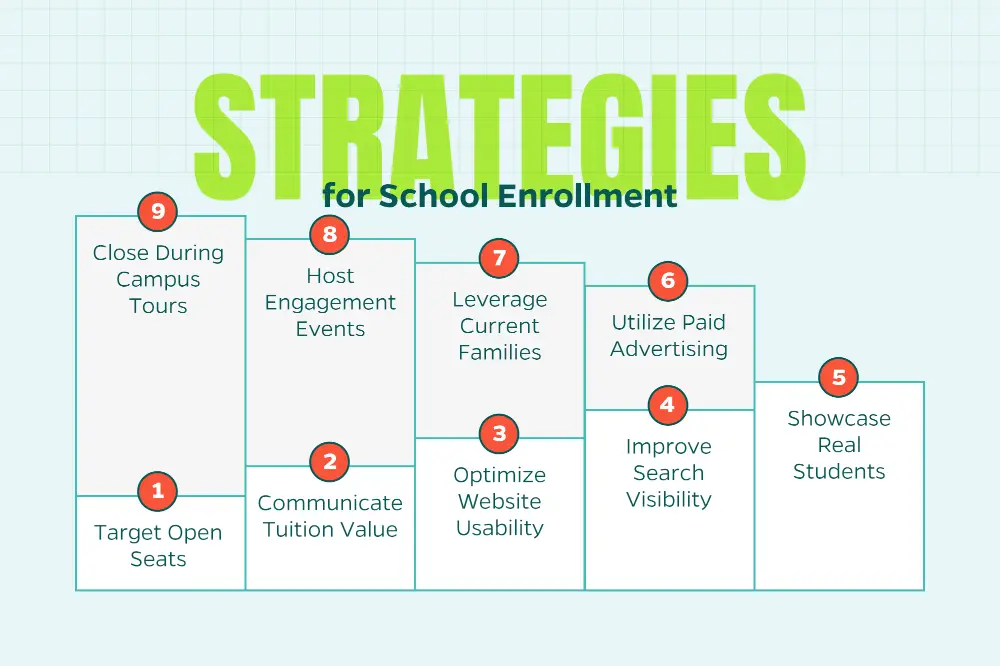
Here are nine practical ways to turn marketing activity into enrolled students this admissions season.
- Start with the grades that have open seats.
- Sell the value of tuition, not your mission statement.
- Make your website easy for parents to act on.
- Get found in search and AI search.
- Show real students on social media and video.
- Use paid ads to reach families before they decide.
- Turn current families into your recruiting team.
- Host small events that lead to a visit.
- Treat every campus tour as the close.
Why Private School Enrollment Takes a Plan Now
Families can compare schools long before contacting an admissions office. They investigate tuition, commute times, student support, academics, and school culture across search engines, social platforms, recommendations, and AI tools. A referral may put a school on the shortlist, but it does not guarantee a tour or fill the particular grade with vacancies.
“As more families consider private-school options, schools are competing for attention earlier and across more channels than they may have in the past,” says Frank Fornaris, Straight North President. “Strong SEO and GEO help schools get found during the research process, while paid search and social can help them reach families sooner and communicate what makes the school meaningfully different.”
“As more families consider private-school options, schools are competing for attention earlier and across more channels than they may have in the past. Strong SEO and GEO help schools get found during the research process, while paid search and social can help them reach families sooner and communicate what makes the school meaningfully different.”

1. Start With the Grades That Have Open Seats
A private school should aim its marketing first at the grades where capacity exists and an additional enrollment matters. Before selecting channels, build a simple seat map using the admissions team’s latest counts. Separate available seats from expected re-enrollments, pending offers, and waitlists so the numbers reflect realistic opportunities.
Example Open-Seat Map (Illustrative Figures Only)
Grade Band | Capacity | Enrolled | Open Seats | Priority |
Pre-K | 40 | 28 | 12 | High |
K–2 | 90 | 86 | 4 | Hold |
3–5 | 90 | 88 | 2 | Hold |
6–8 | 90 | 72 | 18 | High |
9–12 | 120 | 114 | 6 | Hold |
In this example, Pre-K and grades 6–8 deserve most of the immediate recruiting attention. An elementary grade with two openings may need a targeted referral, not a broad paid campaign. An oversubscribed grade should not receive advertising that generates inquiries the school cannot accommodate.
Look closely at natural entry points such as Pre-K, kindergarten, sixth grade, and ninth grade. Families often reconsider school options at these transitions. Build grade-specific landing pages and events around the openings, then adjust as offers are accepted and seats disappear.
“Education organizations don’t need the most leads; they need the right students for the programs, locations, and start dates they are trying to fill,” says David Duerr, Straight North CEO. “Marketing becomes much more effective when it has visibility into enrollment capacity and can focus on the areas where an additional student matters most.”
“Education organizations don’t need the most leads; they need the right students for the programs, locations, and start dates they are trying to fill. Marketing becomes much more effective when it has visibility into enrollment capacity and can focus on the areas where an additional student matters most.”

2. Sell the Value of Tuition, Not Your Mission Statement
Parents need a concrete explanation of what tuition buys and why your school is a better fit than the alternatives. A mission statement can express the school’s identity, but broad promises about excellence, character, and community rarely answer the financial question a family is asking.
A useful school value proposition connects specific strengths to outcomes and experiences that matter to parents. Rather than claiming “individualized attention,” explain how often students meet with teachers, what support is available, and how families see progress. Avoid promising outcomes you cannot document.
Proof that helps justify tuition includes:
- Typical class sizes and how teachers support students with different learning needs.
- Academic offerings, enrichment programs, arts, athletics, and extracurricular access.
- Documented student outcomes, graduation pathways, or school-specific measures of progress.
- Safety policies, student health resources, supervision, and communication practices.
- A clear breakdown of tuition, fees, financial aid, and payment-plan options.
- Firsthand parent and student stories that illustrate the everyday experience.
Price transparency is a trust signal. Publish current tuition and fees, or provide a clearly labeled range and a direct route to accurate figures. Explain aid eligibility and application timing. If financial assistance is available, say how families can begin the process before they rule themselves out.
“Parents may be the real decision-makers, so your targeting and messaging need to reflect that,” says Michael Lovelle, a Senior Paid Advertising Strategist at Straight North. Show families what tuition delivers in terms of classroom experience, teacher access, affordability, and measurable outcomes.
3. Make Your Website Easy for Parents to Act On
A private school website should help a parent find the essential facts and take the next admissions step without searching through multiple menus. Mobile speed, readable layouts, accessible forms, and obvious calls to action matter because a parent may be researching schools between other obligations.
Every admissions page should make these tasks simple:
- Confirm grades served, location, transportation considerations, tuition, and application deadlines.
- Find one primary action, such as “Schedule a Tour,” supported by “Request Information” or “Apply.”
- Read a concise explanation of the admissions process and required documents.
- Find student safety, health, emergency, and policy information without digging through unrelated pages.
- Submit a short mobile-friendly form and receive confirmation of the next step.
“It’s important that student health resources, policy documents, rules and regulations, news and updates, emergency response information, and any other important content that may be related to safety is not buried too deep within the website or too difficult to find,” says Bryan Paravola, a Straight North Senior SEO & GEO Strategist. Clear navigation makes this information useful to prospective families and reinforces trust.
“It’s important that student health resources, policy documents, rules and regulations, news and updates, emergency response information, and any other important content that may be related to safety is not buried too deep within the website or too difficult to find.”

A focused school website design process should prioritize the admissions journey, not just the appearance of the homepage.
4. Get Found in Search and AI Search
“Parents may search by neighborhood, suburb, commute route or a very specific need like preschool, test prep or after-school tutoring,” says Bob Hand, a Straight North Senior SEO & GEO Strategist. Parents also use Google, school comparison sites, and AI tools to research options. Give each grade and distinctive program a clear, accurate page, maintain consistent local information, and answer the questions families ask before scheduling a tour.
“Parents may search by neighborhood, suburb, commute route or a very specific need like preschool, test prep or after-school tutoring.”

5. Show Real Students on Social Media and Video
Social content works best when it lets parents picture their child at your school. Real classrooms, student work, teachers, and ordinary school moments are more persuasive than interchangeable stock imagery. Secure appropriate permissions, follow school privacy policies, and avoid publishing sensitive student information.
Build a repeatable mix of formats:
- Day-in-the-life clips showing a typical experience in a grade with openings.
- Teacher spotlights explaining classroom approaches and student support.
- Short virtual tours featuring spaces prospective families will visit.
- Parent testimonials focused on specific decisions, experiences, and outcomes.
- Event recaps that invite viewers to the next grade-level information session.
Test authentic, school-created or permissioned family content before commissioning an elaborate campaign. One strong classroom story can become a short video, an email feature, a website testimonial, and a slide for an open-house presentation. This is practical video marketing for schools because each asset supports the same admissions message.
6. Use Paid Ads to Reach Families Before They Decide
Paid search can reach parents already comparing schools, while Facebook and Instagram campaigns can introduce the school to relevant local families earlier in their research. Start with the grade-specific openings identified in the seat map, a defined geographic service area, and a landing page that invites a tour. Use platform-compliant targeting, avoid sensitive inferences about children, and review lead quality with admissions staff. Pause or redirect campaigns as grades fill. The goal is not the cheapest inquiry; it is a realistic path to an enrolled student.
7. Turn Current Families Into Your Recruiting Team
Current families can help prospective parents understand what school life is like in a way advertising cannot. Make word of mouth marketing for schools a deliberate, respectful program rather than relying on occasional recommendations. Keep the experience voluntary, and avoid pressuring families to make public endorsements.
- Invite a small parent ambassador group to answer prospective families’ questions at approved events.
- Create a simple parent referral program with a shareable admissions page and clear participation rules.
- Ask willing families for specific, permissioned testimonials for the school website.
- Keep profiles on relevant school comparison sites, including Niche, accurate and consistent.
- Communicate student experiences and school improvements to existing families throughout the year to support re-enrollment.
Independent third-party mentions can reinforce credibility, but schools should not chase review volume. Google has restricted reviews for Business Profiles primarily categorized as schools serving ages 6–18, so do not build a K–12 review strategy around soliciting new Google ratings. Instead, keep factual listings current and use authentic testimonials through channels that permit them.
8. Host Small Events That Lead to a Visit
Small, grade-specific gatherings often let families ask better questions than a crowded all-school event. Match the event to the grades with available seats, and make the next admissions step unmistakable.
- A coffee with the head of school for incoming kindergarten families.
- A shadow day for students considering middle or high school.
- A grade-level information night with teachers, admissions staff, and current parents.
Collect permission to follow up, answer questions promptly, and invite each attendee to a personalized campus tour. Measure the event by completed visits and applications, not just attendance.
9. Treat Every Campus Tour as the Close
A campus tour is one of the most important decision points in private school admissions. The National Association of Independent Schools’ 2024–2025 marketing research identified individual tours and group open houses as the most effective admissions touchpoints among surveyed schools. That makes the process before and after a visit just as important as the tour itself.
Use a five-step tour process:
- Respond: Contact new inquiries the same business day when possible. Confirm the child’s grade, intended start date, and primary questions.
- Book: Offer a specific tour appointment during the first conversation. Send a confirmation with directions, parking details, accessibility information, and the visit agenda.
- Personalize: Show classrooms and programs relevant to the child’s grade and interests. Arrange a conversation with a teacher from that grade when feasible, and leave time for questions about tuition and support.
- Follow Up: Within one business day, thank the family, answer outstanding questions, and provide one concrete next step: a shadow day, an admissions conversation, or the application link.
- Track: Record tour requests, scheduled visits, completed tours, applications, offers, deposits, and enrollments by grade and source. Review where families stop moving forward.
Follow-up should feel helpful, not automated or relentless. Send a short personal message referencing the family’s interests, include the promised resources, and make the next step easy. Assign one admissions owner so no inquiry gets lost between marketing and the front office.
Track conversion at each stage rather than reporting website visits alone. If many families request tours but few attend, investigate scheduling and reminders. If visits are strong but applications are weak, examine the tour experience, tuition concerns, and post-visit communication. Improvements at these handoffs may produce more enrollments without increasing advertising spend.
Build the Plan and Budget Around Open Seats
Marketing budgets should follow enrollment goals, not a fixed list of channels. In the NAIS 2024–2025 State of Independent School Marketing research, 54% of responding schools reported annual marketing budgets above $70,000, while 30% reported operating with a single-person marketing function. These figures describe surveyed schools, not a required budget for every campus.
Set a target for new enrolled students by grade, estimate the number of inquiries and tours needed based on your own historical conversion rates, and fund the activities most likely to close the gap. Revisit allocations as deposits arrive.
Where to Start This Admissions Season
- Build the seat map and choose the two or three grades with the greatest, realistic enrollment opportunity.
- Fix tour response times, visit personalization, and post-tour follow-up before driving more inquiries.
- Choose two channels that reach families for those grades, then measure tours, applications, and deposits.
Frequently Asked Questions
How Do You Attract Parents to Your School?
Show parents that the grade they need has availability, explain what tuition covers, demonstrate student experiences and outcomes, and offer a simple way to visit. The strongest message connects a family’s needs with a clear next step.
What Are Good Marketing Ideas for School Admission?
Low-cost ideas include student shadow days, teacher-led grade nights, parent ambassadors, and short videos featuring real school experiences. Each activity should point toward a tour or application.
How Do You Increase Private School Enrollment on a Small Budget?
Start with the grades that have vacancies, improve inquiry and tour follow-up, and activate current-family referrals. Add paid campaigns only when the school can respond to demand and measure results.
How Is Private School Marketing Different From Public School Marketing?
Private schools generally must persuade families to choose their school and justify tuition. That places greater emphasis on a clear value proposition, affordability information, admissions service, and the campus visit.
Need Help?
Talk to Straight North enhancing the marketing efforts at your school.