

Facebook and Instagram ads can help schools fill seats when campaigns reach families early, show authentic school experiences, and measure enrollment rather than clicks. Start with a realistic geographic audience, connect inquiries to admissions outcomes, and adjust spending to the school’s enrollment calendar.
For a private K–12 school, the goal is not simply to make a parent stop scrolling. It is to turn awareness into a campus visit, an application, and ultimately a student in a classroom. The same principles can support colleges, trade schools, and childcare providers, although their audiences and decision timelines differ.
When Facebook Ads Work for Schools
Do Facebook ads actually work for schools? Yes, when a school has a reachable local audience, credible images or videos, and a reliable process for answering inquiries. Facebook and Instagram are particularly useful for independent and private K–12 schools because families often compare a school’s culture, programs, location, and fit long before completing an application.
Both placements can run through the same Meta Ads Manager campaign. A school can test whether its message performs better in Facebook Feed, Instagram Stories, or Reels without building two disconnected advertising programs.
- Ads work well when a school can define a practical commuting area and offer a clear next step, such as an open house or tour.
- Ads work best when admissions staff respond promptly and can connect each inquiry to an eventual outcome.
- Ads struggle when schools rely on generic stock imagery, leave inquiries unanswered, or begin advertising just days before applications close.
Paid social is therefore most useful as one part of an enrollment plan, not an emergency fix for empty seats.
Facebook Ads vs. Google Ads vs. Organic Social for Schools
The right channel depends on whether a family is already searching or still exploring its options. Schools often need a coordinated mix rather than an either-or choice.
- Facebook and Instagram ads introduce a school to families who may not yet be searching; they need compelling stories and a clear audience geography.
- Google Ads capture existing intent, such as searches for “private elementary schools near me”; they need relevant keywords and helpful landing pages.
- Organic social posts keep current families connected and showcase daily school life; paid campaigns extend that content to prospective families.
A family might first see a classroom video, later search for tuition information, and finally return to book a tour. Consistent messaging across those encounters makes the decision easier.
Facebook and Instagram Ad Formats That Work for Schools
Which Facebook and Instagram formats should schools use? Choose the format based on the enrollment action you want, not what looks newest in Ads Manager.
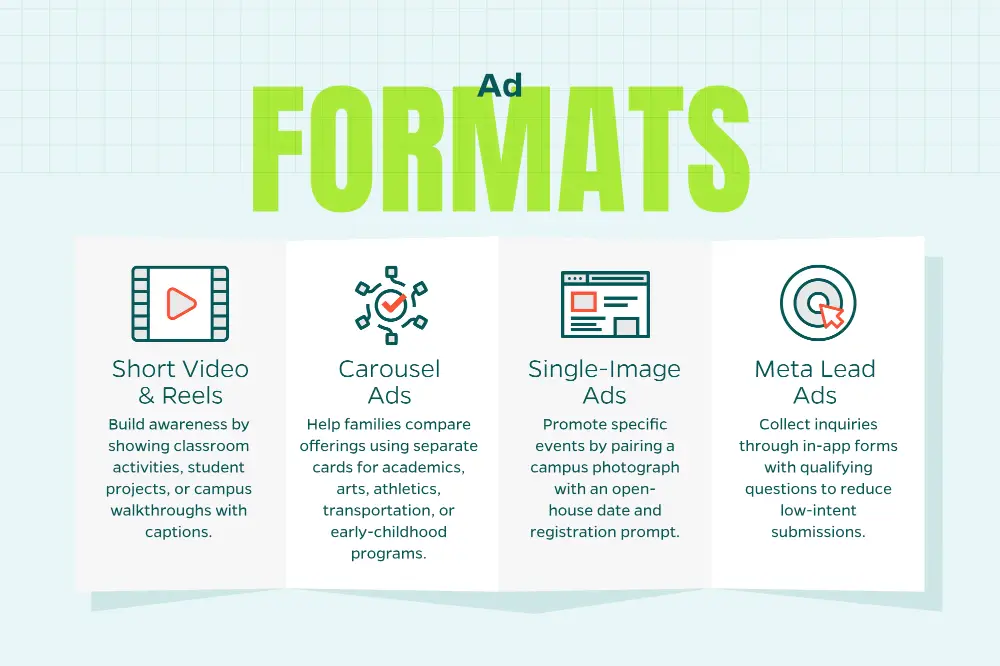
- Short video and Reels build awareness. Show a classroom activity, student project, or brief campus walkthrough with captions for sound-off viewing.
- Carousel ads help families compare offerings. Use separate cards for academics, arts, athletics, transportation, or early-childhood programs.
- Single-image ads promote a specific event. Pair a strong campus photograph with an open-house date and a direct registration prompt.
- Meta lead ads collect inquiries through an in-app instant form. Ask one or two qualifying questions, such as the student’s intended grade or desired start year, to reduce low-intent submissions.
A school can also retarget past website visitors or video viewers with a tour invitation. The creative should change as families move from curiosity to active comparison.
How to Target Parents (and Students) on Facebook in 2026
How do you target parents on Facebook ads now that Meta automates much of audience selection? Start with geography and trustworthy first-party signals, then let delivery systems learn which people respond. Narrow interest stacks are not a substitute for accurate enrollment data.
- Define the enrollment area. Select relevant ZIP codes, communities, or a reasonable radius around the campus and bus routes. A small school should not pay for inquiries from families who cannot realistically attend.
- Build useful audience signals. With appropriate consent and platform permissions, use lists of past inquiries or families, website visitors, and video viewers to create custom audiences. Test lookalike audiences where available. Protect student and family information.
- Use automated audience options carefully. Meta’s Advantage+ audience tools may treat many detailed-targeting inputs as suggestions rather than fixed boundaries. Review the controls available for the chosen campaign objective and confirm that location restrictions behave as intended.
- Separate messages by decision-maker. Parents may prioritize safety, academic outcomes, class size, tuition, and transportation. Older students may respond more to belonging, activities, and the day-to-day experience. Distinct creative can help Meta identify interested groups without excessive filtering.
- Exclude or re-engage thoughtfully. Use eligible custom-audience exclusions to avoid wasting acquisition spending on families who already enrolled, while offering appropriate next-step messages to families who have inquired but not applied.
Meta restricts advertising to teens under 18: advertisers generally cannot use interests or activity-based targeting to reach them, with age and location among the permitted targeting inputs. For K–12 enrollment, focus acquisition messaging primarily on parents and guardians rather than trying to infer a minor’s interests. Education itself is not a Meta Special Ad Category, although all campaigns must still follow Meta’s applicable policies.
What about targeting college students?
Higher education campaigns can use relevant adult age groups, campus geography, program-specific messaging, and retargeting of prospective students who visited admissions pages. Education-related audience signals may vary by account and campaign setup, so check current availability rather than assuming every demographic filter exists. A working adult comparing certificate programs needs different creative from a high-school senior exploring campus life.
For more context on Meta’s shifting automation tools, see Straight North’s article on adapting campaigns to Meta’s AI evolution.
What School Ad Creative to Test First
The strongest school ads show real experiences and give families a reason to take the next step. An authentic student story often communicates more than a polished, generic campus image.
“Start by testing user-generated content that shows real students, real experiences and the environment they’re actually learning in,” advises Michael Lovelle, a Straight North education paid advertising contributor. That means using approved footage of a classroom, a teacher explaining a lesson, or a family describing a school visit, rather than relying only on promotional graphics.
“Start by testing user-generated content that shows real students, real experiences and the environment they’re actually learning in.”

- Test a parent testimonial focused on confidence, fit, and the admissions experience.
- Test a short vertical day-in-the-life video featuring real school activities, with appropriate permissions.
- Test a program-focused carousel showing distinct benefits such as small classes, enrichment, or student support.
- Test an event-specific image with “Book a tour” or “Register for an open house” as the primary call to action.
Launch three or four meaningfully different concepts before spending time on tiny headline changes. Compare which messages generate qualified tours and applications, not merely which collect the most reactions. Use clear, high-resolution assets and ensure every promise matches the destination page.
How Much to Budget for School Facebook Ads, and When to Spend It
How much should a school spend on Facebook ads? Budget from the number of open seats, the families realistically within reach, the value of an enrollment, and the time remaining before decisions are made. There is no universal monthly amount that guarantees results.
“Before you set an advertising budget, you need to understand who you’re trying to reach, where they are and how they search,” says David Ohm, Straight North Director of Paid Advertising. A neighborhood preschool and a regional boarding school have very different reachable audiences, conversion paths, and costs.
“Before you set an advertising budget, you need to understand who you’re trying to reach, where they are and how they search.”

Start by estimating the number of additional enrollments needed. Then examine the school’s historical inquiry-to-tour, tour-to-application, and application-to-enrollment rates. Those rates help estimate how many qualified inquiries advertising must support. Allocate enough spend to a small number of campaigns to gather meaningful conversion data rather than dividing a modest budget across many tiny ad sets.
The enrollment calendar matters as much as the total. For a school with an April application deadline, a practical sequence might look like this:
Window | Family stage | Campaign focus | Success signal |
Fall | Early exploration | Campus-life videos and awareness | Engaged visits and video views |
October–January | Active comparison | Open-house invitations and inquiry ads | Registrations and qualified inquiries |
February–April | Application decision | Retargeting, tour reminders, and application prompts | Completed applications |
Spring onward | Re-enrollment or waitlist | Relevant follow-up for eligible families | Confirmed seats and waitlist movement |
Start months before the deadline so campaigns can collect useful signals while families still have time to visit and apply. Increase investment around open houses and meaningful decision periods, then reduce acquisition spend when a family cannot reasonably enroll. Cost per thousand impressions (CPM) and cost per click will vary with geography, season, placement, competition, and creative quality.
A limited budget is more effective when concentrated on one clear goal and a realistic enrollment window. Do not assume that spending more will solve an unclear offer or a slow admissions process.
Fix What Happens After the Click
Why do school Facebook ads get clicks but no inquiries? Often, the page after the ad creates unnecessary work. A mobile visitor who taps “Schedule a tour” should arrive at a fast, relevant page with the tour details and a short registration form, not a generic homepage.
Keep the next step obvious, ask only for information admissions needs immediately, and acknowledge submissions automatically. Have a staff member follow up the same day whenever possible. If families routinely abandon the page or never hear back, improve that experience before raising the media budget.
Measure Cost per Enrolled Student, Not Cost per Lead
How should schools measure whether Facebook ads work? The most important business metric is cost per enrolled student: total attributable advertising cost divided by students who enroll. Cost per inquiry, cost per tour, and cost per application are useful leading indicators, but they do not prove that a campaign fills seats.
“The cheapest lead is not necessarily the most valuable lead,” says David Duerr, Straight North CEO. “A channel that produces fewer inquiries can still be the better investment if those prospects are more likely to apply, enroll, or fill a priority program.” A low-cost instant form can produce many names while contributing few serious applicants.
“The cheapest lead is not necessarily the most valuable lead. A channel that produces fewer inquiries can still be the better investment if those prospects are more likely to apply, enroll, or fill a priority program.”

Follow each prospect through a consistent admissions funnel: inquiry received, tour scheduled or attended, application started, application submitted, acceptance, and enrollment. The exact stages will vary by school. A CRM or student information system should record status changes so the marketing team can identify which ads and messages lead to enrolled families.
Use this measurement checklist before scaling campaigns:
- Install and test the Meta Pixel and Conversions API with appropriate privacy safeguards and consent practices.
- Define inquiry, tour, application, and enrollment events with consistent naming and deduplication.
- Connect CRM or student information system outcomes to those events when permitted, minimizing personal data shared.
- Review qualified-inquiry rate, tour rate, application rate, and monthly cost per enrolled student by campaign.
- Retarget eligible families who stalled after an inquiry with a relevant next step, such as a tour reminder or application deadline.
Meta’s legacy Offline Conversions API was discontinued in 2025; schools using supported server-side integrations should send eligible offline outcomes through the Conversions API rather than relying on an obsolete upload workflow. Confirm the latest integration requirements with Meta and your admissions software provider.
For example, one campaign might deliver 40 inquiries and two enrollments, while another delivers 20 inquiries and four enrollments. The second campaign is stronger on enrollment efficiency if spending is comparable, even though its cost per lead is higher. That is why admissions feedback should shape the next creative and budget decisions.
Next Steps for Your School’s Facebook Ads
A useful first campaign does not require a complicated account structure. It requires a clear enrollment goal, credible creative, and a way to tell whether interested families eventually register.
- Connect ad reporting to inquiry, tour, application, and enrollment records.
- Map open houses, application deadlines, and waitlist periods before choosing a spending schedule.
- Launch two distinct parent-focused creative concepts, then refine them using qualified outcomes.
Frequently Asked Questions
Is $500 a month enough for Facebook ads for a school?
$500 may support one tightly focused local campaign, but it is a limited testing budget. Concentrate it during an important enrollment period rather than spreading it thinly across many audiences and months; results are not guaranteed.
How much do Facebook ads cost per 1,000 views?
Advertisers commonly compare impressions using CPM, or cost per 1,000 impressions, which is different from video views. CPM depends on audience size, competition, placement, season, and creative; use your own account results to set expectations.
How do I set up Facebook advertising for a school?
Create or confirm the school’s Facebook Page, establish a Meta Business portfolio and ad account, set appropriate access permissions, and install the Pixel and conversion tracking before launch. Then choose an enrollment-related objective, build an audience, add creative, and verify the destination and inquiry follow-up process.
Need Help?
Want help turning paid social into enrolled students? Contact Straight North about Facebook and Instagram advertising.