

Education lead generation is the process of attracting prospective students or families and turning their interest into inquiries that admissions can pursue. The strongest programs do more than collect contact details. They define qualified inquiries, capture calls and forms, respond quickly, connect advertising to application outcomes, and compare sources by cost per application.
What Counts as a Qualified Student Inquiry
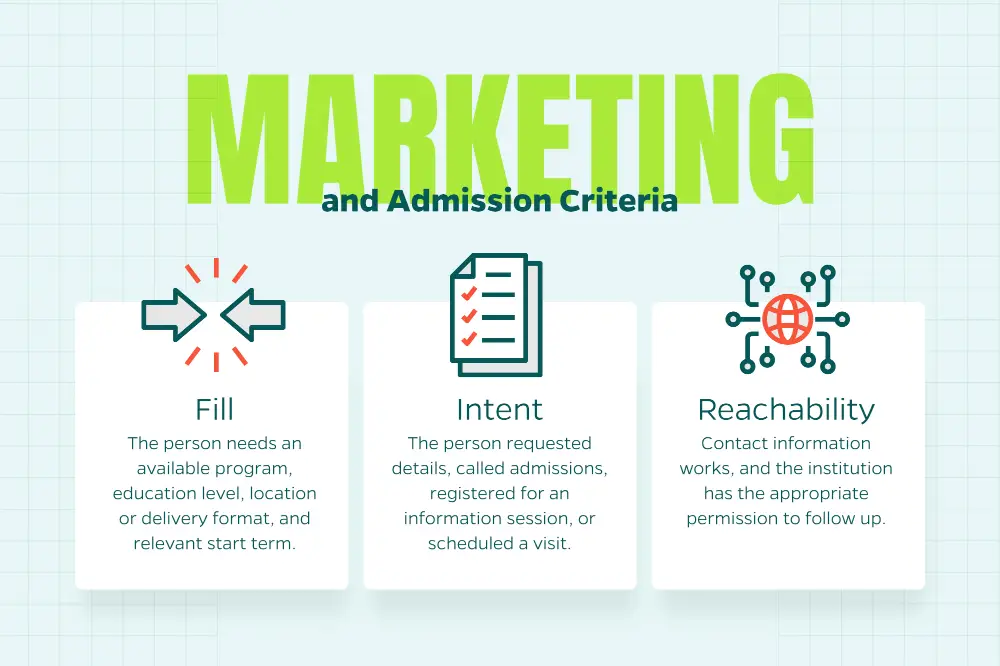
A student lead is a contact; a qualified inquiry is a prospective student or family whose needs match a program the institution can enroll. Marketing and admissions should agree on three tests before assigning a lead score or purchasing names.
- Fit: The person needs an available program, education level, location or delivery format, and relevant start term.
- Intent: The person requested details, called admissions, registered for an information session, or scheduled a visit.
- Reachability: Contact information works, and the institution has the appropriate permission to follow up.
Qualification does not mean admission is guaranteed. It means the inquiry is relevant enough for a counselor to take a meaningful next step. A campaign with fewer such inquiries can be more valuable than one that produces hundreds of unresponsive names.
Buy Student Leads or Build Your Own Inquiries?
Schools can buy student leads, but owned inquiries should form the foundation of an enrollment pipeline. Third-party lists may fill a temporary gap for a specific program. Yet, they rarely provide the same control over student expectations, consent, and the first interaction as an inquiry generated directly through the institution.
Lead source | How it works | What you pay for | Quality risk | Best use |
Shared or aggregator | One prospect is offered to several schools. | Names or delivered inquiries. | Competition, duplicate contacts, weak intent. | Limited tests for a program gap. |
Exclusive vendor | A provider supplies inquiries assigned to one school. | Exclusive contacts or campaigns. | Unclear qualification or sourcing. | Supplement when quality is verified. |
Owned inquiries | Students respond to your search, social, content, events, or referrals. | Media, content, and operations. | Capture or follow-up failures. | Core, sustainable pipeline. |
Shared leads can look inexpensive on a cost-per-name report, yet multiple institutions may contact the same person almost immediately. Test vendors against applications, not just deliveries, and review source transparency, duplicate policies, lead age, and permission records before signing.
The FCC’s proposed one-to-one consent rule was vacated by a federal appeals court in January 2025 and later removed. That change does not eliminate existing consent obligations for marketing calls or texts. Have counsel review applicable federal and state rules, vendor records, and the precise consent language. (This is not legal advice.)
The Channels That Produce Qualified Student Inquiries
The best channel depends on the program, the audience, and how close the prospective student is to making a decision. Higher education lead generation should be planned by program and start term rather than through one institution-wide media allocation.
- Paid search: Reach people searching for a degree, credential, or school. Separate program-specific campaigns and exclude employment searches such as “welding jobs” when promoting training, not jobs.
- Paid social: Reach definable audiences when search demand is limited. Add a relevant qualifying question to convenient, prefilled lead forms.
- SEO and AI search: Build helpful program pages answering admissions, cost, format, career-path, and start-date questions. These are durable owned discovery assets, although results take time.
- Events and conversations: Use virtual open houses, campus visits, current-student chats, and admissions information sessions to turn research into active interest.
- Referrals: Encourage alumni, current families, and community partners to share programs with people who may be a good fit.
A channel should earn more budget only when its inquiries progress. For example, paid social may deliver many names while a narrow search campaign produces more applications. Compare both against the same definition of a qualified inquiry.
Capture Every Inquiry: Forms, Calls, and the First Hour
Schools often lose inquiries they have already paid to generate because a form fails, a phone call goes untracked, or a request sits unassigned. Fixing those handoffs can improve results before any increase in advertising spend.
“Your landing page should make the next step obvious,” says David Ohm, Director of Paid Advertising at Straight North. “You can have great content, but if a prospective student or parent isn’t sure what to do next, you risk losing them.” Each program page should make it easy to request information, book a visit, or begin an application, with the primary action prominent on mobile.
“Your landing page should make the next step obvious. You can have great content, but if a prospective student or parent isn’t sure what to do next, you risk losing them.”

Inquiry forms should request only what admissions needs to route the person: contact details, program of interest, intended start, and necessary permissions. Too many fields discourage completion; too few create extra qualification work. Test the entire submission path, including confirmation messages and CRM delivery.
Phone calls deserve the same attention. Parents evaluating private schools and prospective students comparing programs may call instead of submitting a form. Source-level call tracking helps identify which campaigns generated those conversations, while consistent call disposition records show whether they became qualified inquiries.
Responding within an hour is a useful operational target, not a guarantee of enrollment. Route each new inquiry automatically to a named counselor or admissions queue, with alerts and backup ownership when the first person is unavailable. A response should offer a relevant next step rather than a generic sales message.
Use this capture-and-handoff checklist:
- Agree with admissions on essential form fields and qualification rules.
- Display clear, appropriate consent language beside the submission action.
- Test desktop and mobile forms, confirmations, and CRM delivery.
- Attribute inbound calls to campaigns and record call outcomes.
- Route inquiries by program, campus, or modality to an accountable owner.
- Set an initial-response target of less than one hour, with backup coverage.
- Make a clear next step visible on every program landing page.
- Record tours, calls, information sessions, and applications in the CRM.
“Don’t stop measuring at the initial inquiry,” says Alex Schwimmer, Enterprise Paid Advertising Strategist at Straight North. “You should also track the actions that show continued interest, such as requesting information, scheduling a tour, making a call or taking another meaningful next step.” Those events reveal whether the capture process creates conversations, not just database entries.
“Don’t stop measuring at the initial inquiry. You should also track the actions that show continued interest, such as requesting information, scheduling a tour, making a call or taking another meaningful next step.”

Feed Admissions Outcomes Back Into Your Ad Platforms
Google Ads and Meta can find better prospects when schools send meaningful admissions outcomes back to their advertising systems. If a campaign measures only completed forms, its optimization may favor people likely to fill out forms, even when they never apply.
“A low cost per lead can look great on a report while masking a serious quality problem,” says David Ohm, Director of Paid Advertising at Straight North. A low headline cost can hide invalid contacts, mismatched programs, or prospects who never respond. Better targeting begins with better conversion signals.
“A low cost per lead can look great on a report while masking a serious quality problem.”
A practical feedback loop has four stages:
- Capture attribution. Preserve the ad click identifier when available, along with an email address or other permissible matching information, when the inquiry enters the CRM.
- Record admissions milestones. Have counselors mark inquiries as qualified, contacted, tour scheduled, applied, and enrolled using consistent definitions.
- Return outcomes to advertising. Configure eligible offline or enhanced lead conversions in Google Ads and the corresponding supported CRM-to-ad-platform integration for Meta. Apply appropriate consent and data-handling safeguards.
- Optimize for stronger outcomes. Once there is enough reliable application data for stable learning, test bidding toward applications or other meaningful downstream milestones instead of all form submissions.
The loop is simple: ad click → form or phone inquiry → admissions CRM qualification and application status → eligible conversion feedback to ad platform → better-informed campaign optimization. Google Ads supports enhanced conversions for leads and conversion goals such as qualified leads and converted leads; implementation should follow current platform documentation.
A CRM such as Slate, Salesforce, or HubSpot can support this process, but software alone cannot repair inconsistent status definitions. Marketing and admissions must agree on when an inquiry becomes qualified and when an application counts as submitted. Audit data matching, duplicate events, and delays before relying on automated bidding.
Without feedback, an algorithm may repeatedly reward inexpensive form fills. With reliable outcomes, the institution can steer spend toward the kinds of inquiries its admissions team can convert. This is often a stronger lever than repeatedly narrowing audience settings by hand.
Judge Every Lead Source by Cost Per Application
Schools and their agencies can reduce cost per application by cutting spend on sources whose inquiries rarely apply, repairing missed inquiries and slow handoffs, and returning application outcomes to advertising platforms. Cost per application is the clearest actionable measure of lead quality during an active recruitment cycle.
Metric | Formula | What it tells you | When to act |
Cost per inquiry | Spend ÷ inquiries | Efficiency of initial response. | Daily or weekly. |
Cost per qualified inquiry | Spend ÷ qualified inquiries | Whether contacts fit admissions criteria. | Weekly. |
Inquiry-to-application rate | Applications ÷ inquiries × 100 | How well each source progresses. | As applications arrive. |
Cost per application | Spend ÷ applications | Combined source quality and funnel efficiency. | Monthly during cycle. |
Cost per enrolled student | Spend ÷ enrolled students | Final acquisition economics. | After enrollment decisions. |
Consider a hypothetical comparison: Source A spends $4,000 for 200 inquiries and 10 applications, while Source B spends $4,000 for 80 inquiries and 20 applications. Source A wins on cost per inquiry ($20 versus $50), but Source B wins on cost per application ($200 versus $400). The figures are illustrative, not industry benchmarks.
“The cheapest lead is not necessarily the most valuable lead,” says David Duerr, Straight North CEO. “A channel that produces fewer inquiries can still be the better investment if those prospects are more likely to apply, enroll, or fill a priority program.” A more expensive inquiry may be the smarter purchase when it advances toward an actual seat.
“The cheapest lead is not necessarily the most valuable lead. A channel that produces fewer inquiries can still be the better investment if those prospects are more likely to apply, enroll, or fill a priority program.”

Review each paid campaign, organic channel, referral stream, and lead vendor side by side every month. Break out programs and start terms where practical, because a high-demand certificate and a selective graduate program have different economics. Look at both cost per application and inquiry-to-application rate before shifting spend.
Cost per enrolled student remains the final scorecard, but enrollment may occur months after the marketing decision. Cost per application provides earlier evidence for course correction. Keep an eye on application quality, too: incomplete or ineligible applications should not be treated as equal to viable candidates.
Lead Generation for K-12, Online, and Adult Programs
Education lead generation changes with who makes the decision. In private K-12, the parent or guardian is often the inquirer, and a phone conversation or campus tour may be the most useful next step. Online and adult programs may offer rolling starts or shorter consideration periods, making fast routing and clear schedules particularly important. Childcare inquiries often center on age eligibility, availability, location, and a tour. Edtech lead generation, by contrast, generally means selling products to institutions, a separate B2B process.
Start With One Source and One Number
Schools do not need to rebuild every campaign at once. Start with a focused test that connects marketing activity to a real admissions outcome:
- Audit capture by submitting test forms and calling published numbers, then confirm that each inquiry reaches the right owner.
- Choose one paid source and connect its qualified and applied statuses back to the ad platform.
- Report cost per application for every source through one admissions cycle, and adjust spend based on the results.
Education Lead Generation FAQs
How much should you pay for a student lead? There is no universal price. Work backward from a program’s acceptable cost per application, expected inquiry-to-application rate, and enrollment economics rather than relying on a vendor’s price per name.
Is it legal to buy student leads? Buying leads is not categorically prohibited, but outreach must satisfy applicable consent and marketing rules. Review the vendor’s sourcing and consent evidence, particularly before automated calls or marketing texts, with legal counsel.
What is an example of lead generation in education? A prospective student searches for an online MBA, clicks a program ad, requests information, and books an information session. Admissions can then qualify the inquiry and track whether it becomes an application.
What trends matter most? Schools are improving visibility in AI-assisted research, building owned first-party inquiry channels, and connecting admissions outcomes to ad-platform optimization. The common thread is measuring progression instead of accumulating names.
Need Help?
Want to turn student interest into applications? Contact Straight North for more help with education marketing.