

Social media for higher education works best when it supports enrollment, not just engagement. Colleges can use TikTok and YouTube to introduce themselves, Instagram to show campus life, Facebook to address parents, and LinkedIn to reach career-focused learners. The key is to match each post to a decision students need to make, then track whether it leads to inquiries, applications, and enrollment.
How Colleges Use Social Media to Recruit Students
Social media in higher education is a recruitment and reputation channel. It helps prospective students encounter a college before they search for it, evaluate whether they belong there, and ask questions without scheduling an admissions appointment. It also gives families and admitted students an accessible view of the institution between formal communications.
A campus tour video can make a school feel approachable. A student explaining a demanding major can help an applicant understand the workload. A timely housing Q&A can reassure an admitted student who is deciding whether to deposit.
Short, vertical video and candid student perspectives are particularly useful for reaching younger audiences. Polished institutional announcements still have a place, but they should not crowd out the everyday experiences prospects want to see. Using social media as a classroom learning tool is a separate question from using it to recruit students.
“Before content can rank, earn links, generate engagement, or build that authority, people really just need to find you,” says Michael Fatigato, Operations Specialist at Straight North. For enrollment teams, discovery is the starting point, not the final measure of success.
“Before content can rank, earn links, generate engagement, or build that authority, people really just need to find you.”

Which Social Media Platforms Colleges Should Use
The best social media platform for a college depends on whom it needs to enroll. Undergraduate prospects, parents, working adults, and graduate applicants use platforms differently. Start with audience behavior and program priorities rather than maintaining every available account.
Pew Research Center reported in July 2025 that about nine in 10 U.S. teens ages 13–17 used YouTube, while 63% used TikTok, 61% Instagram, 55% Snapchat, and 32% Facebook. These are teen usage figures, not college-applicant conversion rates, but they offer useful context for undergraduate recruitment.
Platform | Who you reach | Content that works | Enrollment job |
Prospective and current undergraduates | Reels, Stories, campus life, student Q&As | Build familiarity and belonging | |
TikTok | Discovery-oriented younger prospects | Student-led short videos, relatable explanations | Introduce the school to new audiences |
YouTube | Students and families researching deeply | Program tours, longer student stories, explainers | Support comparisons and decisions |
Parents, families, and alumni | Cost updates, events, community information | Answer family concerns | |
Graduate, online, and adult learners | Alumni outcomes, faculty expertise, career stories | Demonstrate professional value |
TikTok is often better suited to initial discovery; Instagram can sustain a relationship through Stories, messages, and campus updates. YouTube supports longer consideration, while LinkedIn can help prospective graduate students connect a program with career goals. Snapchat may be worth testing where a school already has a strong student community, but it need not be a default channel.
Match Your Posts to Each Stage of the Enrollment Journey
A college should post different content at different enrollment stages because students need different answers as they move from discovery to commitment. A calendar filled only with broad content categories, such as “campus life” and “news,” can look active without addressing the decisions that produce applications.
Stage | Who you’re talking to | What to post | Next action |
Discover | Students unfamiliar with the college | Student day-in-the-life clips, campus moments | Visit a program or admissions page |
Consider | Students comparing options; parents | Costs, outcomes, student experiences, safety | Explore a program, attend an event |
Apply | Interested prospects | Deadlines, application walkthroughs, live Q&As | Start or finish an application |
Admitted | Accepted students; parents | Housing, financial aid, orientation, peer groups | Submit deposit and confirm plans |
Enrolled | Incoming and current students | Welcome content, resources, club introductions | Attend orientation and engage |
Discovery content should earn attention without demanding an immediate application. A quick student-led video about a laboratory, performance, or residence hall can spark curiosity and send viewers to a useful next step. Consideration content needs more substance: program requirements, financial aid, career preparation, and student experiences that reveal what attendance is really like.
“As the cost of a traditional four-year degree rises, students are comparing colleges with trade schools, community colleges, certificate programs, and other career-focused paths,” says David Duerr, Chairman and Chief Executive Officer of Straight North. “That changes the marketing challenge: SEO, GEO, paid search, and paid social all need to communicate not just what a program offers, but why the time, cost, and expected outcome make it worth choosing over very different alternatives.” Social content should make that value case with specific examples rather than generic claims about excellence.
“As the cost of a traditional four-year degree rises, students are comparing colleges with trade schools, community colleges, certificate programs, and other career-focused paths. That changes the marketing challenge: SEO, GEO, paid search, and paid social all need to communicate not just what a program offers, but why the time, cost, and expected outcome make it worth choosing over very different alternatives.”

Application-stage posts should remove friction: show how to submit transcripts, clarify deadlines, and invite questions. Once a student is admitted, the goal changes to protecting yield. Explain deposits, aid next steps, housing, and orientation in a reassuring, practical voice. After enrollment, welcoming content can ease the transition and strengthen the student community.
Parents deserve their own consideration and admitted-student content, particularly around affordability, safety, support services, and outcomes. “Parents may be the real decision-makers, so your targeting and messaging need to reflect that,” says Michael Lovelle, Senior Paid Advertising Strategist at Straight North. Even on organic channels, the lesson applies: address the questions families are asking instead of assuming every follower is a student.
“Parents may be the real decision-makers, so your targeting and messaging need to reflect that.”

Let Students Tell the Story
Student-generated content makes a college easier to picture because prospective students can hear from people living the experience.
- Student takeovers → show a real day on campus → let an ambassador document classes, meals, and a club meeting.
- Day-in-the-life videos → reveal what a program feels like → follow a nursing, design, or engineering student through a typical day.
- Student ambassador Q&As → answer candid questions → invite questions about commuting, belonging, or academic support.
- Reposted student content → add social proof → share an approved club event or project video with the creator’s permission.
“Start by testing user-generated content that shows real students, real experiences and the environment they’re actually learning in,” says Michael Lovelle, Senior Paid Advertising Strategist at Straight North. Give ambassadors clear rules for privacy, safety, prohibited claims, permissions, and who approves posts. Respond promptly to comments and direct messages, and route sensitive questions to the right office.
“Start by testing user-generated content that shows real students, real experiences and the environment they’re actually learning in.”
Trends are useful only when they fit the school’s voice and serve a recruitment purpose. Public replies can also become useful content: a clear answer about application timing may help dozens of silent readers.
A Social Media Plan a Small Higher Ed Team Can Keep Up With
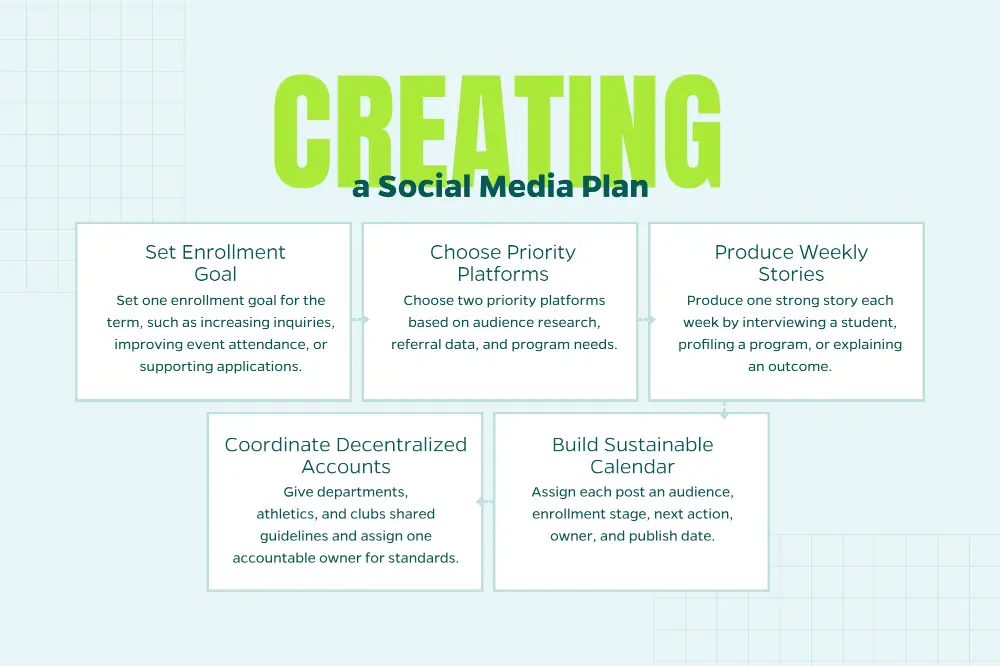
A practical higher education social media strategy should fit the team’s actual capacity. Social media marketing for higher education does not require five busy accounts; two well-managed platforms and one adaptable story each week can be more useful than an ambitious schedule that collapses during admissions season.
- Set one enrollment goal for the term. Choose a defined outcome, such as increasing inquiries for a particular program, improving admitted-student event attendance, or supporting applications before a deadline.
- Choose two priority platforms. Use audience research, past referral data, and the programs you need to fill. Keep other accounts accurate, but do not promise a publishing schedule you cannot maintain.
- Produce one strong story each week. Interview a student, profile a program, or explain an outcome. Cut the same source material into a short video, an Instagram Story, and a longer YouTube segment only where the format makes sense.
- Build a sustainable calendar. Assign each planned post an audience, enrollment stage, next action, owner, and publish date. Increase activity around meaningful deadlines, not because an arbitrary posting rule says to.
- Coordinate decentralized accounts. Give departments, athletics, and clubs shared guidelines for names, accessibility, student permissions, brand claims, and escalation. Assign one accountable owner for cross-campus standards.
“Adapt the content to the platform’s native behavior, not just copy and paste it,” advises Adam Rosenbaum, SEO & GEO Manager at Straight North. A vertical video may need a fast opening and captions, while a YouTube explainer benefits from a searchable title and a complete description.
“Adapt the content to the platform’s native behavior, not just copy and paste it.”

Repurpose existing program pages, admissions webinars, events, and blog articles instead of starting from zero. Revisit evergreen material when deadlines or student questions make it relevant again. A small team can also batch interviews and schedule posts ahead while preserving time for conversations and timely updates.
The calendar should leave room for listening. If prospective students repeatedly ask about a program’s placement opportunities, that is a signal to publish a clear answer, involve the program director, and improve the related website page.
Why Social Media Now Shapes AI Search Answers About Your College
Social media can influence what prospective students encounter when they research colleges through AI-powered search, although posting does not guarantee an AI citation or directly improve Google rankings. Public videos, discussions, and institutional profiles contribute to the wider information environment in which a school is evaluated.
In a September 2026 Straight North survey of 101 marketers across industries, 35 of 101 respondents (35%) said they were placing more emphasis on social media because of AI search. The same survey found that 74 of 101 respondents (73%) had been told by a customer or prospect that they used ChatGPT or another AI platform to discover or research the company. These results are cross-industry findings, not higher-education-specific estimates.
Students may ask an AI tool whether a college is worth the price, what its campus culture is like, or how its program compares with alternatives. Publicly accessible YouTube descriptions, credible third-party discussions, and consistent school information may help inform the sources surfaced or summarized.
“[A brand active in social spaces] has a better chance of being a part of a broader information ecosystem that AI tools reference, like ChatGPT or Grok,” says Michael Fatigato, Operations Specialist at Straight North. The practical implication is to make public information accurate, specific, and easy to understand rather than chasing a guaranteed AI visibility formula.
“[A brand active in social spaces] has a better chance of being a part of a broader information ecosystem that AI tools reference, like ChatGPT or Grok.”
Keep official profile names, campus locations, program names, and URLs aligned with the website. Give videos descriptive titles and captions that answer real student questions. Watch public discussions on Reddit and elsewhere to identify misconceptions and service issues, without trying to manufacture positive commentary. Publish verifiable details about costs, outcomes, and student support where prospects can check them.
Social also supports discovery that can later produce branded searches, website visits, and word of mouth. Treat it as part of a coordinated presence alongside search, email, admissions communications, and paid campaigns, not as a substitute for those channels.
Measure Social by Inquiries and Applications, Not Likes
Higher ed social media is working when it helps the institution attract appropriate prospective students and move them toward enrollment. Reach, saves, shares, and comments show whether content is resonating, but they cannot establish whether a program is filling seats.
- Add UTM parameters to trackable links in profiles, Stories, and campaign posts so analytics can distinguish sources and initiatives.
- Record social-sourced inquiries, campus visit registrations, and event sign-ups in the admissions CRM.
- Ask “How did you hear about us?” on inquiry and application forms to capture influence that last-click analytics may miss.
- Review applications and social-assisted conversions by program, audience, and entry term rather than reporting one campuswide total.
- Compare results monthly with the term’s enrollment goal, then adjust content and calls to action.
Attribution will never be perfect: a student may watch several videos, search independently, and apply weeks later. Use analytics, CRM records, and self-reported responses together. A modest number of well-matched inquiries for a priority program can be more valuable than broad engagement from people unlikely to enroll.
Where to Start This Semester
Begin with three moves: choose the two platforms most relevant to your target students, map next month’s posts to the five enrollment stages, and establish inquiry and application tracking before the next major deadline. Paid social can extend reach during recruitment windows, but it serves a different role from organic community-building.
Frequently Asked Questions
What is the 5-5-5 rule on social media? It is an informal engagement routine with no universal definition. One common version suggests five posts, five comments, and five replies a day. College teams should favor meaningful interaction over a fixed quota.
How often should a university post on social media? Use a repeatable schedule that the team can sustain during peak admissions periods. Evaluate its effectiveness through relevant conversations, inquiries, and applications rather than frequency alone.
Should colleges use organic or paid social media? Both can contribute. Organic social builds community, trust, and ongoing relationships; paid social can expand targeted reach for program launches and application deadlines.
Why are some Gen Z students considering alternatives to college? Tuition concerns and career-focused alternatives can lead prospective students to compare traditional degrees with certificates, community colleges, and trade schools. You should explain costs, time commitments, and likely outcomes clearly rather than assuming a four-year degree is the default choice.
Need Help?
Contact Straight North for help using social media to increase your institution’s enrollment numbers.