

Trade school marketing helps vocational and career schools recruit students for programs such as welding, HVAC, cosmetology, and medical assisting. The most efficient strategy treats each program and start date as its own enrollment goal, excludes searches from people seeking jobs rather than training, and measures the cost of enrolling a student instead of celebrating inexpensive leads.
Trade schools need qualified prospects for programs with open seats, not more inquiries for full classes. This article will explain how to best achieve that goal.
Who Trade Schools Are Recruiting Now
Who is a trade school marketing to? The answer depends on the program, its schedule, and the career decision a prospective student is making. Three groups deserve different messages:
- Recent high school graduates and their families compare training costs, career possibilities, campus safety, and whether a credential offers a credible alternative to a four-year degree. Parents may help evaluate or finance the decision.
- Adult learners and career changers want to understand how quickly they can train, what classes fit around work or caregiving, and whether the potential career change justifies the expense. Evening and weekend options can matter as much as the curriculum.
- Working professionals seeking advancement may need a specific license, certification, or additional skill. They look for eligibility requirements, convenient schedules, and a clear connection between the course and their next credential.
Demand for shorter credentials is meaningful: according to the National Student Clearinghouse Research Center, community colleges enrolled 752,000 students in undergraduate certificate programs in fall 2025, an increase of 28.3% from fall 2021. Federal Workforce Pell provisions also expanded potential Pell Grant access beginning July 1, 2026, for qualifying short-term workforce programs, subject to program eligibility rules. Schools should verify which programs qualify rather than imply that aid is universally available.
Market Each Program to Its Next Start Date
Why does a school-wide marketing campaign waste budget? Trade schools have distinct programs, cohort sizes, and start dates. A general campaign can keep buying welding inquiries after the welding cohort fills while an upcoming HVAC class still has empty seats.
“Enrollment deadlines and program start dates should drive your advertising calendar,” says David Ohm, Director of Paid Advertising at Straight North. That means the admissions roster, not a fixed monthly allocation, should determine which campaigns get more attention.
Build a simple seats-and-starts sheet with the program, next start date, capacity, confirmed enrollments, seats remaining, and typical time from inquiry to enrollment. Update it with admissions every week. Then work backward. A class that starts in six weeks and usually requires four weeks to convert an inquiry needs attention now, not during its final registration week.
For example, a hypothetical weekly planning sheet might look like this:
- HVAC certificate: starts in six weeks; 12 seats open; push qualified search and remarketing now.
- Cosmetology: starts in 10 weeks; 8 seats open; maintain steady inquiries while building awareness.
- Welding: starts in three weeks; 0 seats open; pause start-specific acquisition and offer interested applicants the next cohort.
These numbers are illustrative. Keep rolling-start campaigns steady, and give fixed cohorts an early ramp-up and a cutoff.
“Students and parents rarely experience SEO, GEO, paid search, and paid social as separate channels, even if marketing teams manage them that way,” says Frank Fornaris, Straight North President. “Someone may discover a school through social, research it through Google or ChatGPT, and come back through a paid ad, so the channels need to reinforce the same positioning and enrollment priorities.”
“Students and parents rarely experience SEO, GEO, paid search, and paid social as separate channels, even if marketing teams manage them that way. Someone may discover a school through social, research it through Google or ChatGPT, and come back through a paid ad, so the channels need to reinforce the same positioning and enrollment priorities.”

Spend follows open seats and start dates. Redirect resources when cohorts fill.
The Channels That Fill Trade School Programs
Which channels work best for trade schools? Each has a different role in moving a prospective student from awareness to a campus visit, application, and enrollment. The right mix depends on local demand and the programs that need students.
- Google search ads: capture people already searching for “HVAC classes near me” or a specific credential; watch search intent and geographic reach.
- Facebook and Instagram ads: introduce programs to career changers and families before they search; watch for low-intent inquiries and audience fatigue.
- Short video on YouTube, Reels, or TikTok: show real equipment, instructors, student work, and the training environment; avoid glossy clips that never explain the program.
- Local SEO and Google Business Profile: help nearby prospects find the campus and evaluate it; use authentic neighborhood and commute-area information rather than thin, duplicate city pages.
- Email and text: answer questions and move existing inquiries toward visits and applications; respect consent, frequency, and opt-out requests.
High school counselor relationships, employer partnerships, community events, and selective direct mail can support programs with a defined local audience. Keep program facts and enrollment priorities consistent across channels.
Stop Paying for Job-Seeker Clicks
One of the easiest ways to waste trade school advertising money is to pay for job searches that resemble training searches. “Welding jobs,” “HVAC technician hiring,” and “CDL driver jobs near me” contain valuable trade terms, but the people typing them may want employment immediately, not classes.
“But those users are looking for a paycheck, not a program,” says David Ohm. Search campaigns need to distinguish training intent from hiring intent before budgets rise.
Broad or phrase matching can bring in related queries that are not useful to admissions. Review the actual search terms that triggered ads, especially during a concentrated enrollment push, and add appropriate negative keywords. Words such as “jobs,” “hiring,” “salary,” and “Indeed” are starting points for review, not a universal exclusion list. Some salary-related searches may come from serious prospective students, so judge exclusions against actual query context.
Use this pre-spend checklist:
- Review search terms at least weekly during enrollment pushes and identify employment-only intent.
- Add and maintain negative keywords at the right campaign or account level without blocking legitimate training research.
- Target a realistic commute area for in-person classes; adjust for remote or hybrid offerings.
- Name the program and, when useful, its upcoming start date in the ad.
- Send each ad to the matching program page, not a generic homepage.
- Count relevant program inquiries as lead conversions, not every page view or unrelated contact form.
- Compare qualified inquiries and enrollments by search theme before increasing bids.
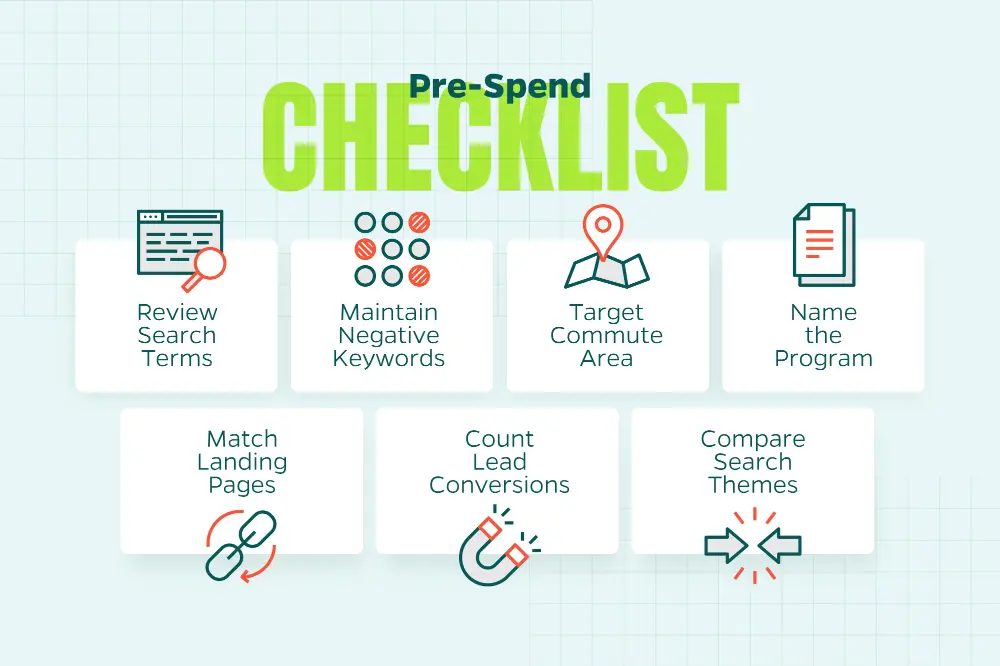
Cleaner search targeting saves money before the next budget increase.
Build Program Pages That Answer Cost, Length and Job Outcomes
What should a trade school program page include? It should make the enrollment decision easier by answering the questions a prospective student would otherwise have to ask admissions. Each major program deserves its own useful page, whether traffic comes from an ad, local search, or an AI-generated comparison.
“Cost, format, duration, outcomes, accreditation, admissions requirements, and who the program is designed for should not require detective work,” says Nick Fatigato, Straight North SEO and GEO expert. Clear, specific facts help prospective students compare options and give search systems information they can represent more accurately.
“Cost, format, duration, outcomes, accreditation, admissions requirements, and who the program is designed for should not require detective work.”

A program page should make these details easy to find:
- Total published tuition and mandatory fees, with a clear explanation of additional expenses such as tools, uniforms, or exams.
- Financial aid and payment options, with eligibility qualifications and a path to official details.
- Program duration, total training hours, and day, evening, or weekend schedule.
- Upcoming start dates, application deadlines, and available learning formats.
- Prerequisites, admission requirements, and any age or prior-education restrictions.
- Credential, license preparation, or certification associated with completion, without implying automatic licensure.
- Specific skills taught, equipment used, and hands-on training opportunities.
- Career pathways and documented outcomes, with clear definitions and dates for any placement statistics.
- Campus location, travel considerations, and contact information.
- One prominent next action: request information, schedule a tour, or apply.
“As the cost of a traditional four-year degree rises, students are comparing colleges with trade schools, community colleges, certificate programs, and other career-focused paths,” says David Duerr, Straight North CEO. “That changes the marketing challenge: SEO, GEO, paid search, and paid social all need to communicate not just what a program offers, but why the time, cost, and expected outcome make it worth choosing over very different alternatives.”
“As the cost of a traditional four-year degree rises, students are comparing colleges with trade schools, community colleges, certificate programs, and other career-focused paths. That changes the marketing challenge: SEO, GEO, paid search, and paid social all need to communicate not just what a program offers, but why the time, cost, and expected outcome make it worth choosing over very different alternatives.”

Do not bury tuition behind an inquiry form if a reliable published amount can be provided. Explain the price and its components clearly. Likewise, replace vague promises of an “exciting future” with concrete training, schedule, and credential details. Clear pages qualify visitors before admissions calls and reduce disappointment after someone submits a form.
Make the page usable on a phone: concise headings, readable schedules, accessible forms, fast loading, and a visible way to reach a real person. Prioritize clear answers and an appropriate next step.
Follow Up Before Another School Does
What should happen after an inquiry? Admissions should respond promptly with information specific to the program, not rely on a generic automated acknowledgment. Prospects often compare multiple schools, so a helpful same-day call or consent-based text can keep a serious candidate moving.
A practical first 14 days might follow this sequence:
- Day 0: acknowledge the inquiry, try a personal call, and send the program’s schedule, cost information, and next start date.
- Days 1–2: answer eligibility or scheduling questions and offer a campus or workshop tour.
- Days 3–5: share financial aid steps and documentation requirements, without promising approval.
- Days 6–10: provide a relevant student experience or instructor introduction and invite an application.
- Days 11–14: remind the prospect of a real deadline or upcoming start, and offer help completing the next step.
If inquiries are plentiful but enrollments lag, inspect the stages between first contact and a confirmed seat. Track unanswered calls, tour attendance, applications, financial aid delays, and withdrawals. Appropriate retargeting can reinforce useful information, but it cannot repair an admissions process that does not follow up.
Keep Ad Claims to What You Can Document
What can a trade school say about jobs and salaries? Advertisements should use supportable, current facts rather than guaranteed outcomes. For institutions subject to federal Title IV rules, 34 CFR 668.74 addresses misleading statements about graduates’ employability, including placement and licensure outcomes. State requirements and accreditor standards may add obligations.
Before publishing a salary figure, placement rate, employer relationship, or certification claim, confirm the source, period covered, definition, and internal compliance approval. Avoid implying that completing a program guarantees a job. This is practical marketing guidance, not legal advice.
Measure Cost per Enrolled Student, by Program
How can a school tell whether marketing works? Start with the cost of getting a student into a specific program, not just the price of a form submission. A low cost per lead may hide many unqualified inquiries, unreachable contacts, or applicants who never start.
Cost per enrolled student = marketing spend attributed to a program ÷ students enrolled in that program.
For example, if a program spends $6,000 and enrolls 12 students from the measured marketing activity, its cost per enrolled student is $500. This is an illustrative calculation, not an industry benchmark. Define whether “enrolled” means a signed enrollment agreement or a student who actually starts, and use that definition consistently.
Review cost per enrollment by program and channel, alongside inquiry-to-application and application-to-start rates. A higher-priced channel can still be worthwhile if it delivers students who enroll and persist. Where privacy, consent, and platform rules allow, connect CRM qualified-lead and enrollment outcomes back to ad platforms so optimization rewards meaningful progress rather than raw form volume.
Where to Start Before Your Next Start Date
What should a trade school do first? Prioritize three changes that make existing spending more useful:
- Create a weekly seats-and-starts sheet with admissions and shift budget to programs with openings.
- Audit paid search terms for job-seeker intent before increasing the budget.
- Improve the page for the program with the most urgent enrollment gap, starting with cost, schedule, and outcomes.
For a broader framework, see Straight North’s guide to higher education marketing. These steps give every campaign a clearer purpose: fill the right seats with students who understand what they are choosing.
Trade School Marketing FAQs
How much should a trade school spend on marketing? Start with the number of seats to fill for each intake and the maximum affordable cost per enrolled student. Test spending against actual conversion rates instead of applying an arbitrary percentage of revenue.
Should a trade school buy leads from vendors? Only when the school can track those leads through enrollment. Ask whether leads are exclusive or shared, how consent is collected, and whether cost per enrolled student beats owned channels.
Is trade school marketing different from community college marketing? Often, yes. Trade schools may market frequent or rolling starts and a narrower career decision, while community colleges typically offer a broader catalog. The distinction depends on the institution.
How can a small welding or HVAC school market on a limited budget? Focus first on a complete Google Business Profile, a strong program page, and tightly targeted search ads for one or two priority programs. Add broader awareness campaigns once enrollment tracking supports them.
Need Help?
Straight North can help you fill your programs. Contact us for more information.