
If you are a business owner, you have probably felt this tension at some point.
You want to invest in marketing, you believe it matters, and you also want to make decisions with the same discipline you bring to the rest of the business. You want clarity on what is working, what is not, and what to do next.
The problem is that marketing does not always show up as a clean, single-line equation. Past the obvious wins, the path from investment to revenue is often indirect. Results can lag. Channels overlap. Buyer behavior is messy. All that makes decision-making harder.
For a long time, I lived on the finance side of this. I was the CFO asking the questions that finance should ask. Then, as president, I also became the person leading marketing at our agency. Not advising but owning the decisions and living with the outcomes.
That combination forced me to build a way to make marketing decisions that respects business fundamentals while also respecting how buyers make their decisions.
I’m writing this series of articles to share the principles I’ve learned when both the economics and the growth engine were mine to own.
What I’ll Cover
In this post, I want to lay out the four principles that will anchor the rest of the series:
- Why marketing decisions improve when the business goal is clear
- Why marketing performs best when it understands the business underneath it
- How to make decisions when attribution is messy
- Why buyer trust and buyer psychology belong in the model
1. Marketing Decisions Improve When They Start with a Clear Business Goal
Marketing decisions are not best made in a vacuum. They are also not best made by defaulting to whatever is easiest to measure in the short term. They are best made when they are anchored to what the business is actually trying to accomplish right now.
The same marketing move can be smart or wrong depending on the goal and constraints. The reason is simple. The goal determines the tradeoffs you are willing to accept.
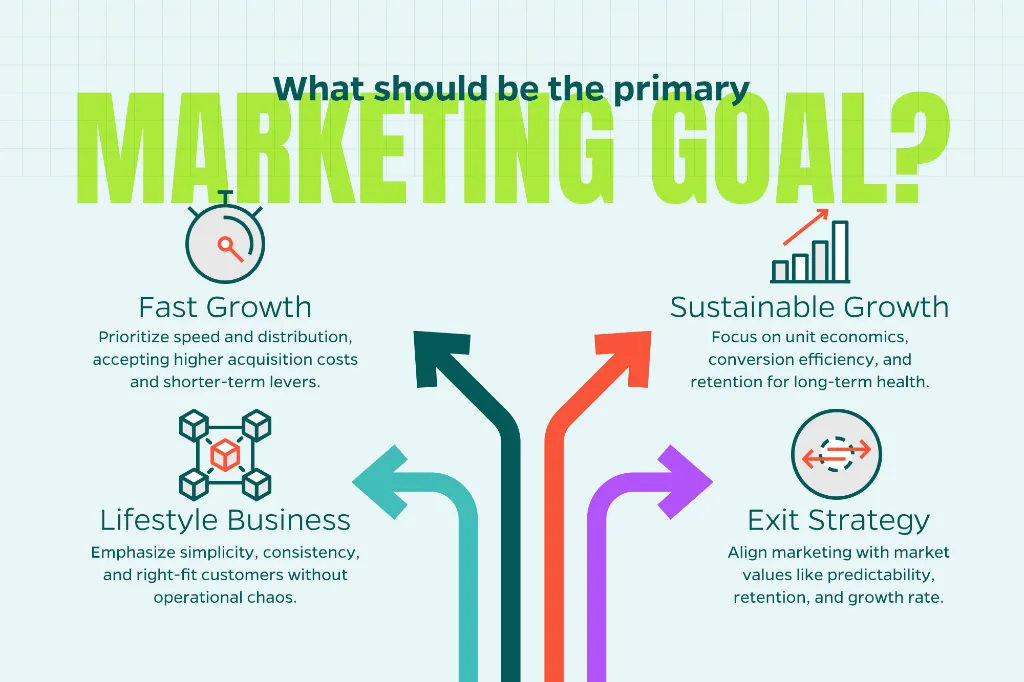
A few examples, just to show how differently “good” can look:
- If the goal is fast growth in the next 6 to 12 months, you tend to prioritize speed and distribution. You may accept higher acquisition costs, shorter-term levers, and more aggressive iteration because time is the constraint.
- If the goal is sustainable, profitable growth, you tend to prioritize unit economics, conversion efficiency, retention, and the quality of growth. You are still growing, but the business must remain healthy while you do it.
- If the goal is a lifestyle business with strong margins, the decisions often favor simplicity, consistency, and channels that deliver the right-fit customer without creating operational chaos.
- If the goal is an exit, marketing often needs to align with what the market values in that industry. That might be predictability, retention, growth rate, margin, or a combination of those.
When the goal is not explicit, the common failure mode is not just volatility. It is worse decision-making. You end up optimizing the wrong thing, chasing activity that looks good in isolation, or shifting priorities without a consistent reason.
When the goal is explicit, the decision logic gets steadier because everyone understands what the business is actually optimizing for.
2. Marketing is Strongest When It Understands the Business Underneath It
Marketing is at its best when it understands the customer: what they want, what they need, what pain they are in, how they buy, and what they need to believe before they act.
But marketing gets much stronger when it also understands the business mechanics underneath the marketing.
In practice, that means marketing understands things like:
- Average customer lifetime value — by product, service line, and buyer type
- A blended average can be misleading. In our agency, where we work across SEO, paid media, web design and development, and other marketing services, average lifetime value can vary meaningfully by service mix, buyer type, and industry.
- Gross margin overall and by service or product
- Resource and operational capacity to grow without breaking quality
- Where the business makes and loses money, not just where it gets leads/revenue
With that context, marketing decisions get easier and more consistent. You can build longer-term strategies because you understand what is worth scaling and what is not. You can prioritize the right work because you understand constraints. You avoid spending time producing “good marketing” that isn’t best for the business.
3. When Attribution is Messy, Judgment Matters More Than Perfect Reporting
One of the most practical truths I ran into leading marketing is that many customer journeys are not single-touch.
A buyer might discover you in one place, build trust in another, and convert somewhere else. Some marketing efforts create demand. Others capture demand. Others reduce friction during evaluation and sales by building credibility at the right time.
Because of that, it is not always realistic to prove the ROI of every activity in isolation, especially in the short term, even when that activity is genuinely important to performance.
So instead of forcing fake precision, I’ve found it more useful to let the answers to a few questions drive decisions:
- What are we measuring directly?
- What are we treating as directional?
- What timeframe is fair for judging this investment?
- What outcomes would make us scale it, refine it, or cut it?
This is how you keep accountability without pretending marketing behaves like a perfectly traceable financial instrument.
4. Buyers Are Not Data Points, and the Model Improves When You Treat Them Like Humans
This sounds obvious, but owning both finance and marketing made it much more real to me.
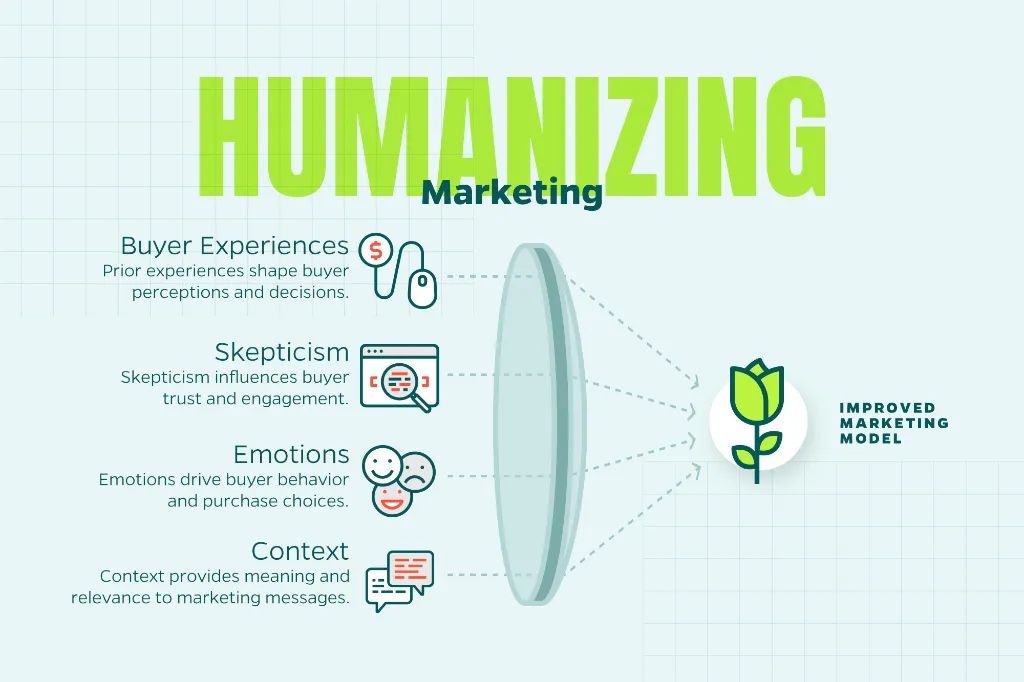
Buyers have prior experiences, skepticism, emotions, and context. They do not move through funnels like robots. A small improvement in trust, clarity, or credibility can significantly impact outcomes — turning an underperforming investment into a home run.
When you include buyer reality in your thinking, your model gets better because you stop assuming human behavior is deterministic. The economics still matter, but the economics are often downstream of what the buyer believes, fears, and trusts.
Final Thoughts and What’s Next
This series is for business owners and operators who want a clearer way to think about marketing decisions in the context of the whole business. The goal is not to recommend a detailed playbook — every business is different. It is to share how I think about these decisions when I am accountable for both business health and growth.
In the following articles, I will go deeper on topics like:
- Why “what will you pay for a customer?” is not one number (it changes as you scale)
- How to make decisions when attribution is messy
- Why investment tail matters — how long the benefit lasts after the spend, whether it is short-lived or compounding
- Why the website and brand are often multipliers, not nice-to-haves
If there is a single thread through all of it, it is this: marketing gets more effective when you treat it as part of the business system, shaped by goals, economics, capacity, human behavior, and judgment.