


Key Takeaways:
- Diagnose performance changes before taking action.
- Prioritize high-impact pages for improvements.
- Create helpful, people-first content that builds trust.
- Strengthen technical SEO and brand authority.
- Monitor results and make steady improvements.
Google updates are a normal part of search, but they can have a significant impact on businesses that depend on organic visibility. While there’s no way to predict exactly how an update will affect your site, consistently improving your content, technical performance and user experience can help protect your rankings and reduce the need for reactive fixes.
A proactive approach follows a simple, ongoing process: diagnose, prioritize, improve, monitor and repeat. Identify weaknesses, focus on the issues that matter most, make meaningful improvements and monitor performance over time.
In this blog post, Straight North SEO & GEO Analytics Expert Marc Holt walks through this process and explains how to address common content and technical issues before they become bigger problems. With steady improvements, you can build a stronger foundation for long-term search visibility and be better prepared for the next Google update.
Step 1: Diagnose Changes in Your Search Performance
A sudden decline in rankings or organic traffic can be alarming, especially when it happens around the same time as a Google core update. But before assuming the update is responsible, start by confirming the timing and ruling out other potential causes.
So the first thing I do is check if Google recently announced a core update, then I compare those dates with when traffic and rankings started to fall. I also check Google Search Console to make sure that there isn’t a manual action causing the problem. If all of those things match up, there’s a good chance the core update played a part.
Use Google Search Console to compare performance before, during and after the update and identify where the biggest losses occurred. Also check for manual actions before attributing a decline to an algorithm update.
Look closely at:
- Organic clicks and impressions: Did visibility and traffic decline at approximately the same time?
- Average rankings: Did rankings decline across much of the site, or are the changes concentrated in certain areas?
- Search queries: Which individual queries experienced the largest losses?
- Landing pages: Are certain pages, sections or types of content responsible for most of the decline?
- Devices and countries: Are losses occurring across your entire audience or primarily within a particular segment?
- Branded and non-branded searches: Did the decline affect people already searching for your business, broader discovery searches or both?
Looking at these factors together can give you a clearer picture of what changed and help you decide where to investigate next.
Correlation Doesn’t Always Mean Causation
Even if traffic declined during a core update, timing alone doesn’t prove the update caused it. Technical problems, website changes, seasonality, tracking issues, lost backlinks or stronger competition can affect organic performance, too.
Diagnose the cause before making major changes so you can focus on the pages and issues that actually need attention.
Step 2: Prioritize the Pages That Need Attention
Once you’ve identified where visibility declined, prioritize pages based on both performance and business value. Start with pages that lost the most traffic or rankings, particularly those that are outdated, thin, repetitive or no longer useful.
- High priority: Revenue or lead-generation pages with significant traffic or ranking losses.
- Medium priority: Informational pages that historically generated meaningful organic traffic.
- Lower priority: Pages with little business value, few impressions or minimal ranking history.
What Does It Mean to Improve a Page?
Improving a page doesn’t always mean rewriting it. Focus on changes that make the content more useful, relevant and trustworthy for visitors. That could mean updating outdated information, adding expert insights, answering important questions, removing repetitive content, strengthening internal links or adding original examples and data.
The goal isn’t to add more content or keywords. It’s to make the page more valuable to the people visiting it.
“When you fix your most important pages first, you give your site the best chance to recover over time.”
Enterprise SEO & GEO Strategist | SEO & GEO Analytics Expert
Prioritize improvements that can make the biggest difference, then evaluate how well those pages are serving the people who find them.
Step 3: Make Your Content More Valuable
Once you’ve identified the pages that need attention, the next step is evaluating whether the content actually serves the people who find it. Improving content isn’t simply about adding more words, targeting additional keywords or trying to satisfy an algorithm. The focus should be on creating content that answers real questions, demonstrates knowledge and gives visitors something genuinely useful.

Google wants content that clearly answers people’s questions and gives them real value. That means sharing real experience, expert knowledge, and fresh ideas. Don’t create content just to rank higher. Create content that helps people solve a problem and gives them a reason to trust your site.
This people-first approach connects closely with E-E-A-T: Experience, Expertise, Authoritativeness and Trustworthiness. First-hand experience, original examples and expert insights give people a reason to trust your content.
Questions to Ask When Reviewing Content
As you evaluate existing pages, look beyond rankings and keywords and consider the experience of someone who actually lands on the page. Ask:
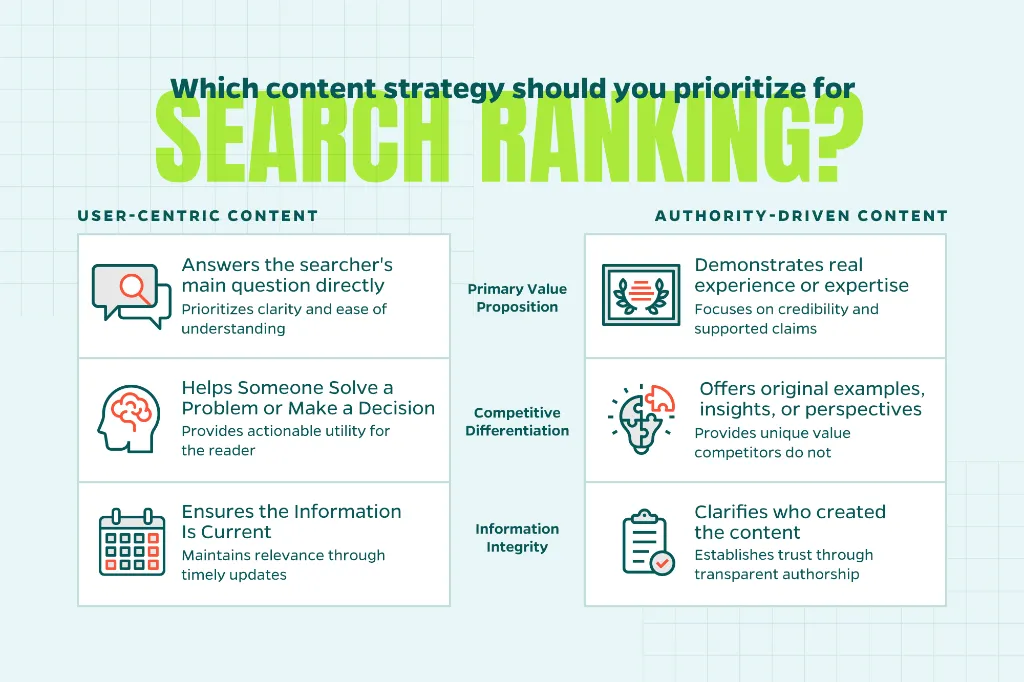
- Does this page answer the searcher’s main question? Make the answer easy to find and understand.
- Does it offer something competitors don’t? Add original examples, insights or perspectives.
- Does it demonstrate real experience or expertise?
- Is the information current?
- Are important claims appropriately supported?
- Is it clear who created the content and why they’re credible?
- Does the content help someone solve a problem or make a decision?
Finally, ask yourself one larger question: Would this page still be worth publishing if Google didn’t exist?
If the only reason a piece of content exists is to capture rankings or target a particular keyword, it may be time to reconsider what value it’s providing. Content created primarily for people has a purpose beyond search visibility. It educates, answers questions, demonstrates expertise and builds trust with potential customers.
That makes people-first content more than a response to the latest Google update. It’s part of building a website that remains useful and credible regardless of how search algorithms continue to change.
Step 4: Fix Your Technical SEO Foundation
Strong content can only do so much if technical issues make it difficult for Google to crawl, understand or index your website. A technical SEO review can uncover problems that limit search visibility or create a poor experience for visitors.
I start by making sure Google can find and index the site the right way. Then I check for broken links, crawl errors, slow pages, and other issues that hurt the visitor’s experience. Fixing those problems won’t solve everything, but it helps Google understand your site and supports your recovery.
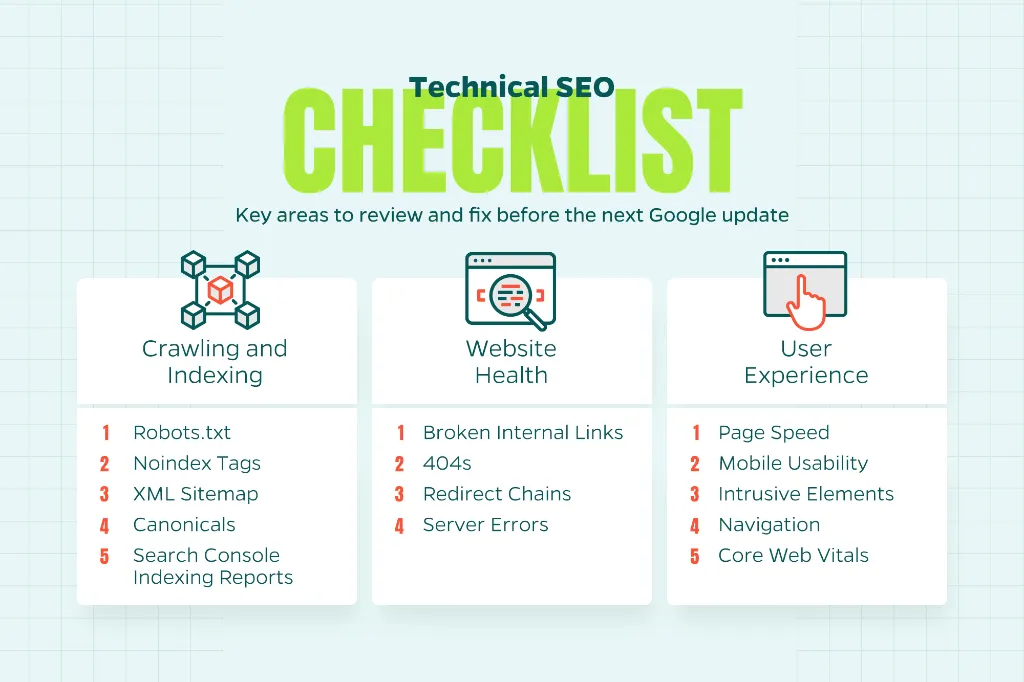
Fixing technical issues alone may not reverse a core update decline, but it creates a stronger foundation for recovery.
Step 5: Build Your Brand’s Authority
SEO recovery isn’t always just an on-page SEO project. Building authority also means strengthening the reputation and credibility of the business behind your website.
Building that authority takes time and consistency. Publishing helpful, original content, keeping your business information accurate, and sharing your expertise in the places where your audience spends time can all contribute to a stronger online presence. As more people recognize, trust, and reference your brand online, you can build a stronger reputation that supports your overall search presence.
“As more people recognize, trust, and reference your brand online, you can build a stronger reputation that supports your overall search presence.”
Enterprise SEO & GEO Strategist | SEO & GEO Analytics Expert
Your website is only one place potential customers encounter your brand. Industry publications, reviews, social platforms, news coverage and recommendations from trusted sources can all contribute to your broader online reputation.
The goal isn’t to manufacture signals of authority simply for search engines. It’s to build the kind of reputation that gives real people reasons to recognize, reference and trust your business.
That makes authority building a long-term part of your SEO strategy rather than a quick response to a core update. Continue publishing useful content, demonstrating expertise and strengthening your presence beyond your own website. Over time, those efforts can help create the trust and credibility that Marc identifies as important for stronger search visibility.
Step 6: Avoid Making Too Many Changes at Once
When rankings decline after a Google core update, the natural reaction may be to start making changes immediately. But changing too much too quickly can create additional problems and make it harder to understand what actually affected your site’s performance.
Rankings can fluctuate while Google finishes rolling out an update, so what looks like a significant loss one day may change as the rollout continues. Instead of reacting to every movement, give yourself time to review the data and identify problems that genuinely need to be addressed.
It’s easy to want to change everything right away, but that’s usually the wrong move. Google rankings often go up and down while Google finishes the update. If you make big changes too soon, it’s hard to know what actually worked. Instead, review your data, fix real problems, and improve your site one step at a time.
Making changes one at a time makes it easier to see what works. If you rewrite content, change site structure, remove pages and make technical updates at the same time, it becomes difficult to determine what actually helped.
Return to the process: diagnose, prioritize, improve and monitor. Use your data to find real problems, fix them, and measure the results before making more changes.
Step 7: Monitor Your Results and Keep Improving
Recovering from a Google core update rarely happens overnight. Even after you’ve made meaningful improvements to your website, Google needs time to crawl your pages, process those changes and reevaluate where your content should appear in search results.
Recovery almost never happens overnight. Google needs time to crawl your site, review your changes, and update its rankings. The best plan is to keep improving your content, fix technical issues, and give people a better experience. Steady progress almost always works better than chasing quick fixes.
After making improvements, track performance to see if your site is moving in the right direction. Don’t judge your results based on a few days of ranking changes. Search visibility can fluctuate, and meaningful recovery may become clearer over a longer period of time.
As you monitor your site, keep an eye on:
- Organic clicks and impressions: Is search visibility improving?
- Ranking distribution: Are important keywords moving into stronger positions?
- Conversions and leads: Is organic performance producing business results?
- Indexing: Are important pages being indexed properly?
- Engagement: Are visitors interacting with the site?
- Updated pages: Are the pages you changed improving?
Look for trends across weeks and months rather than reacting to daily fluctuations. Doing so can give you a clearer picture of whether your improvements are having an impact and where additional work may be needed.
Prepare for the Next Update, Not Just the Last One
SEO recovery shouldn’t end when rankings improve. Search, competitors and customer expectations keep changing. That’s why SEO is an ongoing process: diagnose, prioritize, improve, monitor and repeat.
By consistently improving your content, technical foundation, authority and user experience, you’ll be better positioned to recover from ranking declines — and better prepared for whatever Google changes next.
As Holt puts it, “Steady progress almost always works better than chasing quick fixes.”