


This article is part of CFO Turned CMO, a series on what I’ve learned from leading both finance and marketing. It explores how my finance background has shaped the way I approach marketing, and how that perspective can help other business leaders.
One of the easiest mistakes to make in marketing is to treat Customer Acquisition Cost (CAC) like a fixed number.
It is not.
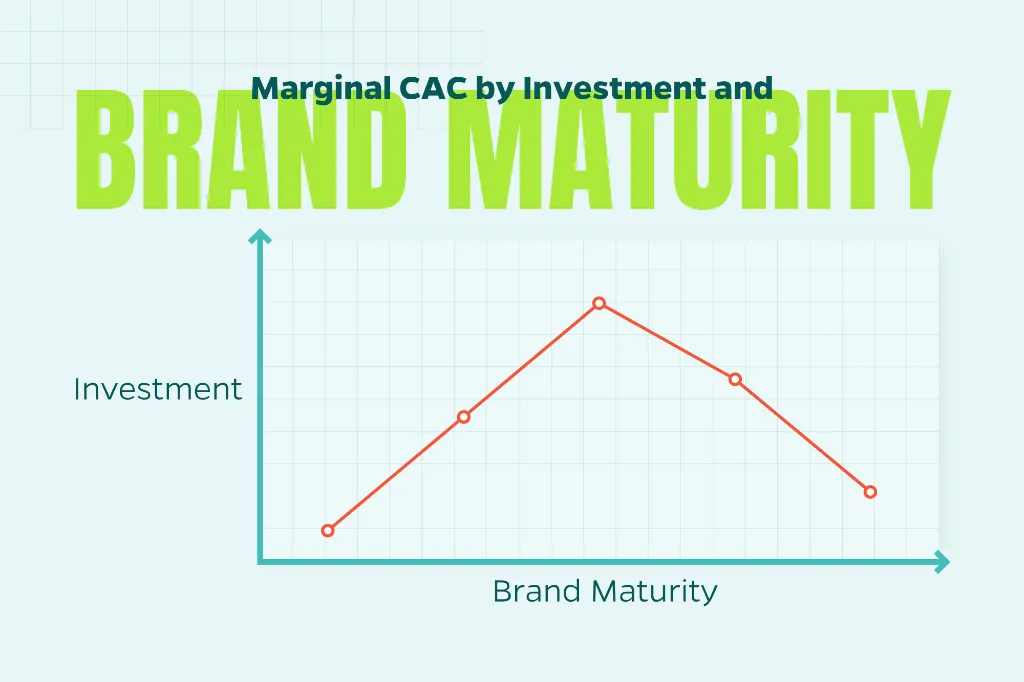
CAC changes as a business grows. In many small-to-medium-sized businesses (SMBs), it gets worse before it gets better.
Early on, growth often comes from the easiest opportunities. You are picking up the highest-intent buyers, the best-fit accounts, the searches most likely to convert, and the leads your sales team closes most easily. The first stretch of growth can look efficient because you are harvesting the low-hanging fruit.
Then that starts to run out.
To keep growing, you have to push into broader audiences, less efficient channels, tougher competition, weaker intent, or buyers who need more convincing. At that stage, the next customer often costs more than the last one.
Later, that can change again.
If the business keeps growing and the brand starts to compound, CAC can flatten out or even come down. More people know who you are. More of the market is already familiar with the brand. Word of mouth improves. Referrals increase. Direct traffic grows. Online and offline virality can start to matter. Buyers come in with more trust. Sales conversations get easier.
So I do not think of CAC as a number. I think of it more like a curve.
In many SMBs, CAC rises first as the easy demand gets exhausted. Then, over time, as brand recognition strengthens, it can level off and decline.
So, what I am willing to pay for a customer can vary. It should evolve with where the business is on that curve.
Why CAC Often Rises, Then Can Fall
One of the reasons CAC gets oversimplified is that people often talk about it as if it should move in one direction.
In reality, it usually changes by stage.
Early growth can look efficient because you are capturing the easiest opportunities. Then CAC often rises as those easy wins thin out. Later, if brand strength starts compounding through awareness, word of mouth, referrals, direct traffic, and familiarity, CAC can level off and even begin to decline.
At the beginning, there are usually obvious wins. You may be under-invested. You may not be covering the full market. Your message may not have been tested enough. Sales follow-up may have been leaving money on the table. There is still demand available that does not take a huge amount of effort to capture.
That can create the illusion that growth should keep working at the same economics.
Usually it does not.
Once those easier wins are gone, the next layer of growth is harder. Marketing has to do more work. Sales may have to do more work too. The audience is colder. The competition is stronger. The conversion path is less direct.
That is when CAC tends to rise.
Then, if the business reaches the point where the brand itself starts helping, the pattern can change again. That is when people are more likely to click because they know your name, take a call because they have heard of you, or convert because trust is already partially there before the conversation even starts.
That is when CAC can stop getting worse and start getting better.
So the right way to think about it is not that CAC always rises with scale. It is that CAC changes with stage.
Why Blended CAC Can Be Misleading
This is why I do not like relying too heavily on blended CAC.
Blended CAC tells you what happened on average.
That can be useful. But it does not tell you what the next dollar is likely to do.
And that is usually the more important question.
If your blended CAC is $5,000, that does not mean the next 50 customers will also cost $5,000 each.
Maybe the next tranche of growth will come at $7,000. Maybe $8,500. Or maybe brand strength has finally started helping, and the next tranche comes in better than the last one.
The point is that the average hides the movement.
That is why I care so much about marginal CAC, not just blended CAC.
Blended CAC helps explain the system you just ran.
Marginal CAC helps explain the economics of the next growth decision.
If I am deciding whether to push harder, slow down, or hold steady, marginal CAC matters more.
The “Right CAC” Depends on the Goal
This is also why I do not think there is one universally correct CAC.
The right CAC depends on what the business is trying to do.
If the goal is disciplined, efficient growth with fast payback, then I should want a lower CAC.
If the goal is to grow faster, open up capacity, build share in a market, or invest for a larger future payoff, I may be willing to accept a higher CAC.
Same company. Same offering. Different answer.
The time horizon matters too.
A business that needs quick cash recovery should not think the same way as a business that can wait longer for the return.
Risk matters too.
How confident are we in retention?
How predictable is the sales process?
How stable is demand?
How long does it take for a new customer to pay back the acquisition cost?
How much margin do we really keep after delivery, commissions, and other direct costs?
All of that impacts what I should be willing to pay.
How I Calculate the Maximum I Could Justify
When I think about what I may be willing to invest to acquire a customer, I like to calculate the maximum first.
Not because that becomes the target. It should not.
I calculate it first because it tells me the ceiling before I start applying judgment.
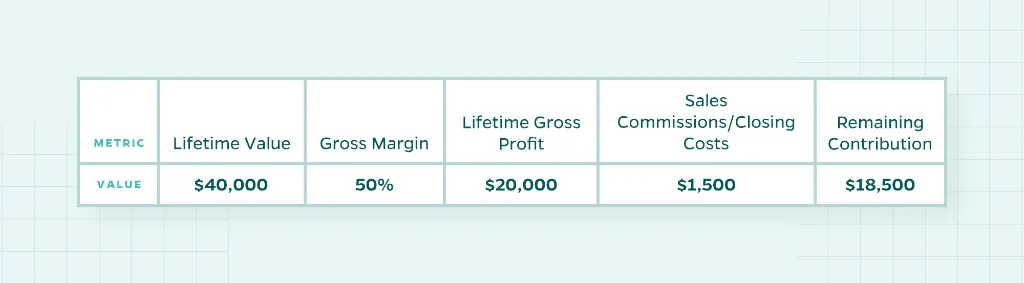
I start with the lifetime value of a customer. Then I reduce it by the cost to deliver the product or service. Then I reduce it again by sales commissions or other direct closing costs.
That gets me closer to the real economic value created by winning that customer.
For example:
- Lifetime value of a customer: $40,000
- Gross margin: 50%
- Lifetime gross profit: $20,000
- Less sales commissions or closing costs: $1,500
- Remaining contribution before marketing, overhead, and profit: $18,500
That leaves $18,500.
That is not the CAC target.
That is the maximum economic pool available before overhead, support costs, bad debt, churn risk, cash timing, and actual profit.
In other words, you cannot spend all of that on acquisition unless you want to make nothing on the customer.
So the next question is not “Can I spend $18,500?”
The next question is “What portion of that am I actually willing to invest to acquire the customer?”
That depends on the business, the goal, and where we are on the growth curve.
If I were comfortable spending 25 percent of that amount, CAC would be about $4,625.
If I were comfortable spending 33 percent, CAC would be about $6,105.
If I were comfortable spending 40 percent, CAC would be about $7,400.
Those are very different numbers. Any of them could be reasonable in the right situation.
That is why I like starting with max first. The math gives me a ceiling. The business decides what is smart underneath it.
Why That Number Should Keep Changing
This is the part I think matters most.
What I am willing to pay for a customer should change as the business changes.
Early on, when there is still obvious demand to capture, I may expect stronger efficiency.
In the middle stage, when the easy wins are mostly gone but the brand is not yet doing enough work on its own, I may need to tolerate a higher CAC if I want to keep growing.
Later, if brand familiarity, word of mouth, referrals, direct traffic, and stronger market presence begin to compound, I may see CAC stabilize or improve again.
So I do not want one CAC target sitting on a dashboard forever as if the business is static.
I want my view of CAC to evolve with reality.
Because the economics of acquisition evolve with reality too.
The Main Point
CAC is not just a measure of marketing efficiency.
It is also a reflection of where the business is in its growth curve.
That is why I do not think “max CAC” is a complete question by itself.
A better question is this:
What should I be willing to pay for the next customer, at this stage of growth, given the economics of the customer, the goals of the business, and where we are on the curve between easy demand and brand compounding?
That is a harder question.
But it leads to better decisions.