


This article is part of CFO Turned CMO, a series on what I’ve learned from leading both finance and marketing. It explores how my finance background has shaped the way I approach marketing, and how that perspective can help other business leaders.
One of the easiest ways for marketing strategy to drift is for leadership to be unclear about the business goal.
Most businesses say they want growth. But growth can mean very different things.
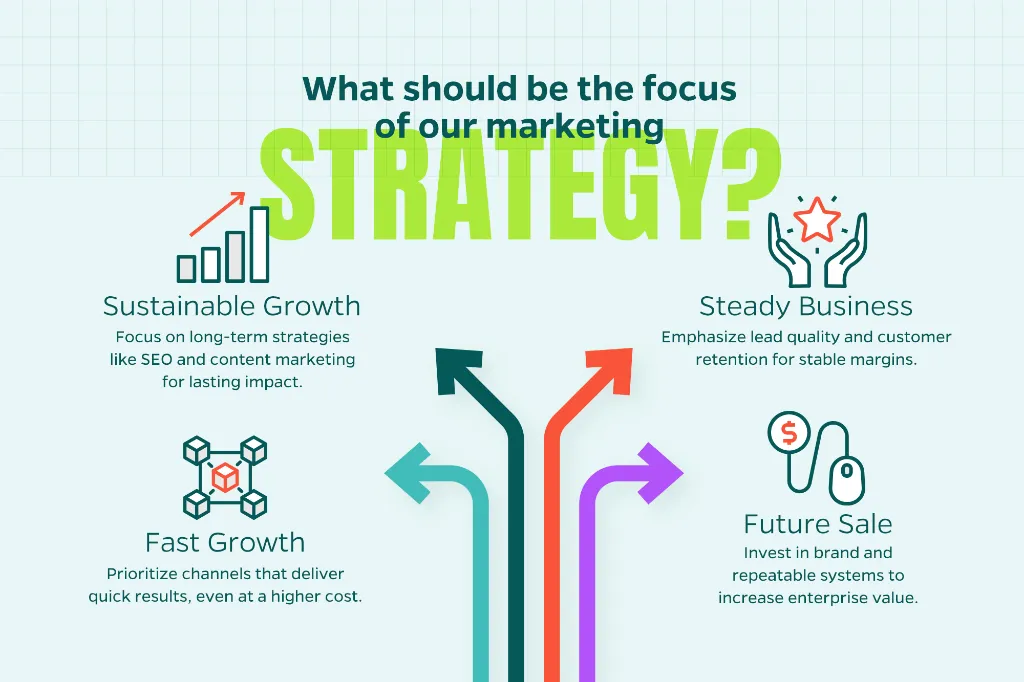
It might mean growing as quickly as possible over the next 12 months. It might mean growing profitably without putting pressure on margins. It might mean building a company that is more attractive to a future buyer. Or it might mean building a steadier, healthier business that gives the owner more control.
Those are all valid goals, but they should not lead to the same marketing strategy.
If leadership does not define the goal clearly, marketing will still move forward. It has to. Budgets get spent, campaigns get launched, channels get tested, content gets created, and reports get built.
But the strategy may start drifting toward what is easiest to measure, easiest to defend, or fastest to deliver, instead of what best supports the business the owner or executive team is trying to build.
That is why I think marketing strategy has to start with the business goal.
The Audience Still Matters
None of this means the business goal overrides the customer.
You still need to be where your audience is and where they make decisions. If buyers search when they have a problem, search matters. If they rely on reputation, referrals, reviews, or third-party validation, those things matter. If they research heavily before talking to sales, then your website, content, proof, and brand presence matter.
That part has to be true.
But once you understand where your buyers are, the business goal helps determine how those channels should be prioritized.
The audience helps define the options.
The business goal helps decide how much to invest, how quickly to expect a return, and how patient the business should be with each investment.
The Goal Defines What “Good” Marketing Looks Like
If the goal is fast growth, the business may be willing to pay more for speed. A channel that produces leads quickly, tests messaging quickly, or helps open a new market quickly may be worth the tradeoff, even if it is not the most efficient option over the long term.
That might mean more aggressive investment in Google Search Ads, paid social, referral sites, outbound campaigns, or landing pages that can create feedback quickly. The company may accept a higher customer acquisition cost for a period of time if the economics support it and speed is the priority.
In that context, a campaign that looks expensive may still be a good decision.
But if the goal is sustainable growth, good marketing may look different. The business may care more about payback, margins, lead quality, retention, and channels that do not require constant increases in spend to keep working.
In that environment, SEO, content, email, website improvements, stronger proof, better positioning, and conversion work may matter more. They may not always create the fastest return, but they can build a stronger foundation over time.
If the owner wants a steadier business with healthy margins and more control, good marketing may look different again. More leads are not always better. Better-fit leads may matter more.
That might mean narrowing the message, being clearer about who the business serves best, filtering out poor-fit prospects, or focusing on customers who are more profitable, easier to serve, and more likely to stay.
If the goal is a future sale, marketing may need to support enterprise value, not just lead volume. A buyer may care about whether demand is repeatable, whether the business depends too heavily on referrals or the owner’s relationships, and whether there is a system that can keep working after a transaction.
That can make investments in brand, reporting, CRM discipline, retention, content, and repeatable lead sources more valuable than they may appear in a short-term channel report.
And sometimes the business is in a constrained season. Cash may be tighter than usual. Delivery may be stretched. Sales follow-up may not be where it needs to be. In that case, the best marketing decision may not be to create as much demand as possible.
It may be to improve conversion, sharpen positioning, increase lead quality, or prepare the business for growth later.
The point is not that one goal is better than another.
The point is that different goals change what “good” means.
Unclear Goals Cause Strategy Drift
This is the part I think leaders underestimate.
When the business goal is vague, marketing teams often lean toward the work that is easiest to explain and defend.
Usually, that means quicker wins.
More leads are easier to report. More clicks are easier to measure. A campaign with visible attribution is easier to justify than a longer-term investment in SEO, content, brand, website improvements, stronger proof, or better sales collateral.
That does not mean the team is wrong. It often means they are responding to the environment leadership has created.
If leadership has not said sustainability matters, the team may optimize for speed.
If leadership has not said margin matters, the team may optimize for volume.
If leadership has not said long-term enterprise value matters, the team may underinvest in work that is harder to prove this month.
Short-term wins are not bad. Sometimes they are exactly what the business needs.
But they should be chosen on purpose.
If a business wants durable growth, better-fit customers, stronger margins, or a more valuable company over time, leadership needs to communicate that clearly. Otherwise, marketing can drift toward what looks best in the next report instead of what best supports the long-term direction of the business.
The Goal Should Be Resilient, Not Reactive
A business goal should not change every time conditions get uncomfortable.
That does not mean the goal is permanent. Businesses change. Markets change. Owners change. Capital needs change. Risk tolerance changes. A company may decide it wants to prepare for a sale, preserve cash, enter a new market, slow growth, or become more aggressive because the broader business context has changed.
Those are real reasons to revisit the goal.
But the goal should not be fragile.
If the stated goal changes every time there is pressure, uncertainty, or a harder quarter, it is worth asking whether the business ever had a clear goal in the first place.
A good business goal should be stress-tested against broader realities. What happens if the economy slows? What happens if capital gets more expensive? What happens if demand softens? What happens if the owner’s timeline changes? What happens if margins tighten or a major customer concentration risk appears?
The point is not to predict every scenario perfectly.
The point is to know whether the goal is strong enough to guide decisions through normal volatility.
That matters for marketing because marketing strategy needs a stable target. If the business goal keeps moving, the marketing strategy will keep moving with it. Channels will be started and stopped too quickly. Long-term investments will be questioned too early. Short-term wins will get overweighted. The team may not know whether it is supposed to optimize for speed, margin, durability, or enterprise value.
The goal can evolve.
But it should not constantly reset.
Marketing strategy works better when the business goal is clear, durable, and communicated well.
The Main Point
Marketing strategy is downstream of the business goal.
That does not mean every decision becomes easy. It does not mean attribution becomes perfect. It does not mean every channel has an obvious answer.
But it gives the team a standard.
Without that standard, almost every channel can be argued both ways.
Google Search Ads can look fast or expensive. SEO can look strategic or slow. Brand can look valuable or hard to measure. Content can look foundational or nonessential. Referral sites can look efficient or costly. Website work can look like a project or a growth lever.
The right answer depends on what the business is trying to build.
So before debating channels, campaigns, agencies, or budgets, leadership should be clear on the goal.
What kind of growth are we trying to create?
How quickly do we need it?
What are we willing to trade?
And what constraints do we need marketing to understand?
Once those answers are clear, the marketing strategy has a much better chance of supporting the business leadership actually wants to build.