




Higher education marketing is how colleges and universities attract, persuade, and enroll students, from initial research to enrollment. Effective programs work backward from enrollment targets, tailor campaigns to individual academic programs, connect search, social, and follow-up, and evaluate performance by cost per enrolled student rather than inquiry volume alone.
The audience includes prospective undergraduates and their families, graduate students, online and adult learners, and employers funding workforce education. Unlike many consumer purchases, choosing a college involves months of comparison, financial commitments, fixed academic start dates, and several decision-makers. The objective is not simply a completed form. It is a student who enrolls in the right program.
Higher Education Marketing Trends Reshaping Enrollment
Higher education marketing is harder than it was five years ago because the pool of prospective students, the ways they research schools, and the alternatives they consider are all changing. Four higher education marketing trends deserve particular attention:
- Demographic pressure. WICHE projects that U.S. high school graduates peaked at approximately 3.9 million in 2025 and will decline by roughly 13% through 2041. Institutions cannot assume the traditional-age applicant pool will keep growing. Source: WICHE, Knocking at the College Door.
- AI-assisted research. Prospects can ask conversational search tools to compare tuition, programs, outcomes, and admissions requirements before they visit a college website. Schools need accurate, accessible answers wherever research occurs.
- Higher communication expectations. Younger prospects expect timely, relevant, two-way communication, including useful answers by email, text, and social platforms. Speed matters, but relevance matters more than sending another generic reminder.
- Different sources of demand. Graduate, online, adult, and continuing-education audiences may offer growth opportunities, but their work schedules, motivations, and purchasing processes differ from those of residential undergraduates.
These shifts do not make brand awareness irrelevant. They make it more important to explain whom each program serves, what students receive, and why the investment makes sense compared with other paths.
How to Build a Higher Education Marketing Plan in 6 Steps
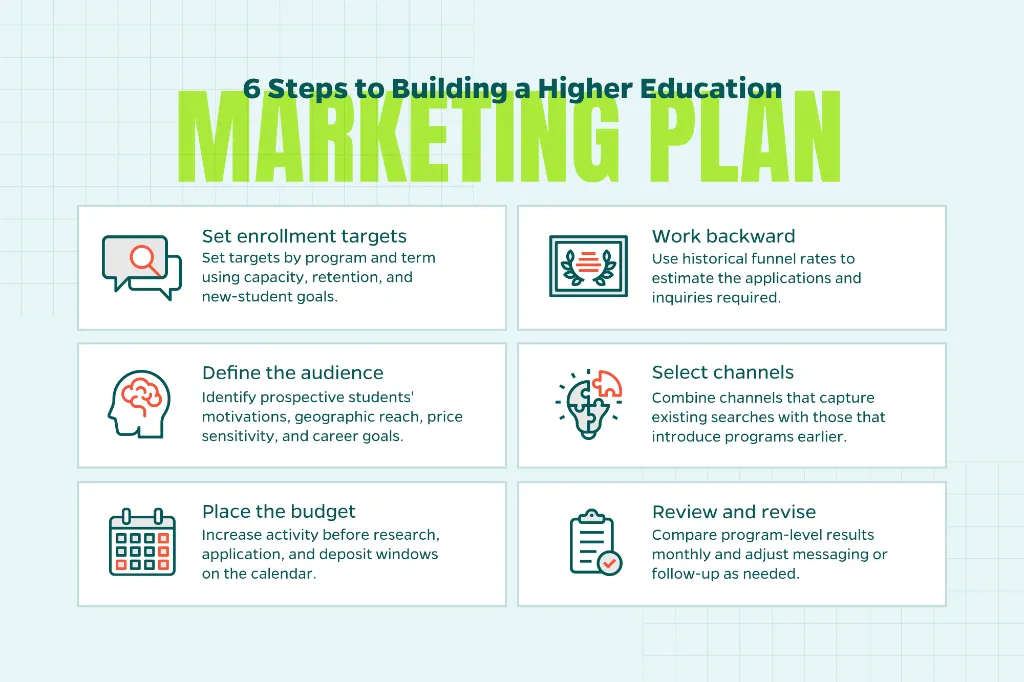
A higher education marketing plan should begin with the number of students the institution needs to enroll, not a wish list of advertising channels. That makes the plan easier to defend in a budget meeting and easier to adjust when applications or deposits fall behind.
- Set enrollment targets by program and term. Start with approved enrollment capacity, retention assumptions, new-student goals, and the programs that most need additional students. Separate fall undergraduate recruitment from rolling online or certificate starts. Confirm targets with enrollment and academic leaders.
- Work backward through the funnel. Use each program’s historical inquiry-to-application, application-to-admit, admit-to-deposit, and deposit-to-enrollment rates. Reverse those rates to estimate the applications and inquiries required. Use realistic rates for each audience rather than applying one institution-wide average.
- Define the audience for each program. Identify prospective students’ motivations, geographic reach, price sensitivity, career goals, objections, and decision-makers. A local nursing applicant, an online MBA prospect, and a parent of a first-year student need different proof.
- Select channels according to intent. Combine channels that capture existing searches with channels that introduce programs earlier in the journey. Assign a role, audience, conversion action, and expected response time to each channel rather than dividing money evenly.
- Place the budget on the enrollment calendar. Increase relevant activity before research, application, and deposit windows, allowing enough time for nurturing and admissions follow-up. Coordinate campaign launches with scholarship deadlines, information sessions, and program start dates. For paid media planning, see Straight North’s guide to budgeting PPC ads.
- Review results monthly and revise. Compare program-level inquiry quality, applications, deposits, enrollments, and cost per enrolled student with the plan. If one program has enough inquiries but weak applications, fix the message or follow-up before buying more traffic.
Here is some hypothetical funnel math. A program needs 60 enrolled students. If 80% of depositors enroll, it needs 75 deposits; if 50% of admitted students deposit, it needs 150 admits; if 60% of applicants are admitted, it needs 250 applications; and if 25% of inquiries apply, it needs 1,000 inquiries. The inquiry goal is an output of the enrollment goal, not the starting point.
“As the cost of a traditional four-year degree rises, students are comparing colleges with trade schools, community colleges, certificate programs, and other career-focused paths,” says David Duerr, a Straight North executive contributor on education marketing. “That changes the marketing challenge: SEO, GEO, paid search, and paid social all need to communicate not just what a program offers, but why the time, cost, and expected outcome make it worth choosing over very different alternatives.” A credible plan therefore links volume targets to a compelling, specific value proposition.
“As the cost of a traditional four-year degree rises, students are comparing colleges with trade schools, community colleges, certificate programs, and other career-focused paths. That changes the marketing challenge: SEO, GEO, paid search, and paid social all need to communicate not just what a program offers, but why the time, cost, and expected outcome make it worth choosing over very different alternatives.”

Higher Education Marketing Strategies That Drive Enrollment
The best marketing strategies for universities and colleges remove uncertainty from the student’s decision. The following university marketing strategies and marketing strategies for colleges work best when they reinforce one another rather than operate as isolated campaigns.
1. Position the institution with evidence
Define the school’s strengths in terms students can verify: program quality, support, affordability, flexibility, and outcomes. Use documented graduate stories, relevant accreditation, and carefully qualified outcomes rather than broad promises of success. Strong positioning helps when a prospect compares several similar institutions.
2. Build a fast, program-first website
Make program pages easy to find, read, and act on, especially on mobile. Explain cost, format, duration, outcomes, accreditation, admissions requirements, and the intended learner without forcing a visitor to request basic information. Clear calls to action should match readiness: explore a curriculum, attend an event, or speak with admissions.
3. Capture program searches with SEO and paid search
Search visibility helps schools reach prospects researching specific degrees, careers, and locations. Organic content supports sustained discovery. Paid search can provide additional reach during competitive application windows. Use dedicated pages and measure downstream applications, not only clicks.
4. Use student voices on social media
Student-generated videos, day-in-the-life stories, and faculty explanations can make a school feel more concrete. Match the platform and creative format to the audience, and secure permissions before featuring students. Social content often introduces the institution before a prospect is ready to inquire.
5. Nurture inquiries with email and text
Build sequences around program interests and decision milestones, including tuition questions, application tasks, and upcoming events. Provide clear ways to reply or opt out. Automated communication should help admissions staff prioritize meaningful conversations, not overwhelm prospects.
6. Offer campus and virtual experiences
Tours, webinars, class previews, and live student Q&As help prospects test whether a program fits. Track attendance and subsequent applications so events are evaluated as enrollment activities rather than merely well-attended occasions.
7. Personalize through the CRM
Use known program interest, academic level, and funnel stage to make outreach more relevant. Keep data practices transparent and ensure the next message reflects what the student has already done. A returning applicant should not receive the same introductory pitch as a first-time visitor.
8. Strengthen reputation and third-party proof
Prospects encounter reviews, rankings, news coverage, and peer discussions outside institutional channels. Keep public profiles accurate, respond constructively to feedback, and explain rankings in context. Credibility grows when outside information supports what the college says about itself.
Market Programs, Not Just the Institution
A university should market both its institution and its individual programs, but those investments serve different purposes. Brand marketing establishes trust; program-level marketing translates that trust into applications for specific offerings. Someone searching for an “online MBA” or “accelerated nursing program” may not begin with a college name.
Institution brand marketing typically looks like this:
- Goal: increase familiarity, preference, and institutional credibility.
- Audience: broad prospective-student and community groups, including parents and alumni.
- Message: overall mission, reputation, campus experience, and distinctive strengths.
- Channels: brand search, institutional content, public relations, broad social, and reputation activity.
- KPI and owner: branded demand and preference indicators; typically centrally managed marketing budgets.
Program-level marketing has a different operating model:
- Goal: fill available seats in a named program and term.
- Audience: learners whose needs and eligibility match that specific program.
- Message: curriculum, schedule, price, outcomes, entry requirements, and competitive alternatives.
- Channels: program-specific search, landing pages, targeted social, email, and employer outreach where appropriate.
- KPI and owner: qualified applicants, enrolled students and cost per enrolled student; marketing and the program director share accountability.
Every priority program should have its own audience definition, landing page, campaign structure, and budget line. Prioritize programs using available capacity, likely student demand, strategic importance, and the contribution the institution can reasonably earn from an additional enrollee. A program with no open seats should not absorb acquisition money simply because its searches convert cheaply.
Separate branded searches from nonbranded and program-specific searches in reporting. Brand traffic often converts differently because those prospects already know the institution. Combining everything can make new-student acquisition look more efficient than it is. The same principle applies to paid budgets: where campaign-level budget controls determine spending, structure campaigns so priority programs can receive deliberate allocations.
A program director should help validate the messaging, admissions criteria, and enrollment capacity. Marketing should then test which program benefits and student questions produce qualified applicants. One campaign attempting to speak for dozens of unrelated degrees rarely provides that precision.
Higher Ed Digital Marketing: How to Choose Your Channel Mix
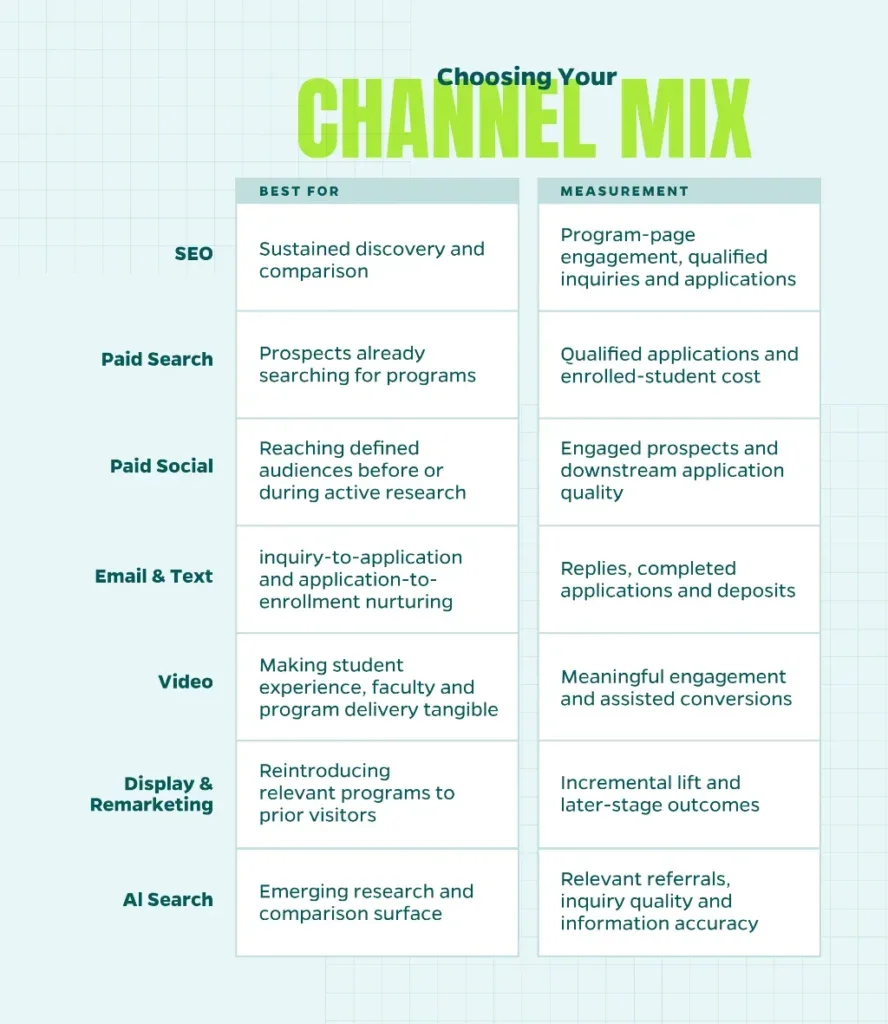
A digital marketing strategy for a university should assign each channel a distinct job in the enrollment journey. Higher ed digital marketing is most effective when channels share consistent program facts and conversion goals. The right higher education digital marketing mix depends on audience behavior, competition, and how soon a program needs students.
- SEO: Best for sustained discovery and comparison; plan months ahead and measure program-page engagement, qualified inquiries and applications. See Straight North’s higher education SEO services.
- Paid search: Best for prospects already searching for programs; it can generate activity quickly once campaigns and landing pages are ready. Measure qualified applications and enrolled-student cost.
- Paid social: Best for reaching defined audiences before or during active research; allow time for creative testing. Measure engaged prospects and downstream application quality.
- Email and text: Best for inquiry-to-application and application-to-enrollment nurturing; results can be tested quickly. Measure replies, completed applications and deposits.
- Video: Best for making student experience, faculty and program delivery tangible; develop reusable assets over a term. Measure meaningful engagement and assisted conversions.
- Display and remarketing: Best for reintroducing relevant programs to prior visitors where privacy and consent permit. Measure incremental lift and later-stage outcomes, not impressions alone.
- AI search: Best treated as an emerging research and comparison surface; improvements may take time and visibility is not guaranteed. Track relevant referrals, inquiry quality and the accuracy of information AI tools surface.
Digital marketing for universities should be coordinated around one enrollment strategy. A student may first encounter a social video, compare schools through search, and return via a paid advertisement. The message about price, format, and outcomes must remain consistent throughout.
How AI Search Is Changing the Way Students Choose a College
AI search gives prospective students and parents another way to compare programs, costs, admissions requirements, and career possibilities. An AI-generated answer may rely on school pages alongside rankings, media coverage, and community discussions. Institutions cannot control every source or guarantee that an AI system will cite them.
“Students and parents rarely experience SEO, GEO, paid search, and paid social as separate channels, even if marketing teams manage them that way,” says Frank Fornaris, a Straight North executive contributor on education marketing. “Someone may discover a school through social, research it through Google or ChatGPT, and come back through a paid ad, so the channels need to reinforce the same positioning and enrollment priorities.” This makes consistent information across channels a practical enrollment priority.
“Students and parents rarely experience SEO, GEO, paid search, and paid social as separate channels, even if marketing teams manage them that way. Someone may discover a school through social, research it through Google or ChatGPT, and come back through a paid ad, so the channels need to reinforce the same positioning and enrollment priorities.”

In Straight North’s September 2026 cross-industry survey of 101 marketers, 52% said a customer or prospect had told them multiple times in the preceding 12 months that they used ChatGPT or another AI platform to research their company. This was a B2B marketing sample, not a study of college students, so it illustrates broader research behavior rather than measuring higher education adoption.
Schools can improve their readiness by publishing plain-language program pages with tuition information, course format, entry requirements, timelines, and substantiated outcomes. Keep those details consistent on directories and other third-party profiles. Review how programs appear in common AI-assisted comparisons and connect any measurable AI referral traffic to applications and enrollments. For implementation ideas, see Straight North’s practical AI search framework.
Continuing Education and Executive Education Marketing
Continuing education marketing differs from undergraduate recruitment because adult learners often begin with a specific job, credential, or skill gap. They ask whether the program fits their schedule, what it costs, how quickly they can use what they learn, and whether an employer will help pay. Executive education marketing adds another layer: the participant and the person approving the budget may be different buyers.
Traditional undergraduate programs generally involve:
- Decision-maker and payer: the student, often with parents or guardians influencing affordability and fit.
- Timeline and message: a long, calendar-driven comparison centered on academic experience, support, value and belonging.
- Channels and metric: search, social, events and counselor communication; measure deposited and enrolled students.
Continuing and professional education generally involves:
- Decision-maker and payer: a working adult who may self-fund or use employer assistance.
- Timeline and message: shorter or rolling starts; emphasize skill relevance, flexible delivery, total cost and time to completion.
- Channels and metric: credential-specific search, professional communities, LinkedIn and measured email nurture; track paid registrations and completed enrollments.
Executive education generally involves:
- Decision-maker and payer: a manager, HR or learning-and-development team may approve or purchase seats for employees.
- Timeline and message: a budget and approval cycle tied to business objectives, leadership capabilities, and measurable organizational value.
- Channels and metric: employer partnerships, targeted LinkedIn outreach, account-based campaigns, and relationship-driven follow-up; track employer-sponsored enrollments and repeat accounts.
Under Section 127 of the Internal Revenue Code, employers can generally provide up to $5,250 per employee annually in qualifying tax-free educational assistance under applicable rules; the statutory limit is indexed for inflation after 2026. Source: Association of American Universities, Employer-Provided Educational Assistance Benefits. Schools should encourage learners to confirm eligibility with their employers rather than treating the benefit as guaranteed funding.
For executive programs, build an employer value proposition alongside the student-facing page. Explain who benefits, what skills the training addresses, how delivery fits the workday and what information an approving manager needs. Maintain employer account lists and track the organizations that sponsor learners.
Not every interested adult is ready to enroll this term. A useful nurture sequence might offer a curriculum overview, a short faculty session, employer reimbursement guidance, and a reminder when the next cohort opens. Treat a delayed decision as part of the purchasing cycle rather than immediate evidence that the campaign failed.
Aligning Marketing and Admissions
Marketing spend is wasted when an institution can generate interest but cannot turn it into a timely, relevant admissions conversation. Marketing and admissions should operate from shared definitions, records, and program-level goals.
- Agree on what counts as an inquiry, qualified lead, applicant, admit, deposit, and enrolled student.
- Maintain one accessible CRM record per prospect, with appropriate permissions and deduplication.
- Track inquiry response time, contact attempts, and successful conversations by program.
- Assign clear ownership for follow-up, event invitations, and stalled applications.
- Review the program-level funnel together every month, including the reasons prospects stop progressing.
A lead is not necessarily qualified because a form was completed. Admissions feedback about eligibility, intended start date, and program fit should shape marketing audiences and campaign optimization.
How to Measure Higher Education Marketing by Cost per Enrolled Student
The right way to measure higher education marketing is to connect spend with students who enroll in a particular program and term. Clicks, rankings, and inquiry totals can explain performance, but they cannot by themselves settle whether a campaign is producing the enrollment the institution needs.
- Cost per inquiry = marketing spend ÷ inquiries generated. This is an early efficiency indicator, useful for spotting changes in demand or landing-page conversion. It should not decide budget allocations alone.
- Inquiry-to-application rate = applications ÷ inquiries × 100. This shows whether interest becomes a meaningful next step. Low rates may signal poor targeting, missing program information or weak follow-up.
- Cost per application = marketing spend ÷ applications attributable to that spend. This is more informative than cost per inquiry, but applications can still differ greatly in eligibility and eventual enrollment.
- Admit-to-enroll yield = enrolled students ÷ admitted students × 100. This shows how effectively the institution converts offers into students. For planning, separately track admit-to-deposit and deposit-to-enrollment rates when those stages are available.
- Cost per enrolled student = marketing spend ÷ enrolled students attributed to the program or channel. This is the primary acquisition decision metric: compare it with the program’s economics, enrollment goals and available capacity.
For example, a campaign spending $24,000 that generates 240 inquiries, 60 applications, and 12 enrolled students has a $100 cost per inquiry, a $400 cost per application, and a $2,000 cost per enrolled student. A competing campaign with cheaper inquiries but only three enrollments could be far less efficient. These figures are illustrative, not higher education benchmarks.
Connect the student information system or admissions CRM to marketing reporting, using appropriate data governance. Google Ads supports importing offline conversion outcomes through supported identifiers and first-party data, allowing advertisers to connect later CRM events with earlier ad interactions. Where enough reliable data exists, optimize toward qualified applications or enrolled outcomes rather than every form submission.
Report by program, term, and channel, and distinguish directly tracked outcomes from modeled or assisted contributions. Attribution is directional: students use multiple devices, ask family members, and interact with offline events. A clear, consistent measurement approach is more useful than claiming every enrollment has one perfectly identifiable source.
Review cost per enrolled student alongside student fit, academic capacity, and expected net tuition contribution. A low acquisition cost is not a win if the program cannot serve the student or the enrollment does not support institutional goals.
Common Higher Education Marketing Mistakes (and What to Do Next)
The most expensive higher education marketing mistakes come from disconnecting activity from enrollment outcomes. Five are especially common:
- Using one generic message for every program. Replace it with pages and campaigns tailored to priority degrees, credentials, and audiences.
- Calling the channel with the most inquiries the winner. Compare qualified applications, actual enrollments, and acquisition costs instead.
- Spending the same amount every month. Schedule investments around research, application, deposit, and cohort-start dates.
- Letting inquiries wait for follow-up. Agree on response expectations, monitor them, and give admissions staff useful context.
- Treating continuing education like first-year undergraduate recruitment. Address adult learners’ schedules, employers, credentials, and payment decisions directly.
The next step is a program-by-program review of enrollment targets, conversion rates, marketing spend, and the points where prospective students disengage. That review reveals whether the immediate need is more reach, clearer information, better follow-up, or a different allocation of budget.
Higher Education Marketing FAQ
How much should a college spend on marketing?
Build the budget from enrollment targets and an affordable cost per enrolled student for each program. For example, a goal of 40 incremental enrollments at a sustainable acquisition cost of $1,500 suggests a $60,000 acquisition budget. Adjust for existing organic demand, program economics, and the institution’s ability to convert inquiries; there is no universally suitable percentage of revenue.
What is the difference between higher education marketing and enrollment marketing?
Enrollment marketing focuses on recruiting prospects and helping them progress from inquiry to enrollment. Higher education marketing is broader: it also supports institutional brand, reputation, program positioning, community relationships, and, in some cases, retention and lifelong learning.
What digital marketing strategy works for a small private college?
A small private college can start with two or three programs that have both demand and room to grow. Create useful program pages, target relevant search terms, follow up consistently by email and text, and measure applications and enrollments before expanding the channel mix.
When should a university hire a higher education marketing agency?
Consider outside support when the internal team lacks capacity for the necessary channels, campaign execution, or CRM-to-enrollment measurement, or when acquisition costs rise without a clear explanation. Ask prospective partners to demonstrate program-level reporting, admissions collaboration, and practical measurement beyond inquiry totals.
Need Help?
Talk to Straight North about higher education digital marketing and how to turn your enrollment goals into a measurable plan.
