



Key Takeaways
- Paid search is shifting from keyword management to signal management.
- First-party data and qualified conversion data give AI better direction.
- AI needs human strategy, context, and guardrails to perform effectively.
- Test AI-driven formats incrementally instead of adopting, or rejecting, everything at once.
- The marketer sets the strategy; AI increasingly executes the tactics.
AI is blurring the line between paid and organic search, pulling both disciplines toward the same goal: the best answer. Winning isn’t about chasing keyword rankings anymore. It’s about content quality, site strength, and the signals you send Google.
For paid search, that means a shift from keyword management to signal management. Success depends less on bidding up individual keywords and more on feeding AI systems the high-quality signals they need to find the right opportunities.
Those signals act as guardrails. Straight North Director of Paid Advertising David Ohm explains it well: marketers still decide what information the system gets, clean it up, and set the boundaries that guide automation. Within those guardrails, AI needs room to find the auctions and users most likely to convert.
That requires a different approach to control. The goal isn’t to dictate every decision or hand everything over to automation. It’s to give AI strong signals and clear boundaries, then enough room to find opportunities keyword-by-keyword management might miss.
Why Keywords Are No Longer the Whole Paid Search Strategy
Keywords remain a core part of paid search, but AI-driven campaigns are expanding beyond them. Formats like Performance Max use a wider range of signals to determine when and where ads should appear, making the information advertisers provide increasingly important.
Even campaigns that have search as a major component, like Performance Max, are consistently kind of shedding the keyword label, and broaching into other areas, outside of it, and providing the right signal so it knows, kind of, where to float outside of its comfort zone of search and keywords, is really important, because PMax can get off the rails, and all AI can get off the rails very quickly, if the right signals aren’t in place.
Moving beyond keywords doesn’t mean giving up control; it shifts control upstream. Instead of managing every keyword and auction individually, advertisers increasingly shape AI’s decisions through the signals they provide.
That makes the quality of those inputs the next priority: AI can only expand effectively when the information guiding it is accurate and useful.
The Signals That Matter Most in AI-Driven Advertising
As paid search becomes more AI-driven, the quality of the information feeding the system matters more. Keywords still provide an important signal, but they’re now part of a much larger set of inputs Google can use to decide who to reach and where to reach them, as well as which opportunities are worth pursuing.
The key is giving AI context it couldn’t otherwise infer on its own. A form fill, for example, tells Google that someone converted. But connecting that interaction to customer relationship management (CRM) data can tell Google whether that person became a qualified lead, a customer, or ultimately generated revenue. That distinction gives the platform a much clearer picture of what success looks like.
I would say these are our primary two signals. So the first-party data, the existing customer data, or lead data, and then qualified lead data coming in the other way. That’s kind of the system that allows us to go beyond, traditional search and really feel comfortable with it. Some other kind of, I don’t want to say lesser signals, still very important, are search themes, which are essentially a version of keywords that’s been repackaged for PMax, very important. Landing page content is really important, that’s a signal. A lot of campaigns already use this, where they will kind of use landing page content dynamically, and instead of keywords, they look at landing page content and decide, oh, I’m gonna find users that are looking for content like this, and they’re searching this way, or they’re on websites like this. So landing page content is another kind of way to steer Google AI in a direction, and a lot of the things that PMax and other campaigns and dynamic aspects of Google will look for in content and use is very similar to the way, like the things that we want in that content is very similar to what we would want, you know, from an organic standpoint.
The more meaningful those inputs are, the more confidently advertisers can allow AI to operate beyond the boundaries of traditional search. Instead of optimizing simply for more clicks or conversions, the system can begin looking for the types of users and interactions that create business value.
Signal quality matters more than volume. Clean first-party data, accurate conversion tracking, and clear content give AI a more reliable definition of what, and who, is valuable.
Why AI Makes Human Strategy More Important
As AI takes on more of the day-to-day execution of paid search, human oversight becomes more important. Automation can make decisions faster and at a scale marketers can’t match, but it still needs marketers to define what success looks like.
“AI is great at optimizing towards a target, but humans still need to decide what that target is.”
That distinction matters. If an advertiser gives AI the wrong goal or incomplete information, the system can efficiently optimize in the wrong direction. Marketers still need to establish clear objectives and provide the context AI needs to pursue them.
In an AI-driven environment, context is another signal. Give the system as much relevant information as possible: clear goals, historical performance data, specific service or product pages, audience data, conversion actions, and other business inputs. As Ohm puts it, “Context is everything. Context is signals.”
That leads to a simple division of responsibilities: humans set the strategy; AI executes the tactics. Marketers determine the goals, inputs, and guardrails, while AI increasingly handles the execution needed to pursue them.
The more tactical control AI assumes, the more valuable the marketer’s ability to give it the right direction, context, and boundaries becomes.
How Gemini/AI Mode Is Changing the Search Ad Experience
AI Mode changes not just where ads appear, but how they enter the search experience. Sponsored recommendations can now be woven into a broader, conversational answer rather than appearing only in predictable ad positions.
It’s definitely an evolution rather than a replacement. Traditional search ads are very keyword-driven, and kind of appear as separate sponsored listings or, you know, below the organic results. Users kind of decide, you know, whether or not to click them before engaging with any content. AI kind of synthesizes that entire experience. Instead of presenting, like, a list of links, it understands the user’s intent, and introduces a sponsored recommendation if it’s relevant to the conversation. So the ad is kind of woven into a broader response, rather than standing alone on a search results page. So it’s a little bit less about, you know, winning a click, you know, and a little bit more about earning that place in the AI’s recommendation set. And this is, again, content quality, product information, reviews, all these credibility pieces, merchant center data for, you know, e-commerce-driven advertisers. But those are so important to AI to answer a question, and it becomes more than just matching a keyword, and more about kind of being part of a conversation.
The implication is a broader definition of relevance. When deciding whether business or product belongs in the response, AI can consider the full conversation instead of just a single query.
Commercial intent also plays a role in whether an ad appears at all. Questions such as “What’s the best CRM for a small business?” or “Which running shoes should I buy?” create a natural opportunity for a sponsored recommendation. More philosophical or informational conversations may not.
For advertisers, earning that recommendation depends on giving AI enough information to establish both relevance and credibility:
- Content and landing-page quality: Clear, trustworthy content helps AI understand a business and confidently reference it.
- Product and Merchant Center data: Accurate pricing, availability, specifications, and other structured data give AI reliable product information to draw from.
- Reviews and credibility signals: These provide additional evidence that a business or product is trustworthy.
- Existing advertising signals: Search, Shopping, and Performance Max performance continue to provide Google with information about relevance.
- Whole-conversation context: AI can consider the user’s broader dialogue and intent rather than relying on a single query or keyword.
The Two Biggest AI Advertising Mistakes
As AI-driven advertising becomes more capable, marketers may be tempted to either embrace every new feature immediately or hold tightly to the control they already have. Both approaches carry risk. The better path is somewhere in the middle: adopting AI deliberately, with the right signals, guardrails, and testing strategy in place.
Mistake #1: Turning Everything on at Once
Enabling Broad Match, AI Max, Performance Max, auto-created assets, and other AI features all at once can give the system too much freedom before the right signals and guardrails are in place. Without that foundation, campaigns can quickly move in the wrong direction, resulting in wasted spend and poor-quality leads.
Mistake #2: Refusing to Adopt AI
The opposite approach can be just as limiting. Avoiding AI-driven features may preserve control in the short term, but it also prevents advertisers from learning how these tools work. As automation becomes a larger part of paid search, marketers who wait could eventually be forced to adapt without the experience, data, or infrastructure they need.
The better approach is controlled, incremental experimentation: Test new capabilities alongside what already works, learn from the results, and expand AI’s role as the right signals and guardrails are put in place.
Which AI-Powered Campaign Types Should You Test First?
Adopting AI-driven campaigns doesn’t have to mean abandoning what already works. Ohm describes traditional exact- and phrase-match search as a “safety net.” It’s a more predictable, controllable foundation that advertisers can maintain while testing the greater reach and power of Broad Match, AI Max, PMax, and Demand Gen.
For newer accounts or advertisers with smaller budgets, Ohm suggests expanding in stages rather than jumping straight to the most automated formats:
- Traditional Search: Start with exact- and phrase-match keywords as the controlled foundation.
- Broad Match: Take a first step into AI-driven expansion while retaining significant keyword-level control.
- AI Max: Expand search further while maintaining visibility into search terms and controls such as negative keywords.
- Performance Max: Move beyond search into Google’s broader inventory. At this stage, qualified audience and conversion data become especially important as keyword-level control decreases.
- Demand Gen: Expand further up the funnel when the goal shifts toward creating new demand through more visual, awareness-oriented advertising.
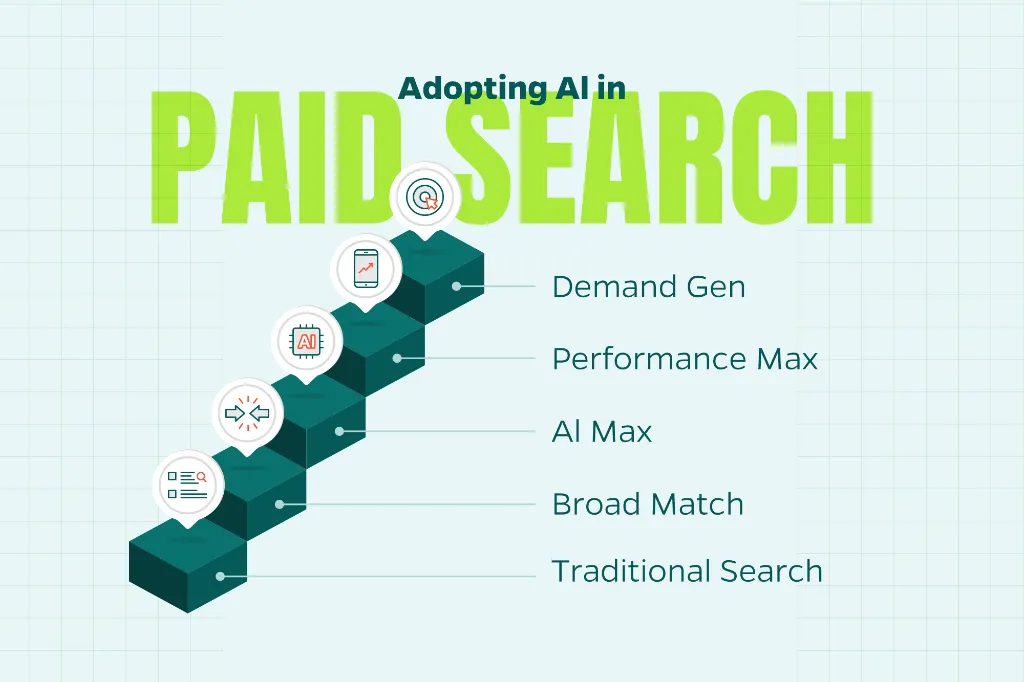
There isn’t a universal formula. How far and how quickly an advertiser moves along that spectrum should depend on budget, the quality of available signals, existing infrastructure, and, most importantly, how the previous step performs.
How To Test AI Without Sacrificing Existing Performance
Testing AI-driven campaigns doesn’t require putting proven search performance at risk. The key is to treat existing search campaigns as a stabilizing foundation, then use newer formats to find incremental opportunities beyond what’s already working.
That means segmenting campaigns where it provides meaningful control. For example, advertisers can protect “home run” keywords that already perform well in traditional search rather than allowing Performance Max to compete for the same traffic. This gives PMax more room to uncover demand the existing search campaign isn’t already capturing.
So we’d always recommend segmenting branded traffic out of your standard non-branded-oriented PMax campaign, especially if you’ve just got one, and running that branded traffic in an isolated search campaign, because it performs differently. So yeah, I would definitely recommend that. You can’t really completely segment AI Max. I would not recommend having a separate search campaign with AI Max, and then a search campaign with the same keywords without AI Max. That’s, like, fits into my traditional A-B testing kind of way of thinking, but realistically, if you do something like that, you’re probably segmenting conversion data way too much, and both campaigns are having trouble learning. So, there is a time and a place where you kind of have to eat that disruption a little bit, and then dig into the data and see where it’s working and where it’s not working. So, I would say AI Max Broad Match, this is kind of in the campaigns, you have to kind of move the data pieces around and determine, is this worth it to stay, is it not? From Performance Max, while there is some overlap with search, I would advise segmenting that within reason to maintain the stability and success that you’ve potentially built already with search.
But more segmentation isn’t always better. As Ohm explains, trying to create perfectly isolated tests with tools like AI Max can divide conversion data to the point that neither campaign has enough information to learn effectively. Sometimes advertisers need to accept a degree of overlap or short-term disruption, then evaluate the data to determine whether the AI-driven expansion is actually adding value.
Ultimately, the goal isn’t simply to see conversions appear in a new campaign type. It’s to determine whether AI is producing incremental growth like new traffic, leads, or demand that the existing search strategy wouldn’t have captured on its own. Keeping proven search campaigns stable, separating branded traffic where appropriate, and avoiding unnecessary overlap can make it easier to see whether AI is truly expanding performance rather than simply taking credit for conversions that were already there.
The Guardrails Every AI-Driven Campaign Needs
Giving AI more freedom doesn’t mean giving it free rein. Strong AI-driven campaigns start with the right signals and controls. Qualified offline conversion data and first-party audience data are the priority, helping Google understand what valuable outcomes and customers look like. Negative keywords, brand exclusions, content suitability settings, and placement controls provide the next layer of guardrails.
Getting those controls in place before the campaign begins learning is especially important. Early signals can influence the direction a campaign takes, and weak guardrails can lead AI to waste spend learning lessons that could have been avoided from the start.
As you would add negative keywords with, you know, a search campaign, you do that with the Performance Max campaign as well. It’s, you know, even more important there, I would argue, but it’s really important to look at the Performance Max placement reports, and for Demand Gen, look at where my ads show my ads have shown section to on an ongoing basis, exclude placements that you don’t want to trickle through. So essentially, as part of your weekly or monthly maintenance, depending on the size of the account. I would also add placement exclusions, placement analysis and exclusions to essentially make sure that even if you had a great upfront strategy with content suitability and mobile apps excluded, that, you know, stuff isn’t kind of trickling in around the cracks. Like, same way we would for negative keyword additions. You get a lot out of the way up front, but there are some things you just can’t predict, and they need ongoing maintenance.
But those guardrails aren’t a one-time setup. As campaigns learn and expand, advertisers need to review placements, exclusions, and auto-created assets regularly. Ohm notes that auto-created assets can sometimes pull otherwise relevant content from the wrong service line or page, making ongoing review especially important for complex or brand-sensitive accounts.
The takeaway is simple: AI campaigns should never be “set it and forget it.” Establish the ground rules upfront, then continue refining them as the campaign learns.
What This Means for the Future of Paid Search
As AI takes on more campaign execution, advertisers will likely give up some of the tactical control that has traditionally defined paid search. But that doesn’t make the marketer less important. It changes where that control happens.
Competitive advantage will increasingly come from what marketers give AI to work with: better first-party data, stronger websites and content, more meaningful measurement, clearer strategic inputs, and guardrails that keep automation aligned with business goals. Just as important will be the experience marketers build by testing these tools and learning when and how to trust them.
“Marketers are more setting the strategy, and AI is kind of executing the tactics.”
PMax already offers a glimpse of that future. Ohm notes that, with the proper signals and guardrails in place, PMax has helped some lead-generation accounts move beyond the limits of traditional search and uncover demand they otherwise wouldn’t have reached.
Marketers Moving Forward With AI
The shift toward AI-driven paid search doesn’t call for blind trust or blind resistance. Marketers need to build the data, measurement, content, and processes that allow them to take advantage of automation without giving up strategic control.
As AI assumes more of the tactical work, the marketer’s value moves upstream. The most important decisions become what the system should optimize for, which signals it should trust, and where the guardrails belong.

It’s just important to define everything for the AI as clearly and obviously as possible and allow the AI to optimize. Again, this comes back to signals and execution versus strategy, and marketers still have the strategy and the inputs provided, and the AI kind of has the execution. The strongest results for campaigns here are gonna come from, you know, a partnership of AI and human ingenuity.
That partnership is the point: use AI for speed, scale, and execution while keeping human judgment focused on objectives, context, and oversight.
The future of paid search isn’t marketers versus AI. It’s marketers setting the strategy and AI extending what that strategy can achieve.