

To increase college enrollment, identify where students stop progressing from inquiry to application, admission, deposit, or arrival, and fix that bottleneck first. Strengthen program pages, improve visibility in search and AI search, respond quickly, simplify applications, explain affordability, and support admitted students. Evaluate success by cost per enrolled student, not inquiries alone.
Nine practical strategies can help: sharpen your value proposition, improve program pages, answer AI search questions, respond personally, feature student voices, simplify applications, clarify costs, strengthen yield, and recruit beyond traditional first-year students.
Why Increasing College Enrollment Is Harder Now
College enrollment is not moving in one direction across every institution. WICHE projected that U.S. high school graduates would peak near 3.9 million in 2025 and decline to approximately 3.4 million by 2041, a decrease of about 13%. Meanwhile, the National Student Clearinghouse Research Center reported that fall 2025 undergraduate enrollment increased 1.2% to 16.2 million, with community colleges up 3.0% and private nonprofit four-year institutions down 1.6%.
That uneven landscape makes inefficient recruitment expensive. Institutions need to explain their value clearly and convert more of the interest they already generate, rather than assuming a larger advertising budget will solve every enrollment challenge.
Find Where Your Enrollment Funnel Leaks Before You Add Tactics
The first enrollment strategy to fix is the stage with the largest unexpected decline in conversion compared with prior cycles. Compare inquiry-to-application, application-to-admission, admission-to-deposit, and deposit-to-enrollment rates by program, student type, and acquisition channel. A steady loss of prospects at each step is normal; a sudden deterioration at one step demands attention.
For example, a college with healthy application volume but weak deposits has a yield problem. More search advertising might produce additional applicants without changing their decision to attend. A school with strong program-page traffic but few inquiries should instead examine its message, page experience, and calls to action.
What you see | Likely weak point | Fix first |
Program traffic, few inquiries | Program page conversion | Strategy 2: improve page clarity and inquiry paths |
Inquiries, few applications | Follow-up and intent | Strategy 4: faster, tailored responses |
Started, unfinished applications | Application experience | Strategy 6: remove friction |
Admits, few deposits | Affordability or yield | Strategies 7 and 8: cost clarity and outreach |
Deposits, fewer arrivals | Summer melt | Strategy 8: sustained pre-arrival support |
Weak demand for select programs | Positioning and audience fit | Strategies 1, 3, and 9 |
Review both rates and counts. A modest percentage decline in a large program can affect more students than a dramatic decline in a small one. Also check whether a program has capacity for additional students before increasing its recruitment spend. This makes the plan actionable for admissions, marketing, financial aid, and academic leadership.
1. Sharpen the Value Proposition for the Students You Actually Enroll
The strongest marketing strategy to attract students starts with the reasons successful students choose, attend, and remain at your institution. Interview recent enrollees, examine admitted-student feedback, and compare outcomes across programs. Avoid describing every degree with the same broad claims about excellence or community.
Build distinct messages for first-year, transfer, adult, and graduate prospects. A working adult may prioritize flexible schedules and credit for prior learning; a first-year student may want campus belonging and career direction. In each case, connect the promise to verifiable evidence.
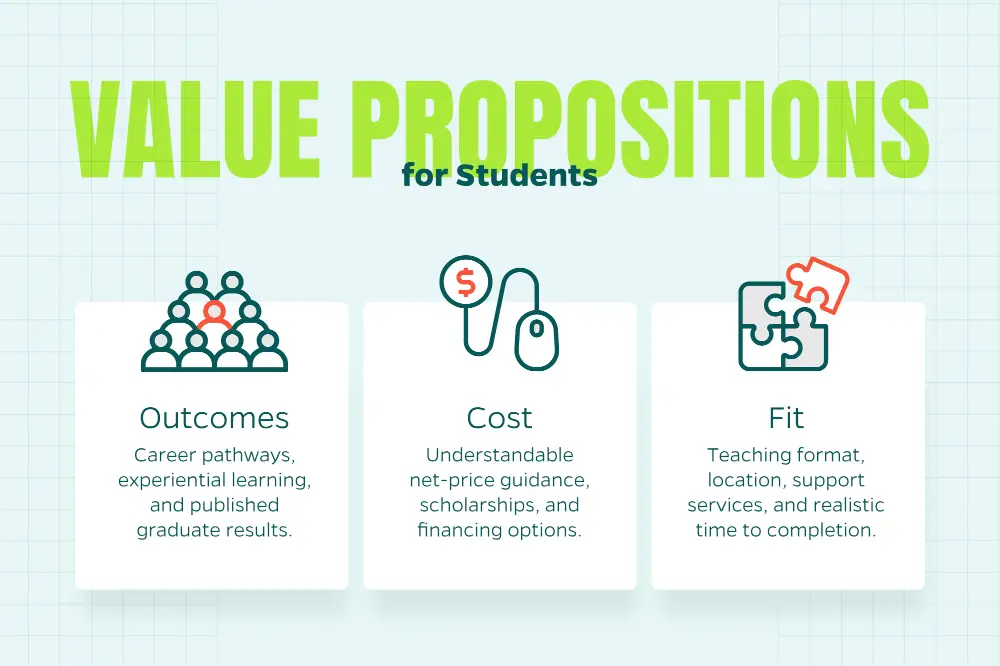
- Outcomes: career pathways, experiential learning, and published graduate results.
- Cost: understandable net-price guidance, scholarships, and financing options.
- Fit: teaching format, location, support services, and realistic time to completion.
Student recruitment strategies should also acknowledge alternatives. Prospects may compare a four-year degree with community college, certificates, apprenticeships, or entering the workforce. Explain what your particular program delivers for its time and cost, without dismissing those options.
2. Build Program Pages That Win Organic and Paid Search
Program pages matter more than a general homepage for many enrollment searches because prospective students usually have a specific degree, credential, or career in mind. Each priority program needs a dedicated page that can answer those questions, appear in relevant organic searches, and serve as a focused destination for paid search traffic.
Every priority program page should make the following easy to find:
- Program name, credential, learning outcomes, and likely career pathways.
- Tuition, estimated net price, financial aid, and scholarship information.
- Campus, online, hybrid, full-time, and part-time formats.
- Schedules, start dates, deadlines, and expected completion time.
- Admission requirements, transfer-credit policies, and application steps.
- Student or graduate perspectives, with specific evidence where available.
- A short inquiry form, an admissions contact, and a clear next action.
Keep essential information visible near the top of the page, especially on mobile. Use plain headings that match student questions. Link to supporting detail without forcing visitors to hunt across several departments for basic answers.
“Increasing media spend doesn’t always solve an enrollment problem,” says Frank Fornaris, Straight North President. “If the website does not clearly communicate the value of the school or program, sometimes the highest-return advertising decision is improving what happens after the click before buying more clicks.” That principle applies equally to paid landing pages and organic entry pages.
“Increasing media spend doesn’t always solve an enrollment problem. If the website does not clearly communicate the value of the school or program, sometimes the highest-return advertising decision is improving what happens after the click before buying more clicks.”

Use paid search to cover valuable program queries where organic visibility is limited, then examine which pages attract visitors but fail to produce meaningful next steps. A landing page should be evaluated on inquiries and subsequent applications, not pageviews alone. For more, see Straight North’s guide to landing pages for PPC campaigns.
3. Get Your Programs Into AI Search Answers
Prospective students increasingly use AI tools while comparing colleges. In an EAB survey of more than 5,000 high school students conducted in October and November 2025, 46% said they used AI tools such as ChatGPT in their college search, compared with 26% in spring 2025. EAB also reported that 18% had removed a college from consideration because of AI-generated results.
AI search can shape a shortlist before a student reaches a college website. Students may ask which programs offer evening classes, how much a degree costs, whether credits transfer, or what graduates do next. Clear, consistent, accessible answers give AI systems more useful material to work with, although no institution can guarantee inclusion in an AI answer.
Start with the same program pages that support organic and paid search. Add concise answers to common questions, publish current tuition and outcome information, and keep program names, formats, deadlines, and locations consistent across official pages and relevant institutional profiles. Avoid burying key facts in images or downloadable brochures alone.
Track referral visits from identifiable AI platforms where analytics allows, and periodically check whether your institution is mentioned for representative program questions. These observations are directional: AI prompts vary, personalization affects answers, and much AI-assisted discovery may not generate a trackable referral.
4. Answer Every Inquiry Fast and Personally
Admissions should respond to inquiries promptly, with a clear internal service standard and coverage during evenings, weekends, and deadline periods where feasible. A quick acknowledgment is useful, but the next message must address the student’s actual program and decision stage.
Use a higher education CRM, such as Slate or Salesforce Education Cloud, to route inquiries to the right counselor, flag unanswered requests, and trigger appropriate follow-up. Coordinate email with text, phone, and chat when students consent and those channels are suitable. Repeated generic messages are not personalization.
“Don’t stop measuring at the initial inquiry,” says Alex Schwimmer, a paid advertising expert at Straight North. “You should also track the actions that show continued interest, such as requesting information, scheduling a tour, making a call or taking another meaningful next step.” These behaviors help teams distinguish an active prospect from a contact who is not ready to apply.
“Don’t stop measuring at the initial inquiry. You should also track the actions that show continued interest, such as requesting information, scheduling a tour, making a call or taking another meaningful next step.”

5. Let Current Students Do the Recruiting
Prospective students need evidence of what attending a college feels like, not just polished institutional claims. Current students can describe classroom expectations, advising, housing, internships, and campus culture in terms that are useful to applicants.
- Student ambassadors who answer questions in live sessions or moderated conversations.
- Short day-in-the-life videos showing a typical class, commute, or study routine.
- Program-specific testimonials featuring projects, faculty access, and student support.
- Short-form social content built around real questions rather than promotional slogans.
- Virtual tours and recorded events for students who cannot visit in person.
Recruit diverse voices across academic programs and student types, and obtain permission before publishing their stories. Give ambassadors guidance on accuracy and privacy without scripting away their experiences. Place relevant content on program pages and in follow-up communications, where it can help students make a decision.
6. Remove Friction From the Application
Students abandon applications when the process feels confusing, repetitive, or difficult to complete on a phone. Audit the experience as a prospective applicant, including how many steps are required, which documents are requested, and whether instructions explain what happens next.
- Make forms mobile-friendly and request only information needed at that stage.
- Allow applicants to save progress and return without starting over.
- Explain transcript, recommendation, fee, and deadline requirements plainly.
- Send useful reminders to applicants with unfinished steps, with clear opt-out options.
- Measure completion rates by program, device, and marketing source.
Where appropriate and consistent with institutional policies, direct admissions can offer eligible students a proactive path to admission based on available academic records. It does not eliminate the need to communicate affordability, program fit, or next steps. Removing barriers helps qualified students progress without weakening admissions standards.
7. Make Cost and Financial Aid Clear Early
Colleges should discuss affordability before an admissions decision, not only after an offer. Put tuition, fees, net-price resources, scholarships, and financial aid contacts on program pages and in early communications. Distinguish sticker price from individualized aid estimates, and make deadlines unmistakable. Parents and other supporters often participate in the decision, so give them clear, accessible explanations as well.
8. Win the Yield Between Admission and Deposit Day
Increasing enrollment requires converting admitted students into students who arrive, not simply issuing more offers. Build a program-specific communication plan from admission through deposit and summer onboarding, with outreach coordinated across admissions, financial aid, and student services.
- Invite admitted students to program events, campus visits, and virtual faculty sessions.
- Connect them with current students and future classmates when appropriate.
- Send separate, practical information to parents or supporters with student permission.
- Provide deadline reminders, financial aid troubleshooting, and registration guidance.
- Identify deposited students who miss orientation or other pre-arrival milestones.
The Abdul Latif Jameel Poverty Action Lab has noted that up to 20% of students who are accepted and intend to attend college do not ultimately enroll. This phenomenon, often called summer melt, makes continued support essential. Retention begins before the first class: a student who enrolls but quickly leaves does not represent durable enrollment growth.
9. Recruit Adult, Transfer, and Online Learners
Colleges can widen their recruitment pool by serving adults with some college credit but no credential, community college students seeking transfer pathways, and prospects considering online or graduate study. These audiences often compare programs through practical questions about cost, schedules, transfer credits, and time to completion.
Create dedicated messaging and search campaigns for those needs rather than recycling first-year recruitment materials. Coordinate with academic leaders to ensure the promoted formats, credit policies, and start dates are available and supportable.
Measure Cost per Enrolled Student, Not Cost per Inquiry
The most useful enrollment marketing metric connects spending to students who enroll. An inquiry may be inexpensive but never become an application. Report progression through admission, deposit, and enrollment by channel and program, while recognizing that students may interact with several touchpoints before deciding.
“Education organizations don’t need the most leads; they need the right students for the programs, locations, and start dates they are trying to fill,” says David Duerr, Straight North CEO. “Marketing becomes much more effective when it has visibility into enrollment capacity and can focus on the areas where an additional student matters most.” Capacity and start dates should shape the budget as much as headline lead volume.
“Education organizations don’t need the most leads; they need the right students for the programs, locations, and start dates they are trying to fill. Marketing becomes much more effective when it has visibility into enrollment capacity and can focus on the areas where an additional student matters most.”

Metric | How to calculate | What it reveals |
Cost per inquiry | Marketing spend ÷ inquiries | Cost to create initial interest |
Inquiry-to-application rate | Applications ÷ inquiries | Whether interest advances |
Application completion rate | Completed ÷ started applications | Application friction |
Yield rate | Deposits ÷ admitted students | Strength of admitted-student conversion |
Melt rate | Deposited students who do not enroll ÷ deposits | Loss between commitment and arrival |
Cost per enrolled student | Marketing spend ÷ enrolled students attributed to that spend | Recruitment efficiency |
Connect CRM milestones with campaign records and, where feasible, send qualified application or admission outcomes back to advertising platforms as offline conversions. Straight North paid advertising expert David Ohm recommends optimizing toward qualified CRM outcomes instead of treating every form submission as equally valuable. Document attribution rules and compare trends consistently rather than pretending every enrollment has one perfectly identifiable source.
“Enrollment deadlines and program start dates should drive your advertising calendar,” says David Ohm. Allocate more effort when students can still take the next step, and avoid spending heavily on programs that are full or closed for the term.
Where to Start This Admissions Cycle
A workable plan for the next cycle starts with three decisions:
- Compare last cycle’s conversion rates and locate the most consequential leak.
- Improve the highest-priority program pages and establish a reliable inquiry-response process.
- Set up program-level cost-per-enrolled-student reporting before expanding media spend.
Frequently Asked Questions
Is college enrollment declining or increasing?
Both trends exist. Undergraduate enrollment increased overall in fall 2025, but performance differed across institution types, while the high school graduate pool is projected to contract over the longer term.
Why are fewer Gen Z students choosing college?
Cost concerns and questions about the value of a degree can affect decisions. Colleges should explain program outcomes, affordability, and fit without assuming every student has the same priorities.
How much should a college spend on marketing per enrolled student?
There is no universal target. Calculate your own costs by program and channel, then weigh them against capacity, student fit, and institutional goals.
How can a smaller college increase enrollment with a limited budget?
Start with the largest funnel leak, improve three to five priority program pages, and strengthen inquiry response before buying additional traffic.
Should enrollment marketing stay in-house or go to an agency?
Internal teams bring institutional knowledge and access to admissions operations. An agency may add specialized search, paid media, and analytics capabilities; the right model depends on staff capacity and goals.
Need Help?
If you need help coming up with a digital marketing strategy to help college enrollment, reach out to Straight North.