

Marketing for accountants works best when a firm identifies the clients it wants, then demonstrates its expertise wherever those clients look. A focused website, referrals, reviews, Google search, AI search, and useful year-round communication reinforce one another. Measure success in qualified consultations and new clients, not simply website visits.
- Lead with a defined client niche rather than a generic list of services.
- Make the website substantiate the expertise behind every referral.
- Coordinate local search, organic search, and emerging AI discovery.
- Schedule acquisition around tax-season capacity.
- Track which channels produce profitable client relationships.
How Accounting Firms Get Clients Today
Accounting firms get clients through personal recommendations, search engines, professional networks, and targeted advertising. These sources work best as parts of one client-acquisition system, rather than separate campaigns.
- Referrals from existing clients, bankers, attorneys, and financial advisors often introduce prospects with established trust.
- Google Search and Maps connect firms with people looking for a nearby CPA or a specialized tax service.
- AI assistants may help prospects assemble shortlists for specific accounting needs.
- LinkedIn, industry associations, and partner networks introduce firms to business owners before an urgent need arises.
- Paid search can capture immediate demand for services such as tax notice assistance.
Referrals alone can produce unpredictable growth and an uneven mix of clients. An accounting firm marketing strategy should identify the ideal client, articulate the firm’s advantage, and only then select channels. That order keeps marketing from generating inquiries the practice does not want or cannot serve.
Start With a Niche: Why Specialists Win Referrals and AI Search
An accounting firm should choose a niche before choosing marketing channels because a defined specialty gives every channel a consistent message. The niche might be an industry such as construction, a client type such as U.S. expatriates, or a service such as outsourced CFO advisory.
“Aligning your services to the correct audience may be considered the most important part of a professional services firm’s positioning,” says Nick Fatigato, Straight North Enterprise SEO & GEO Strategist.
“Aligning your services to the correct audience may be considered the most important part of a professional services firm’s positioning.”

That principle helps partners prioritize the clients whose needs, fees, and working relationships best fit the practice. A niche accounting firm can still accept other engagements; its specialty is the promise it leads with, not a restriction on whom it serves.
In Straight North’s November 2026 survey of 101 professional services respondents across multiple industries, 35 respondents (34.65%) selected expertise in the prospect’s industry as one of the most important factors they believe prospective clients consider online.
A specialization also makes referrals more precise: an attorney can remember “the CPA who works with dental practices” more readily than “a full-service accounting firm.” Likewise, someone asking an AI assistant for an accountant for American expatriates in Germany presents a more specific matching problem than a broad request for an accountant.
Straight North’s published Expat CPA case study reports a top-five Google position for “expat tax accountant,” a 69% increase in total traffic, and a 48% increase in total leads. These results illustrate focused search marketing, not proof that specialization alone caused the gains.
Start with three decisions: identify the most valuable client segment, document its recurring questions, and write one sentence explaining why the firm is equipped to help. Use that sentence consistently across the website, profiles, and referral conversations.
Build a Website That Proves Your Specialty
An accounting firm website should tell visitors whom the firm serves, what problems it solves, and why its team can be trusted. A polished design helps, but relevant proof and an easy path to consultation matter more than decorative features.
“For professional services firms, it’s important to have clear service pages, intuitive navigation, and content that addresses what potential clients are looking for,” says Christian Thomas, Straight North Senior SEO & GEO Strategist.
Each service page should explain who needs the service, what an engagement includes, common situations, and how to begin. Useful examples can connect general advice with the firm’s actual capabilities without disclosing confidential client details.
Accounting firm website essentials:
- A niche-focused headline visible immediately on the homepage.
- Separate pages for core services and important client segments.
- Team biographies with accurate credentials and relevant experience.
- Appropriate reviews, testimonials, or approved client stories.
- Click-to-call contact details, a short inquiry form, and mobile-friendly pages.
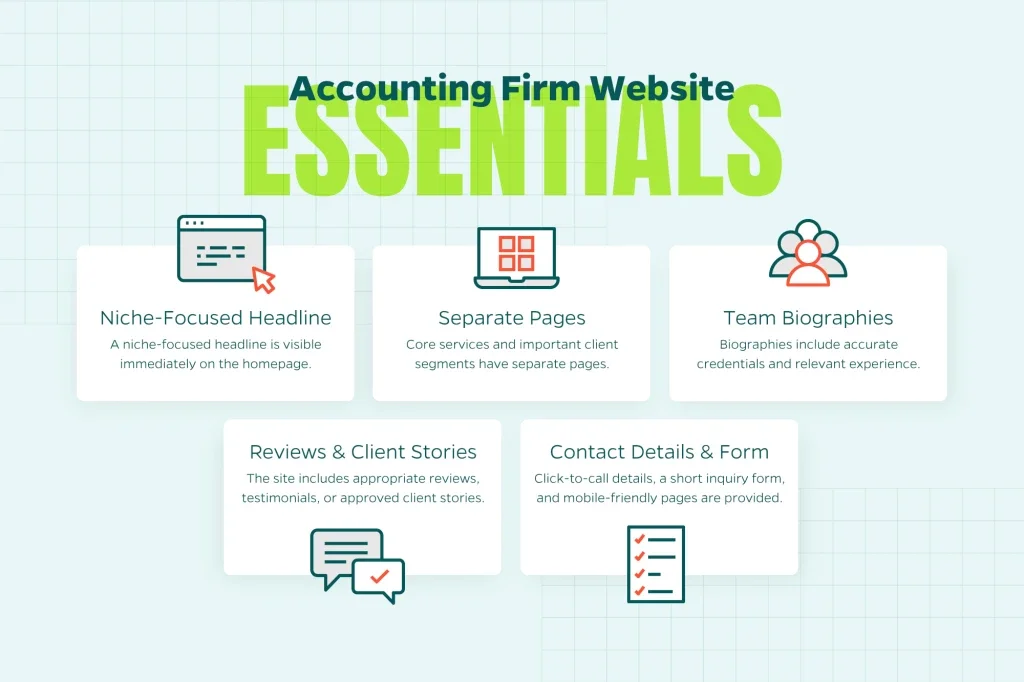
For additional implementation considerations, see Straight North’s accounting website design resources: https://www.straightnorth.com/accounting-web-design-company/.
Referrals Still Matter, but Prospects Check You Online First
Digital marketing matters even when an accounting firm grows by referral because the introduction is often followed by online research. A recommendation creates interest; the website, Google listing, and third-party evidence help a prospect decide whether to contact the firm.
“While referrals may bring people to the firm, SEO helps them learn more, build trust, and decide whether to reach out,” says Marc Holt, Straight North Enterprise SEO & GEO Strategist.
“While referrals may bring people to the firm, SEO helps them learn more, build trust, and decide whether to reach out.”

In Straight North’s November 2026 survey of 101 mixed-industry professional services respondents, 63 (62.38%) described their organizations as very or extremely dependent on referrals for new business.
In the same survey, 48 of 101 respondents (47.52%) believed referred prospects were likely to search their company on Google before making contact.
These are respondents’ perceptions, not observed accounting-buyer behavior. Referrals and online credibility belong together.
A referred prospect commonly checks:
- Google reviews and whether the firm responds professionally.
- The firm’s service pages, niche expertise, and team credentials.
- Its Google Business Profile, contact information, and location.
- Partners’ LinkedIn profiles and professional activity.
Make introductions easier by giving clients and partners a repeatable description of the ideal referral. Build relationships with bankers, attorneys, financial advisors, and relevant trade associations, and thank partners when introductions occur. After successful engagements, request honest reviews without offering incentives or exposing private financial information.
SEO, Local SEO and AI Search for Accounting Firms
Accounting firms can become easier to discover by building search pages around specific services, maintaining accurate local listings, and publishing credible answers to client questions. Search visibility takes sustained work, and no firm can guarantee rankings or AI recommendations.
Organic SEO begins with the language prospects use, such as “tax accountant for expats” or “bookkeeping for construction companies.” Each important service should have a useful, distinct page that explains the problem, process, and relevant qualifications. Internal links should connect related services and articles naturally.
Local SEO for accounting firms requires a complete Google Business Profile, consistent name and contact details across legitimate directories, appropriate service categories, and a steady stream of authentic reviews. Keep hours and locations current, especially when seasonal availability changes.
“There is an increased need to create content that helps verify credibility and authority, rather than just being relevant,” says Bryan Paravola, Straight North Senior SEO & GEO Strategist.
“There is an increased need to create content that helps verify credibility and authority, rather than just being relevant.”

AI search introduces another discovery path as prospects ask assistants to recommend specialists. Clear descriptions of services, named credentialed professionals, reviews, and corroborating third-party profiles can make a firm easier to understand and evaluate, although AI citations and recommendations are not guaranteed.
Search-readiness checklist:
- Complete and maintain the Google Business Profile.
- Publish dedicated, informative service and niche pages.
- Keep business listings accurate and request legitimate reviews.
- Answer client questions in plain language, with appropriate qualifications.
- Identify authors and reviewers by name, role, and credentials.
For more on this topic, visit the following links: https://www.straightnorth.com/accounting-seo-company/ and https://www.straightnorth.com/blog/how-to-optimize-for-ai-search-a-practical-geo-framework/.
Content, LinkedIn and Email: Stay Visible All Year
Content, LinkedIn, and email keep an accounting firm useful to clients between engagements. The most efficient approach is to answer recurring questions once, then adapt that answer into several formats rather than creating unrelated messages for every channel.
- Content: publish concise explanations of niche questions, filing considerations, and planning decisions, with dates and caveats where tax rules may change.
- LinkedIn: encourage partners to share practical observations and respond to industry conversations instead of posting only promotional announcements.
- Email: send a manageable monthly update and timely deadline reminders, including opportunities for advisory or bookkeeping conversations.
- Video and webinars: turn frequently asked questions into short explainers or host an annual planning session for a defined audience.
Digital marketing for accountants should help clients make decisions, not merely remind them the firm exists. A useful article on cash-flow forecasting, for example, can become a LinkedIn post, an email note, and a short webinar segment. For more information, check out Straight North’s LinkedIn marketing guide.
Paid Search for Accounting Firms: When It Pays Off
Google Ads can make sense when a firm wants to capture urgent, high-intent inquiries or introduce a service in a new market. Searches involving an IRS notice, an overdue filing, or a specific advisory need are often more actionable than broad awareness keywords.
Ads should lead to a dedicated page that matches the searcher’s problem, explains the service, and makes contacting the firm straightforward. Track phone calls and form submissions, screen inquiries for fit, and pause campaigns when the team lacks capacity. Paid search can produce inquiries quickly, but the economics depend on conversion quality, fees, and staffing, not clicks alone.
A Tax-Season Marketing Calendar for Accounting Firms
Accounting firms should plan marketing around capacity rather than distribute acquisition spending evenly throughout the year. Busy season is a good time to capture proof and strengthen referrals; quieter months offer more room for website improvements and new-client development.
Season | Capacity | Marketing Priority | Example Moves |
January–April | Limited compliance capacity | Proof and referrals | Request reviews after completed work; collect approved stories; keep listings accurate. |
May–September | More planning room | Acquisition and improvements | Update niche pages; publish content; promote advisory and recurring bookkeeping. |
October–December | Extension work and year-end planning | Next-season pipeline | Discuss year-end planning; nurture leads; book next-season consultations. |
Keywords Everywhere data cited in the brief show U.S. searches for “marketing for accountants” reaching 1,900 in October 2025 and 480 in April 2026, compared with a 12-month average of 390; those figures describe marketers’ searches, not demand for accounting services.
The October extension deadline is relevant to the calendar: eligible individual taxpayers who timely request an extension generally have until October 15 to file, although any tax owed remains due in April. Firms should confirm current deadlines and exceptions before publishing reminders.
Treat the calendar as a staffing tool. If partners cannot take calls during filing season, collect reviews and prepare follow-up material instead of buying more leads. Reserve time after deadlines for consultations, referral-partner outreach, and improvements that will benefit the next cycle.
How to Measure Accounting Firm Marketing (and What to Spend)
An accounting firm knows its marketing works when it can connect spending to qualified consultations, new engagements, and client value. Traffic, rankings, and followers can indicate visibility, but they are not substitutes for revenue.
Measure before you scale:
- Track calls and forms by channel, including referral sources.
- Record consultations, qualified opportunities, and new clients in one system.
- Estimate annual fee value and expected ongoing relationship value by client type.
- Calculate monthly marketing cost per new client for each channel.
- Review capacity and lead quality before increasing spend.
There is no universal marketing-budget percentage that fits every practice. Build an accounting firm marketing plan backward from the number and value of clients the firm can responsibly serve, then sustain two or three channels long enough to evaluate results. Compare acquisition costs with contribution margins, retention, and service capacity.
6 Accounting Firm Marketing Mistakes to Avoid
The most common mistakes are failures of focus and follow-through:
- Marketing to everyone: lead with the best-fit client niche.
- Relying only on referrals: make online proof support introductions.
- Publishing a website without evidence: show credentials, services, and appropriate client proof.
- Ignoring reviews and AI search: maintain credible, consistent public information.
- Promoting compliance work during peak capacity: shift acquisition toward quieter periods.
- Judging success by traffic: measure consultations, new clients, and client value.
Frequently Asked Questions
How do accounting firms get clients? Referrals, Google Search and Maps, professional networks, and increasingly AI-assisted research introduce prospects. Clear specialization and credible online proof help convert that attention into inquiries.
How much should an accounting firm spend on marketing? Start with the value of a desirable new client, the number of clients you can serve, and the acquisition cost you can afford. Reassess the budget using real conversion and retention data.
How long does accounting firm marketing take to work? Paid search may generate inquiries within weeks, while organic search, reputation building, and AI search visibility generally require sustained effort over months. Results vary by market and execution.
Should an accounting firm outsource its marketing? Outsourcing can help when no one internally has time to manage it consistently. Partners still need to provide expertise, approve claims, and participate in relationship building.
Is marketing different for bookkeepers and tax preparers? The same positioning and measurement principles apply, but bookkeeping services are usually sold throughout the year while tax preparation often follows seasonal deadlines.
Where to Start
Start with three manageable moves: write one sentence describing your ideal client, strengthen your Google Business Profile and review process, and establish tracking for calls and forms. Then choose the channels you can maintain throughout the accounting year.
To discuss a practical growth plan for your firm, contact Straight North.