


LinkedIn helps accounting firms attract clients when partners use their personal profiles to demonstrate expertise, build relationships, and answer questions prospective clients are asking. The company page supports those efforts, but the partners are the people prospects will work with. You can measure success by the consultations and new business those relationships produce.
- Write partner profiles for prospective clients rather than recruiters.
- Build connections with business owners and referral partners in your specialty.
- Publish useful content on a schedule the firm can sustain.
- Track conversations through to consultations and new clients.
Why LinkedIn Matters for Accounting Firms
LinkedIn gives accountants a way to reach business owners, CFOs, and other decision-makers before they need accounting services. It also gives someone who has received a referral a chance to learn about the accountant behind the recommendation.
In the November 2026 Professional Services Marketing Survey, 35.64% of 101 respondents across professional services and other industries reported that LinkedIn currently generates meaningful leads for their organizations.
That finding is not specific to accounting firms, but it illustrates why the platform deserves consideration. When evaluating social media for accountants, LinkedIn is particularly relevant for firms pursuing business and advisory clients. Unlike a job seeker trying to impress a hiring manager, an accounting partner needs to demonstrate how their expertise applies to a potential client’s business.
Your Partners’ Profiles Are the Firm’s Real LinkedIn Page
Accounting firms should prioritize their partners’ personal LinkedIn profiles over their company page for relationship-building and lead generation. A business owner referred to a particular CPA may search for that individual by name to see whether the accountant has experience working with businesses like theirs.
In the November 2026 Professional Services Marketing Survey, 23.76% of 101 respondents across a mixed-industry sample believed referred prospects were likely to look at their organization’s LinkedIn presence before contacting them.
That is a reported belief, not a direct measurement of buyer behavior. Still, it highlights another opportunity to reinforce the credibility of a referral. A partner who regularly discusses the financial challenges of manufacturers, for instance, gives a manufacturing executive more reasons to pursue an introduction.
The company page has a different job. It provides a central home for firm news, recruiting, and service announcements while amplifying the expertise of individual partners. Here is how the responsibilities differ.
Partner Profile | Company Page |
Who sees it: Clients, prospects, and referral contacts | Who sees it: Firm followers and job candidates |
Purpose: Demonstrate expertise and build relationships | Purpose: Reinforce the firm’s brand and share news |
Who posts: Partners with marketing support | Who posts: Marketing or administrative staff |
Measure: Conversations and consultations | Measure: Reach and referral traffic |
How to Set Up an Accountant LinkedIn Profile That Attracts Clients
An effective accountant LinkedIn profile explains whom the accountant serves, what problems they solve, and how a prospective client can take the next step. Credentials matter, but they should support a message about client needs rather than dominate it.
“I would also explain practical fit, such as the organization sizes, geographic markets, or project scopes the firm supports,” says Nick Fatigato, Straight North Enterprise SEO & GEO Strategist. An accounting partner can apply that advice by identifying the types of businesses they work with, their service area, and the financial responsibilities they can take on.
“I would also explain practical fit, such as the organization sizes, geographic markets, or project scopes the firm supports.”

Use this checklist to update each partner’s profile:
- Headline: Identify your specialty, intended client, and benefit. Include CPA after your name if you hold that credential.
- About section: Begin with the client’s situation, explain your services, and close with a link to schedule a consultation on the firm’s website.
- Photo and banner: Use a recent professional headshot and a branded banner that communicates your specialty.
- Experience: Describe the client problems you help address rather than simply listing your responsibilities.
- Featured section: Highlight a relevant firm guide or other resource that demonstrates your expertise.
- Recommendations and skills: List relevant capabilities and request recommendations from clients or referral partners, subject to permission and professional rules.
A good LinkedIn headline for an accountant makes the value of working with that person apparent. Compare these illustrative examples:
Recruiter-Facing Headline | Client-Facing Headline |
Senior Tax Accountant at Smith CPA | CPA: Tax planning for owner-operated construction firms |
Audit Partner at Jones Accounting | Audit readiness for growing nonprofit organizations (CPA) |
Advisory Services Director | Fractional CFO services for multi-location businesses |
Partner Profiles Also Feed Google and AI Search
A partner’s LinkedIn profile can help search platforms understand the relationship between an identifiable expert and the content published on the firm’s website.
“A complete active LinkedIn profile is a really good start to align their role and expertise to what they’re actually trying to do on your site,” says Bob Hand, Straight North Senior SEO & GEO Strategist. Link each partner’s website biography to their LinkedIn profile, and keep credentials, job titles, and specialties consistent across both. This supports a coherent expert footprint without guaranteeing search rankings or AI citations.
“A complete active LinkedIn profile is a really good start to align their role and expertise to what they’re actually trying to do on your site.”

Build a Network of Clients and Referral Partners
The most valuable LinkedIn network for an accountant consists of people who may need the firm’s services or introduce the firm to someone who does. Start with relationships you already have before approaching unfamiliar prospects.
- Current and former clients: Stay in touch as their businesses evolve and new accounting needs arise.
- Referral partners: Connect with bankers, attorneys, financial advisors, and insurance agents who serve similar clients.
- Business owners and finance leaders: Seek out decision-makers in the industries your firm specializes in.
- Industry groups: Participate in communities where prospective clients discuss their business challenges. LinkedIn groups for accountants can be useful for professional development, but groups serving your target industries may offer more client opportunities.
Include a short personal note with connection requests. Mention a shared event, mutual professional interest, or relevant discussion rather than immediately offering services. Comment thoughtfully on posts from clients and referral partners, too. A useful observation about a business issue can start a conversation without requiring a sales message.
What Accountants Should Post on LinkedIn
Accountants should publish LinkedIn content that answers the financial and operational questions their ideal clients face. A post about a specific business decision will often be more relevant to a prospective client than a generic reminder that tax season is approaching.
“The goal is to adapt the content to the platform’s native behavior, not just copy and paste it, because certain socials are kind of geared towards that,” says Adam Rosenbaum, Straight North SEO & GEO Manager. Instead of sharing a firm article with only a link, turn one of its recommendations into a standalone LinkedIn post.
“The goal is to adapt the content to the platform’s native behavior, not just copy and paste it, because certain socials are kind of geared towards that.”

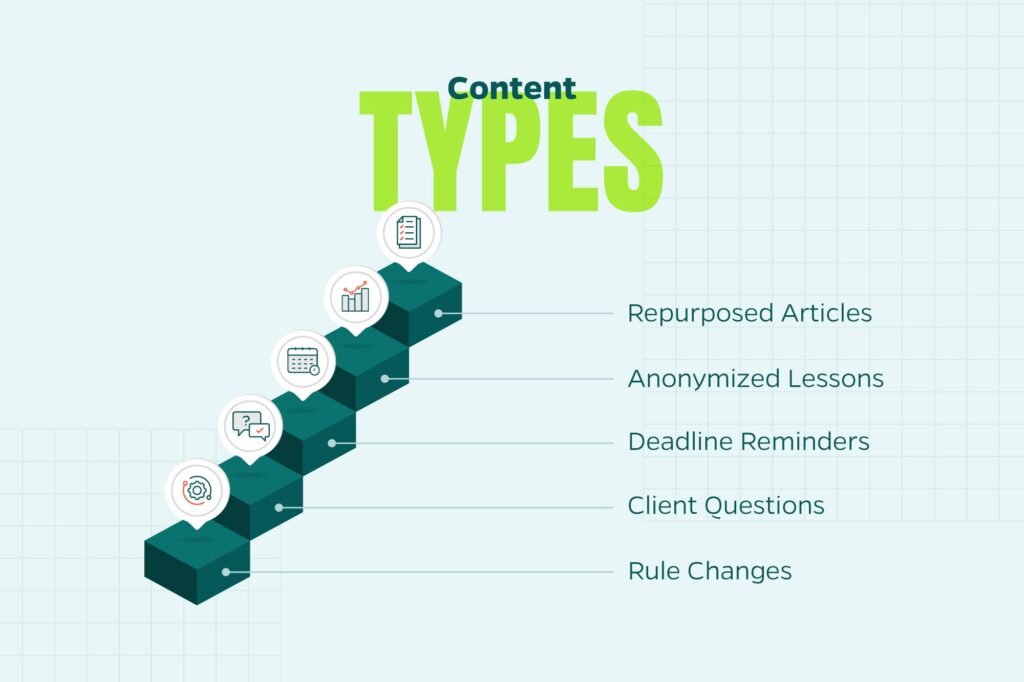
Consider these five types of content:
- Rule changes: Explain how a new tax provision could affect a particular industry.
- Client questions: Answer a recurring question, such as when a growing business should consider outsourced CFO services.
- Deadline reminders: Explain what records clients need to gather and why the deadline matters.
- Anonymized lessons: Describe a common financial mistake and how businesses can avoid it without revealing confidential details.
- Repurposed articles: Extract a useful checklist or recommendation from a firm blog post.
Aim for two or three posts per week per active partner as a starting point, and prepare content before busy season. Never disclose confidential client information without the client’s specific consent, consistent with the AICPA Confidential Client Information Rule. Check applicable state board advertising requirements before publishing testimonials.
Make LinkedIn a Firm System, Not a Partner Hobby
Accounting firms can maintain a consistent LinkedIn presence without expecting partners to spend hours writing posts. The key is to divide the work between the professionals who have the expertise and the people who can help communicate it.
- Choose two or three partners to represent the firm. Assign each a specialty that reflects their experience and the type of work the firm wants to attract. A tax partner might focus on closely held businesses while an advisory partner addresses cash flow and financial forecasting.
- Protect a weekly time block. Start with 30 minutes for one post, ten thoughtful comments, and five personalized connection requests. Adjust the routine based on capacity and results rather than treating those numbers as quotas.
- Give partners editorial support. Have a marketing employee or assistant collect recurring client questions and draft posts from partner notes. Partners should review the technical accuracy and add their own perspective before publication.
- Involve the rest of the firm. Encourage employees to share relevant partner posts with their own observations, and use the company page to amplify useful content. Participation should feel natural rather than requiring everyone to publish identical messages.
- Prepare for January through April. Build a reserve of evergreen posts and schedule a lighter publishing cadence during tax season. Keep someone responsible for responding to comments and messages while partners are busy.
Coordinate the LinkedIn calendar with the firm’s website content and SEO strategy. If the firm publishes a guide to year-end tax planning, partners can discuss individual decisions covered in that guide over several weeks. The website provides depth, while LinkedIn creates opportunities for discussion. Consistency helps prospective clients become familiar with the firm’s expertise before a need arises.
Turn LinkedIn Conversations Into Consultations
LinkedIn outreach works best when an accountant begins with a useful observation or question rather than an unsolicited sales pitch. A connection who posts about opening a second location, for example, may appreciate a general suggestion about tracking profitability separately for each location.
When someone raises a substantive accounting question, offer a short conversation if the issue falls within your expertise. You might say, “There are a few factors that could affect how you approach that. Would a brief call be helpful?” Include a booking link if they express interest, and move confidential discussions to an appropriate private channel.
LinkedIn Sales Navigator can help firms identify and organize prospective clients, but most accounting firms do not need it to get started. First establish whether partners can consistently develop relevant connections and turn those relationships into qualified consultations. A paid prospecting tool is more useful once the underlying outreach process works.
When to Pay: LinkedIn Ads vs. Microsoft Ads’ LinkedIn Targeting
LinkedIn ads are worth considering when an accounting firm has a defined audience and a specific offer, such as a webinar for construction business owners or a year-end tax planning guide for executives. Sending paid traffic to a general homepage gives prospects fewer reasons to respond.
Microsoft Advertising offers another option: LinkedIn profile targeting allows advertisers to use company, industry, and job function information in eligible search and audience campaigns. This can help accounting firms refine their approach to business audiences while reaching people through search.
Test Microsoft Advertising as a potentially lower-cost starting point rather than assuming either platform will deliver cheaper leads. Compare the cost per qualified consultation, not just the cost per click, and make sure the offer and landing page match the intended audience.
Measure LinkedIn by Consultations, Not Likes
The primary measure of LinkedIn marketing for accounting firms should be the number of qualified consultations booked through the platform. Likes, followers, and profile views are useful indicators of visibility, but they do not establish whether the firm is attracting work it wants.
In the November 2026 Professional Services Marketing Survey, 29.70% of 101 respondents across a mixed-industry sample selected qualified leads as one of the metrics their organization uses most often to judge marketing performance.
Track the following five stages monthly to understand where LinkedIn relationships are progressing or stalling:
Stage | Metric to Track |
Profile view | Number of profile views |
Connection | Relevant connection requests |
Conversation | Substantive prospect conversations started |
Consultation | Qualified consultations booked |
Client | New clients attributed to LinkedIn |
Set up measurement before increasing publishing activity:
- Add “How did you hear about us?” to intake forms, include LinkedIn as an option, and record responses in the CRM.
- Use UTM tags on links from partner profiles and posts to distinguish LinkedIn website traffic in analytics.
- Record the partner, original source, and outcome of each consultation, including referrals that LinkedIn helped reinforce.
Review the results by partner, specialty, and post type. If profile views increase but conversations do not, reconsider the audience or content. If conversations increase but consultations do not, test the invitation to book a call. These are diagnostic signals, not proof of causation. Over time, compare booked consultations with signed engagements to determine whether the channel is producing the right clients.
FAQ
Is LinkedIn Worth It for Small Accounting Firms?
Yes, particularly for firms serving business clients in a defined specialty. Start with a manageable posting schedule and evaluate whether partner activity generates qualified consultations.
What Other Social Media Platforms Should Accountants Use?
Facebook and Instagram can be useful for practices serving individuals and local households. When planning social media marketing for accounting firms that focus on business and advisory services, prioritize LinkedIn.
How Often Should Accountants Post on LinkedIn?
Two or three posts per week per active partner is a reasonable starting point, supplemented by brief daily commenting when schedules permit. Prepare posts ahead of tax season and adjust frequency based on capacity and results.
Is This the Same as Using LinkedIn to Find an Accounting Job?
No. While profile fundamentals overlap, job seekers write for recruiters, and partners write for prospective clients. A client-facing headline, About section, and publishing strategy should emphasize the problems the accountant can help solve.
Where to Start
Start this month by selecting the partners and specialties your firm wants to promote, updating their headlines and About sections, and establishing a simple tracking process. Build a manageable publishing schedule before busy season arrives. LinkedIn should complement the firm’s broader accounting marketing strategy rather than operate independently of its website, search visibility, and referral efforts.
Need more help? Contact Straight North to turn your firm’s online visibility into qualified leads.