


Financial advisor marketing works best when a practice defines its ideal clients, earns introductions, and makes its expertise easy to verify online. Advisors and registered investment advisers (RIAs) should prioritize referrals, search visibility, and a credible website, build regulatory review into production, and judge results by new clients and revenue rather than impressions.
- Choose a client niche before selecting marketing channels.
- Treat online research as the second half of a personal referral.
- Compare channels by the time and money required to generate revenue.
- Create a repeatable marketing review and recordkeeping process.
- Track first meetings, new relationships, and revenue by source.
How Financial Advisors Get Clients Today
Financial advisors win clients through personal relationships and through the information prospective clients find while evaluating those relationships. Most established practices depend heavily on introductions, but a referral-driven pipeline can stall when contacts slow down or send poorly matched prospects.
- Client referrals and centers of influence, especially CPAs and estate-planning attorneys.
- Advisor directories, Google Search, Google Maps, and increasingly AI-assisted research.
- LinkedIn, educational content, newsletters, and small professional events.
- Targeted paid search and other advertising for specific client needs.
Marketing for financial advisors connects these sources into a repeatable system: the right people hear about the practice, verify its qualifications, and know how to schedule a conversation. Newer advisors may also use direct outreach, but cold prospecting works better when backed by a defined audience and clear message.
Start With a Niche and a Clear Value Proposition
A niche gives prospects a reason to choose one advisor over another and helps referral partners recognize a suitable introduction. It may describe a profession, a transition, or a complex planning need rather than a narrow income bracket.
- Profession: physicians balancing student debt, insurance, and retirement planning.
- Life event: business owners preparing for an exit or families approaching retirement.
- Specific need: executives managing equity compensation or concentrated stock.
“A firm should clearly explain who it serves, the financial situations it helps clients navigate, and how its advisory relationship works,” says Nick Fatigato, Straight North Enterprise SEO & GEO Strategist. That explanation belongs on the homepage, advisor biographies, and every major service page.
“A firm should clearly explain who it serves, the financial situations it helps clients navigate, and how its advisory relationship works.”

An effective value proposition names the client, the problem, and the experience offered: “We help retiring business owners coordinate investment, tax, and estate decisions through an ongoing planning relationship.” Niche marketing for financial advisors makes the same promise recognizable in search, introductions, and follow-up conversations without promising investment outcomes.
How to Build a Financial Advisor Marketing Plan
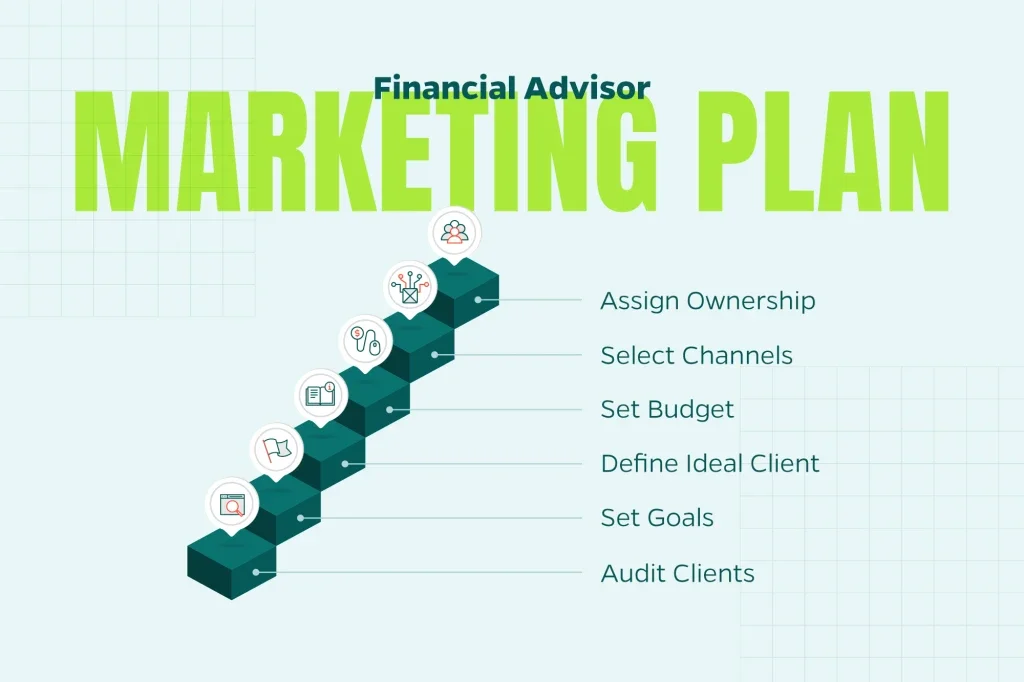
A financial advisor marketing plan should connect business goals to a small number of channels that can be measured and maintained. The strongest financial advisor marketing strategies start with existing client relationships rather than a long list of tactics.
- Audit where recent clients originated, how long they took to convert, and which relationships fit the practice.
- Set goals for qualified first meetings, new clients, and annualized revenue.
- Define the ideal client and the planning problems the practice solves.
- Set a budget based on expected new-client value, capacity, and available staff time.
- Select two or three channels that reinforce each other, such as referrals, SEO, and email.
- Assign ownership for approvals, source tracking, monthly reporting, and quarterly adjustments.
In Straight North’s November 2026 professional services survey, 75 of 101 respondents (74.3%) said their website was very or extremely important to their sales or business development process. The mixed-industry sample provides planning context, not a financial-advisor-only estimate.
Market Under the SEC Marketing Rule Without Stalling
The SEC Marketing Rule permits eligible investment advisers to use testimonials, endorsements, and certain compensated referrals when applicable disclosure, oversight, and disqualification requirements are satisfied. It does not mean every review or advertisement can run without review. Broker-dealer representatives and dual registrants may face additional FINRA communication and supervisory requirements.
“Financial advisors can identify the credentialed professional behind the guidance, tie that person’s qualifications to the exact issue, cite current primary sources and explain the assumptions, tradeoffs, methodology and limitations behind a recommendation,” says Bob Hand, Straight North Senior SEO & GEO Strategist. This approach makes educational material more useful and gives reviewers concrete claims to assess.
A practical compliance-ready workflow includes:
- Approved templates for recurring posts, emails, and landing pages.
- An agreed review owner and turnaround time in the publishing calendar.
- Required testimonial and endorsement disclosures, with appropriate oversight.
- Archived versions of ads, posts, approvals, and supporting substantiation.
- A named owner to monitor third-party reviews and escalate concerns.
The firm’s own compliance team should approve its specific process and materials before publication. Treat legal review as a scheduled step, not a last-minute obstacle.
Which Marketing Channels Pay Off for Advisors
The most useful channel comparison is cost per dollar of new annual client revenue, including advisor and staff time. The 2026 Kitces marketing study reports a median revenue acquisition cost of $0.70 for each $1 of new annual client revenue across surveyed advisory practices.
The study’s channel averages differ sharply. The following figures represent marketing costs, including time, per $1 of new annual client revenue, not guaranteed returns or an individual firm’s forecast.
Channel | Cost per $1 of revenue | What it needs |
Online advisor listings | $0.28 | Accurate directory profiles |
Client referrals | $0.34 | Client relationships and introductions |
SEO | $0.45 | Useful service pages and ongoing upkeep |
Third-party review sites | $0.67 | Reputation monitoring and oversight |
Centers of influence | $0.72 | CPA and attorney relationships |
Sponsorships and paid advertising | $1.31 | Audience targeting and measurement |
In-person networking | $1.45 | Time and follow-up |
Blogging | $1.64 | Expert-reviewed educational articles |
Seminars | $1.76 | Planning, promotion, and attendance |
Client appreciation events | $4.54 | Event expense and staff time |
Social media | $4.88 | Frequent publishing and engagement |
Source: Kitces Report, “How Financial Planners Actually Market Their Services” (2026), Figure 4.1. Review-site and social-media estimates rely on only 5–9 responses and should be interpreted cautiously. Podcast figures are omitted because the report presents inconsistent values.
Listings, referrals, and search deserve early attention because they combine relatively low reported acquisition costs with clear buyer intent. Referrals cannot be switched on at will, however, so pair relationship building with an owned discovery channel such as SEO. A low-cost channel that attracts unsuitable clients is not a bargain; compare client fit and retention as well as acquisition cost.
Referrals Still Lead, but Prospects Vet You Online First
A referral is an introduction, not a completed decision. Prospects often check the firm’s website, people, reputation, and regulatory history before accepting a meeting. Digital marketing should confirm the credibility conveyed by the person making the introduction.
“While referrals may bring people to the firm, SEO helps them learn more, build trust, and decide whether to reach out,” says Marc Holt, Straight North Enterprise SEO & GEO Strategist. The observation applies to professional-services buying decisions: search helps people independently evaluate a recommendation.
“While referrals may bring people to the firm, SEO helps them learn more, build trust, and decide whether to reach out.”

In Straight North’s November 2026 survey of 101 professionals across several industries, 40 respondents (39.6%) believed referred prospects were likely to read online reviews before making contact. This measures respondents’ perceptions, not observed behavior among financial-advice buyers.
Referred prospects may check:
- Google reviews and relevant third-party profiles.
- Advisor biographies, credentials, and areas of specialization.
- Public regulatory records and professional history.
- LinkedIn profiles and evidence of current activity.
- How search engines or AI assistants describe the firm.
To make referrals easier, give clients and professional partners a concise “who we help” sentence, thank them for introductions, and cultivate a few complementary centers of influence. Make sure your digital presence tells the same story. AI-generated summaries may contain mistakes, so monitor important descriptions and correct inaccurate information at its source where possible.
Your Website, SEO, Local Search and AI Search
The website should answer three questions quickly: Is this advisor right for my situation? Can I verify their qualifications? What happens if I reach out? SEO for financial advisors begins with service pages that match the language and concerns of a defined audience, not generic investment commentary.
“Reviews can make a significant difference for personal injury law firms and financial advisors, particularly because prospective clients are making decisions that involve their finances, legal rights, or long-term financial security,” says Josephine Schramm, Straight North Senior SEO & GEO Strategist. Reviews are one visible trust signal, but should be considered alongside credentials and substantiated experience.
“Reviews can make a significant difference for personal injury law firms and financial advisors, particularly because prospective clients are making decisions that involve their finances, legal rights, or long-term financial security.”

Use this website and local-search checklist:
- A homepage headline identifying the ideal client and specialty.
- Credentialed biographies and clearly explained advisory relationships.
- Dedicated pages for services and common planning situations.
- A complete, accurate Google Business Profile where eligible.
- Consistent contact information across relevant directories and profiles.
- An appropriate review process and a simple way to request a meeting.
AI search visibility also benefits from clear, consistent descriptions of expertise across the website and reputable third-party sources. No firm can guarantee inclusion in an AI-generated answer, and money-related guidance deserves particularly careful sourcing and review.
Content, LinkedIn, Email and Events
Content marketing for financial advisors should answer the questions that arise before a prospect is ready to hire someone. One well-researched article can support organic search, a LinkedIn post, an email newsletter, and a conversation with a referral partner.
“For financial advisors, that can include planning scenarios, tax/retirement decision frameworks, market analysis and guidance reviewed by appropriately credentialed professionals,” says Bob Hand, Straight North Senior SEO & GEO Strategist. Such material shows how the advisor thinks while making the assumptions and limits of general education clear.
“For financial advisors, that can include planning scenarios, tax/retirement decision frameworks, market analysis and guidance reviewed by appropriately credentialed professionals.”

- LinkedIn: maintain a complete advisor profile and share short, practical insights for the chosen niche.
- Email: send a useful monthly update addressing a client question or timely planning decision.
- Events: host smaller sessions for specific audiences with relevant partners rather than defaulting to large seminars.
- Repurposing: turn a substantive guide into brief posts, a checklist, and a discussion prompt without changing its meaning.
Consistency matters more than publishing everywhere. Select formats the firm can sustain, review, and connect to a next step.
Paid Advertising for Financial Advisors
Paid search can help advisors reach people actively looking for a specialized service or researching advisors in a new market. It generally requires more direct spending than referrals or SEO, so test narrow keywords and geographic areas before scaling.
Send each campaign to a relevant landing page with a clear offer, compliant copy, and call and form tracking. Measure qualified consultations and clients rather than clicks alone. Straight North reported a 300%+ increase in quality Google paid conversions for DFIN, a financial-compliance company, in a published campaign comparison. DFIN is not an advisory practice, so that result illustrates paid-search execution in a regulated financial category rather than an expected advisor outcome.
How to Measure Financial Advisor Marketing
Marketing performance is the number and value of suitable client relationships created, not the size of an audience. Traffic, search visibility, and social engagement help diagnose progress, but the business outcome is qualified meetings that turn into clients.
Track the following consistently:
- Calls and forms, with source attribution where available.
- Qualified first meetings and their originating channels.
- New clients, annualized revenue, and client fit by source.
- Total spending plus advisor and staff time by channel.
- Acquisition cost divided by new annual revenue for each channel.
In Straight North’s November 2026 mixed-industry survey, 21 of 101 respondents (20.8%) selected revenue generated as one of their most-used marketing performance metrics. This finding describes the survey sample, not the measurement habits of RIAs specifically.
Review performance quarterly, allowing for long consideration periods and referrals that cross several touchpoints. A channel that generates fewer leads may still be the best investment if its clients are more suitable and valuable over time.
6 Financial Advisor Marketing Mistakes to Avoid
- Marketing to everyone: define the clients and planning needs you serve best.
- Depending only on referrals: support introductions with discoverable, credible information.
- Avoiding reviews entirely: establish a compliance-reviewed reputation process.
- Starting with expensive channels: compare acquisition cost and client fit first.
- Treating approval as an afterthought: schedule review and retain records.
- Reporting only followers or traffic: measure meetings, clients, and revenue.
Frequently Asked Questions
How do I market myself as a financial advisor? Start with a clearly defined niche, build relationships that generate introductions, and ensure your online biographies and service pages substantiate your expertise.
How much should a financial advisor spend on marketing? There is no universal percentage. Budget according to client economics and capacity; the 2026 Kitces study found a median cost of $0.70 per $1 of new annual revenue, including staff time.
Can financial advisors use testimonials and online reviews? The SEC Marketing Rule permits certain testimonials and endorsements subject to conditions. A firm’s compliance team should review the specific use, required disclosures, oversight, and any applicable FINRA requirements.
What is the 80/20 rule for financial advisors? It is a rule of thumb suggesting a minority of clients may account for much of a practice’s revenue. Analyze your own book of business before using that idea to shape marketing priorities.
Where to Start
Begin by writing a one-sentence description of your ideal client and the work you do for them. Next, check that your Google Business Profile, advisor bios, and review process support that positioning. Finally, track the sources of new conversations so you can improve the program with evidence.
Want more help building a focused plan? Contact Straight North for more assistance in tackling financial advisor marketing.