
LinkedIn has grown well beyond its origins as a digital resume. Today it is the world’s largest professional network, with more than one billion members across 200 countries. For marketers — particularly those focused on B2B — it represents something rare: an audience that is already in a professional mindset, open to industry insights, and more receptive to business-related content than on almost any other platform.
But presence alone does not produce marketing results. LinkedIn rewards marketers who understand how the platform works, what its audience responds to, and how to integrate organic and paid strategies into a coherent plan. This guide covers the full picture, from building a strong foundation to running campaigns that deliver measurable ROI.
Why LinkedIn Deserves a Dedicated Strategy
Many marketing teams treat LinkedIn as an afterthought. They mistakenly view it merely as a place to share blog posts and company announcements when there’s nothing more pressing on the content calendar. That approach consistently underperforms.
The platform’s distinguishing characteristic is audience quality. LinkedIn users self-identify by job title, industry, company size, seniority level, and skills. That level of professional data is simply not available on Facebook, Instagram, or X. For companies selling to other businesses, that targeting precision is enormously valuable.
LinkedIn also tends to drive higher-quality leads than other social channels. The traffic may be lower in volume, but visitors who arrive through LinkedIn are more likely to be decision-makers or influencers within the buying process. In industries like professional services, manufacturing, technology, financial services, and healthcare, that distinction matters a great deal.
A dedicated LinkedIn strategy acknowledges this reality and invests accordingly, rather than treating the platform as a secondary distribution channel.
Building a Company Page That Works
Your LinkedIn Company Page is the hub of your presence on the platform. It’s often the first place a prospective customer, partner, or employee will look when evaluating your organization, so it needs to make a strong first impression and sustain credibility over time.
Complete Every Section
LinkedIn rewards completeness. Pages with full profiles — including a banner image, logo, tagline, about section, website URL, industry, company size, and specialties — receive significantly more views than incomplete ones. Each section is also an opportunity to reinforce your positioning and include relevant keywords that improve discoverability within the platform.
The About section deserves particular attention. This is not the place for boilerplate corporate language. Write clearly about what your company does, who you serve, and what sets you apart. Avoid vague claims and focus on specifics that a prospective buyer would find meaningful.
Use Your Banner Image Strategically
The banner is prime visual real estate. Many companies use it for a generic brand image and leave it unchanged for years. A better approach is to treat it as an active marketing asset. You should regularly update it to reflect a current campaign, a flagship service, a major announcement, or a value proposition you want front and center.
Showcase Pages for Specific Audiences
If your company serves multiple distinct markets or has several product lines, Showcase Pages allow you to create dedicated sub-pages tailored to each audience. Rather than sharing a mix of content that may only be relevant to a fraction of your followers, Showcase Pages let you deliver focused, relevant content to segmented audiences, each of which can be followed independently.
Organic Content: What Performs on LinkedIn
LinkedIn’s algorithm has shifted meaningfully over the past few years. The days of hollow engagement-bait posts racking up thousands of reactions are largely over. The platform now prioritizes content that generates meaningful conversation, keeps users engaged, and reflects genuine expertise. That’s good news for marketers willing to put in the effort to produce substantive content.
Formats That Drive Engagement
Not all content types perform equally on LinkedIn. Based on consistent observation across the platform, certain formats tend to outperform others:
- Text posts with a strong opening line tend to perform well because LinkedIn truncates long posts with a “see more” prompt. The first two or three lines determine whether someone keeps reading.
- Document posts (carousels) consistently earn high engagement. A well-designed carousel that walks through a framework, a list of insights, or a step-by-step process gives people a reason to swipe through and share.
- Short-form video is growing in importance on LinkedIn, particularly for thought leadership and behind-the-scenes content. It does not need to be production-quality to perform well.
- Polls generate quick, low-effort engagement and can provide useful audience data. Use them to surface opinions or prompt reflection on an industry issue, rather than just fishing for interactions.
- Long-form articles published natively on LinkedIn can establish subject-matter authority and are indexed by search engines, extending their reach beyond the platform.
Posting Frequency and Timing
There is no single formula that works for every organization, but a cadence of three to five posts per week is a reasonable starting point for most company pages. Consistency matters more than volume. An account that posts daily for two weeks and then goes silent for a month sends mixed signals to the algorithm and to your audience.
Timing also plays a role. LinkedIn traffic is highest during business hours, with Tuesday through Thursday generally showing the strongest engagement. Morning windows — between 7 and 10 a.m. in your target audience’s time zone — tend to perform well, as do midday slots around the lunch hour. That said, test and verify what works for your specific audience rather than treating generic benchmarks as fixed rules.
Employee Advocacy
One of the most underutilized assets in LinkedIn marketing is the collective reach of your employees. Individual profiles consistently outperform company pages in organic reach, because LinkedIn users tend to engage more readily with people than with brand accounts.
A structured employee advocacy program can dramatically amplify your organic reach. You simply coordinate with team members to share company content, post about their professional experiences, and comment on relevant industry conversations. This does not mean scripting what employees say. Authenticity is what makes individual posts effective. It means making it easy for employees to engage, providing content they feel comfortable sharing, and recognizing those who contribute.
LinkedIn Advertising: An Overview
LinkedIn’s paid advertising platform gives marketers access to targeting options that simply do not exist elsewhere. The trade-off is cost: LinkedIn CPCs and CPMs are consistently higher than other social platforms. The key to justifying that cost is focusing on audience quality and aligning your campaigns with objectives that reflect the actual value of a LinkedIn-acquired lead.
Ad Formats
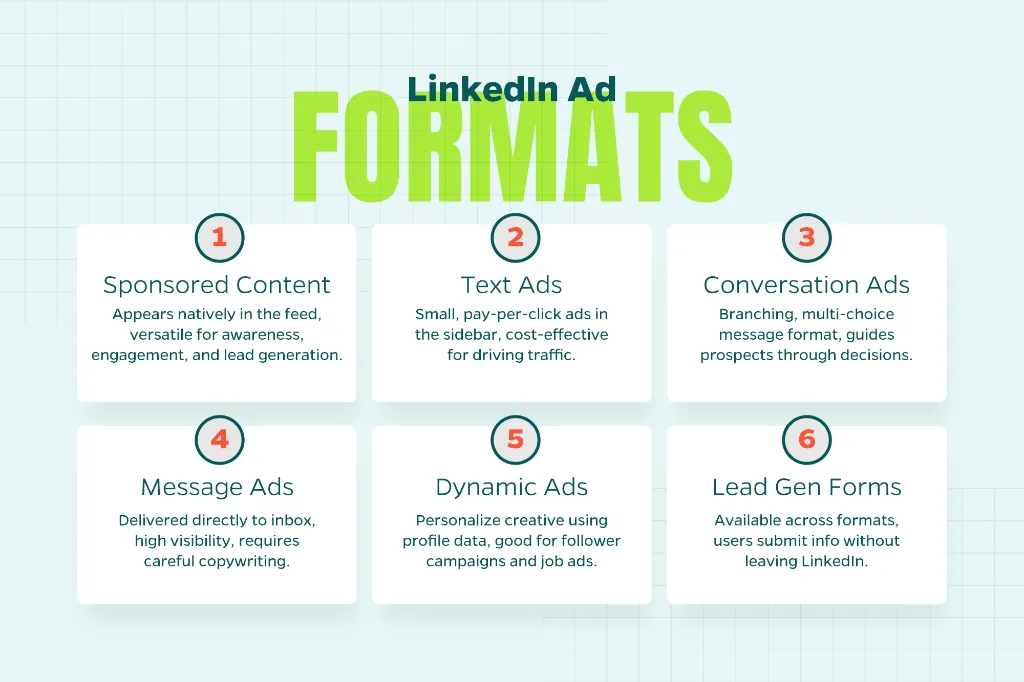
LinkedIn offers a range of ad formats, each suited to different objectives:
- Sponsored Content appears natively in the LinkedIn feed as single-image ads, carousel ads, or video ads. These are the most versatile format and work well for awareness, engagement, and lead generation.
- Message Ads (formerly InMail) are delivered directly to a member’s LinkedIn inbox. They have high visibility but require careful copywriting to avoid feeling intrusive. They work best for event invitations, content downloads, and direct offers.
- Text Ads are small, pay-per-click ads that appear in the sidebar. They have limited visual impact but can be cost-effective for driving traffic to specific landing pages.
- Dynamic Ads personalize the creative using the viewer’s profile data, including their photo, name, or job title, to create a more tailored experience. They work well for follower campaigns and job ads.
- Conversation Ads allow for a branching, multi-choice message format. They can be effective for guiding prospects through a decision tree or toward a relevant resource.
- Lead Gen Forms are available across several ad formats and allow users to submit contact information without leaving LinkedIn. Because LinkedIn pre-populates the form with profile data, completion rates are significantly higher than traditional landing page forms.
Targeting Options
LinkedIn’s targeting is what separates it from other advertising platforms. Marketers can target by:
- Job title, job function, and seniority level
- Industry and company size
- Company name (useful for account-based marketing)
- Skills, certifications, and education
- Group membership
- Geography
Matched Audiences extend targeting further by allowing you to upload contact lists, retarget website visitors (via the LinkedIn Insight Tag), or sync with your CRM. Lookalike Audiences let you reach new prospects who share characteristics with your existing customers or high-value contacts.
One important note on LinkedIn targeting: resist the temptation to layer too many filters at once. Overly narrow audiences can limit delivery and drive up costs. Start with a focused but reasonably sized audience, then refine based on performance data.
Campaign Objectives and Bidding
LinkedIn’s Campaign Manager organizes ads around three objective tiers: Awareness, Consideration, and Conversions. Selecting the right objective matters because it tells the algorithm what kind of user behavior to optimize for. Running a Lead Gen campaign under a Consideration objective, for example, will produce less efficient results than choosing Conversions from the start.
For bidding, Maximum Delivery (automated bidding) is a reasonable default for most campaigns. Manual bidding gives you more control over cost per click or impression, which can be useful when you have enough data to know what a click or lead is worth to your business.
Content Strategy for Lead Generation
LinkedIn is most effective as a lead generation channel when it operates as part of a broader content funnel rather than as a direct-response platform. Very few B2B buyers are ready to request a demo or a consultation the first time they encounter your brand. The goal is to be consistently visible and valuable enough that when they are ready, your company is top of mind.
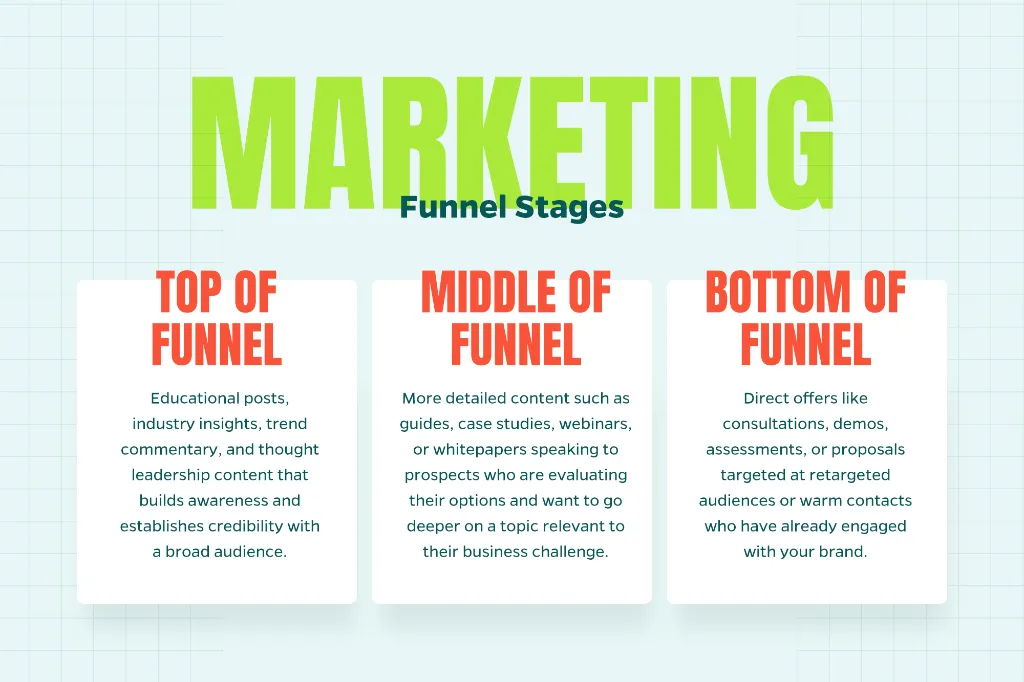
A content funnel for LinkedIn typically looks something like this:
- Top of funnel: Educational posts, industry insights, trend commentary, and thought leadership content that builds awareness and establishes credibility with a broad audience.
- Middle of funnel: More detailed content such as guides, case studies, webinars, or whitepapers speaking to prospects who are evaluating their options and want to go deeper on a topic relevant to their business challenge.
- Bottom of funnel: Direct offers like consultations, demos, assessments, or proposals targeted at retargeted audiences or warm contacts who have already engaged with your brand.
Paid campaigns and organic content should reinforce each other at each stage. A well-performing organic post can be boosted to extend its reach. A whitepaper promoted via Sponsored Content can be amplified organically by employees sharing it to their networks.
Measuring LinkedIn Marketing Performance
What you measure on LinkedIn should be tied directly to what you’re trying to achieve. Vanity metrics including follower counts, likes, and impressions are worth monitoring for general context, but they should not be the primary basis for evaluating performance.
Organic Metrics
For company page content, the most meaningful metrics include:
- Engagement rate: The percentage of people who saw a post and took an action (reaction, comment, share, or click). A strong engagement rate signals that your content is resonating with your audience.
- Click-through rate: How often people who see your content click through to your website or landing page. This connects LinkedIn activity to on-site behavior.
- Follower growth: Not just how many followers you’re gaining, but the quality and relevance of those followers. A small, highly targeted audience is more valuable than a large, diffuse one.
- Reach and impressions over time: These help you assess whether the algorithm is favoring your content and whether changes to your posting strategy are having an effect.
Paid Campaign Metrics
For LinkedIn advertising, key metrics to track include cost per click, cost per lead, lead volume, and conversion rate from lead to qualified opportunity or customer. LinkedIn Campaign Manager provides solid built-in reporting, but connecting your LinkedIn leads to your CRM and downstream revenue data gives you a much clearer picture of actual return on investment.
The LinkedIn Insight Tag, when installed on your website, enables conversion tracking and audience retargeting. It also provides demographic data about your website visitors — including job titles, industries, and companies — which can inform both your paid targeting and your broader content strategy.
Common LinkedIn Marketing Mistakes to Avoid
Even experienced marketers make missteps on LinkedIn. A few patterns consistently show up across underperforming programs:
- Treating the company page as a press release feed. Announcements have their place, but a page that does nothing but promote the company’s own milestones provides little value to followers. Mix in educational and industry-focused content that speaks to your audience’s interests, not just your own.
- Neglecting the comment section. LinkedIn rewards posts that generate conversation and engage with comments extend the life and reach of a post. Ignoring comments leaves reach on the table and sends a signal that the page is managed impersonally.
- Running ads without a strong landing page. LinkedIn can drive highly qualified traffic, but if the destination page is slow, unclear, or misaligned with the ad’s message, conversion rates will suffer regardless of how well the campaign is targeted.
- Underinvesting in creative. On a platform crowded with content, mediocre visuals and generic copy do not stand out. Investing in quality design and compelling copy for both organic and paid content is table stakes.
- Abandoning campaigns too quickly. LinkedIn advertising often requires a learning period of two to four weeks before the algorithm optimizes delivery effectively. Pausing or significantly changing campaigns before that window closes can prevent you from getting meaningful performance data.
Conclusion
LinkedIn marketing, done well, is one of the highest-leverage channels available to B2B marketers. Start with a strong company page, build an organic content cadence grounded in your audience’s actual interests, layer in paid campaigns aligned to clear objectives, and measure performance against outcomes that matter to your business. Each of these elements reinforces the others, and over time they compound into a meaningful competitive advantage. The organizations that treat LinkedIn as a serious channel are the ones that consistently see returns worth talking about.
Need Help?
If you’d like help developing or refining your LinkedIn marketing strategy, the team at Straight North is ready to assist. Contact us today to get started.